

Summary
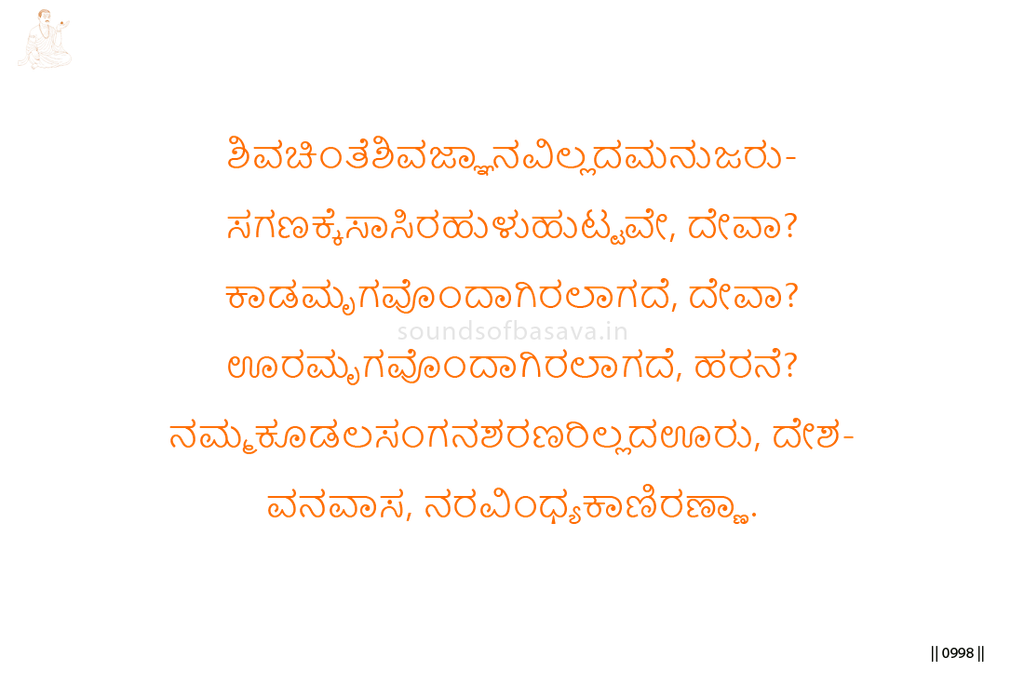
Basavanna asks what human life becomes when Shiva-thought and Shiva-knowledge are absent. Mere birth, grouping, movement, or social arrangement do not make life spiritually awakened.
He first compares such life to worms born in dung, then to animals of the forest and village. These images do not deny life; they deny the claim that mere existence or collective movement is enough. The Aikya source states that form and gathering do not complete what remains unawakened, and that movement may continue without depth or direction.
The final judgment is severe: a town or country without Kudalasangama’s Sharanas is not true habitation, but wilderness. The presence of Sharanas is the sign that life has turned inward and become spiritually awake.
Imagery & Symbolic Relevance
The opening phrase “without Shiva-thought and Shiva-knowledge” gives the governing condition. Basavanna is not speaking against human beings as such. He is asking what remains of human birth when the mind has not turned toward Shiva and knowledge has not awakened.
The image of “thousands of worms born in dung” gives the first comparison. Birth by itself is not spiritual worth. Many forms of life may arise, multiply, and move, yet that does not make them divine or awakened.
The question addressed to “Deva” sharpens the comparison. Basavanna places the image before the Lord and asks whether mere arising can be called sacred fulfillment. The answer implied is no.
The forest animal gives the next image. Animals in the forest may move together in groups. This shows collective life, but not awakened life.
The village animal gives the following image. Domestic animals too gather, move, and live within human settlement. Yet living in a village does not itself make them inwardly awakened.
The address to “Hara” keeps the question before Shiva. Basavanna is not making a social observation alone. He is measuring life by Shiva-thought and Shiva-knowledge.
The phrase “the town or country without our Kudalasangama’s Sharanas” gives the decisive turn. A place may have people, houses, roads, and activity, but if Sharanas are absent, the source of awakened presence is absent.
The word “wilderness” completes the reversal. A populated place without Sharanas is still spiritually wild. The Aikya source explains that such a land is called wilderness not because people are absent, but because seeing is absent.
Together, the images move from birth, to grouping, to settlement, and finally to awakened presence. Worms, forest animals, village animals, towns, and countries all show that outer life is not enough. What makes life truly human is the presence of Shiva-awareness and Kudalasangama’s Sharanas.
Lingayoga
In Lingayoga, this vachana teaches that outer life must not be mistaken for awakened life. Birth, society, gathering, and habit cannot replace Shiva-thought and Shiva-knowledge.
The practice-point is direct: seek the presence that awakens. The source states that where even one stands in that presence, movement changes; conduct aligns, work carries meaning, and offering arises without separation.
For the seeker, the question is not whether one lives among many, but whether life has turned toward Kudalasangama Deva. Without that turning, the mind remains in herd movement; with it, even ordinary life becomes a field of awakened presence.
Editorial Commentary
This vachana should be read as a correction of mere collectivity. Basavanna does not call society sacred simply because people gather, live, build, or move together. Herds also gather, and creatures also arise.
The presence of Sharanas is the true measure. A town without them may be outwardly full, but spiritually barren. A place where Kudalasangama’s Sharanas stand becomes inwardly inhabited.
Related Vachana
Supporting Vachana
Sharana Sthala Vachana 242 — The Economy of Awakening
Sharana Vachana 242 supports this Aikya vachana by teaching that human birth should not be spent in further wanting, pride, or closed self-importance. Its center is the company of Shiva-bhaktas and open-hearted speech with Kudalasangama’s Sharanas. The source states that birth becomes meaningful when pride loosens and speech becomes sincere in the company of realized devotees.
Aikya Vachana 156 carries this concern into a wider measure. In Sharana Vachana 242, the individual seeker’s birth becomes meaningful through Sharana-company. In Aikya Vachana 156, even a town or country becomes spiritually meaningful only when Kudalasangama’s Sharanas are present.
Advancing Vachana
Aikya Sthala Vachana 941 — See the Sahaja Sharana
Aikya Vachana 941 advances this teaching within Aikya Sthala. Vachana 156 says that a land without Sharanas is wilderness because awakened seeing is absent. Vachana 941 shows the kind of Sharana whose presence gives such a field its meaning: the Sahaja Sharana is not confined by birth and death, doubt, form or formlessness, nor by escape from embodied life.
Thus Vachana 156 shows the necessity of the Sharana’s presence, while Vachana 941 reveals the mature quality of that presence. What is absent in the wilderness of Vachana 156 becomes visible in Vachana 941 as the uninterrupted Sahaja Sharana of Kudalasangama Deva.
