Why This Work — and What the Vachanas Ask of Us
This work arose from a desire to understand Basavanna’s Vachanas not merely as profound expressions of devotion, but as a living path of self-examination and transformation.
A Vachana may contain only a few lines, yet those lines can expose something deeply hidden within us — fear, pride, attachment, possessiveness, falsehood, social distinction, expectation, or the contradiction between what we profess and how we actually live.
It may awaken devotion, correct conduct, deepen awareness, transform work and relationships, and gradually lead the seeker towards surrender and non-separation.
My effort has therefore been to approach each Vachana with a few simple questions:
What is Basavanna revealing here?
What condition within the human being is being addressed?
What transformation is being called for?
And how does this movement relate to the larger journey of Shatsthala?
From this inquiry grew the present study of 1,417 explained Vachanas.
A Personal Journey into the Vachanas
My engagement with Basavanna’s teachings did not begin as an academic exercise. They entered my life through family, work, service, responsibility and lived example.
From childhood I was taught that earning should carry responsibility and that what we receive from society should, in some measure, return to society. Long before I came to understand the philosophical language of Kayaka and Dasoha, I had witnessed something of their spirit in practice.
My maternal grandfather, Dr. Basappa Danappa Jatti, founder-president of Basava Samithi and former Vice-President and Acting President of India, carried Basavanna’s principles of simplicity, equality, honest work, service and human dignity into public life. For him, Basavanna was not merely a historical personality to be remembered ceremonially; his teaching was a moral direction to be lived.
My mother, Dr. Vilasavathi Somanathappa Khuba, continued this inheritance through social service and the activities of Basava Samithi at Kalaburagi. I therefore encountered Basavanna not only through books, but through lives influenced by his message.
Yet the truth of the Vachanas belongs to no single family, institution, community, language, region or generation.
From 432 Vachanas to 1,417
My earlier work began with detailed explanations of 432 selected Vachanas, later developed through the project Sounds of Basava.
The original Kannada was preserved, the Vachanas were presented through voice, and translations and explanations were prepared so that people from different linguistic backgrounds could approach them.
That work taught me something important:
Translation alone does not reveal the full movement of a Vachana.
We may understand the words and still fail to recognise:
- the bondage being exposed,
- the inner contradiction being examined,
- the transformation being sought,
- and the changing relationship between Anga and Linga.
That recognition led to the present study of 1,417 Vachanas.
Shatsthala — A Living Map, Not a Hierarchy
Shatsthala helped me understand how one inner movement may prepare the seeker for another.
The six Sthalas are:
Bhakta — 180 Vachanas
Maheshwara — 152 Vachanas
Prasadi — 127 Vachanas
Pranalingi — 127 Vachanas
Sharana — 395 Vachanas
Aikya — 436 Vachanas
Total — 1,417 Vachanas
The detailed distribution in the study places the Vachanas under these six Sthalas.
These are not ranks of spiritual superiority, titles or permanent identities.
They describe movements of ripening:
Devotion awakens → becomes conduct → learns to receive without possession → enters Prana and everyday life → matures through surrender and service → and moves towards non-separation.
The map is useful only if it helps the seeker walk.
It should never become another identity for the ego.
How the Vachanas Were Placed
Each Vachana was considered according to its principal inward movement.
The classification was not made merely because a particular word appears in a Vachana.
The guiding question was:
What transformation is this Vachana principally producing in the seeker?
A single Vachana may naturally illuminate more than one Sthala.
Its principal placement indicates what this study understands as its dominant transformative movement, while its wider connections are recognised through Supporting Vachanas and Advancing Vachanas.
Supporting and Advancing Vachanas
The 1,417 Vachanas are therefore not simply arranged under six headings.
Their wider relationships have also been brought together.
Supporting Vachanas
A Supporting Vachana may reveal:
- an underlying cause,
- a related condition,
- an earlier movement,
- or a complementary understanding.
Advancing Vachanas
An Advancing Vachana may show how that condition is:
- corrected,
- deepened,
- transformed,
- carried towards surrender,
- or brought towards fulfilment.
In the present cross-referencing structure there are:
5,801 Supporting relationships
3,952 Advancing relationships
Total — 9,753 relationships
The detailed study traces these lineages across the Sthalas.
These relationships do not create new teachings, establish a hierarchy, or place one Vachana above another.
They represent my interpretive understanding, developed only as a study aid to help the seeker recognise continuity between Vachanas.
The Broad Inner Movement
Across the six Sthalas, one broad pattern repeatedly becomes visible:
Hidden condition → Recognition → Correction → Transformed living → Anubhava → Surrender → Fulfilment
Basavanna repeatedly goes beyond the outward act to the motive beneath it.
He asks us to examine the fear, desire, pride, attachment, identity, expectation or contradiction sustaining what we do.
Therefore, the deeper questions are not merely:
What did I do?
but also:
Why did I do it?
What am I attached to?
What am I afraid of losing?
Is there pride behind service?
Expectation behind giving?
Possession behind love?
Identity behind devotion?
Has what I understand actually entered my conduct?
The Measure — Compassion and Conduct
Throughout this work, two principles remain central.
First, compassion towards all living beings lies at the root of Dharma.
Second, inward understanding must become outward conduct.
Knowledge, ritual, learning, sacred signs, devotion, service and even claims of spiritual attainment lose meaning if they become grounds for pride, discrimination, exploitation, humiliation or indifference towards another living being.
For Basavanna:
Spiritual understanding must become life.
This is why the relational movement remains important:
Arivu must become Achara.
Achara must enter Kayaka.
Kayaka must remain truthful.
What is received must not become possession.
What is offered must not become pride.
And Linga must become visible in our relationship with the living Jangama.
How to Read the Vachanas
Shatsthala should be used first as a mirror, not as a ladder for comparing one person with another.
A simple way of approaching a Vachana is:
Read the original Vachana.
Understand its meaning.
Look within.
Recognise what it is revealing.
See what must change.
Relate it to conduct, work, relationships and service.
Follow its Supporting and Advancing Vachanas.
Then try to live what has been understood.
The most useful questions remain:
What is this Vachana revealing in me?
What contradiction is it exposing?
What must change in my conduct?
How does its teaching enter my work, earning, relationships, sharing and service?
A map can show direction.
It cannot walk on behalf of the traveller.
Basavanna’s Intent — Relevance for Today and Tomorrow
Basavanna’s Vachanas were not meant merely to provide information, establish a philosophy or remain preserved in books.
Their deeper purpose is:
Self-recognition. Correction. Transformation.
Humanity today has extraordinary knowledge, technology, communication, wealth and power.
Artificial Intelligence can analyse information, translate languages and connect billions of people.
But fundamental human questions remain unchanged:
How should I live?
How should I work and earn?
How should I treat another human being?
How should wealth and power be used?
How do I recognise pride, greed, fear and discrimination within myself?
How can progress remain connected with conscience?
These are not only questions of the twelfth century.
They are questions for today — and they will remain questions for tomorrow.
Basavanna’s teachings remind us:
Knowledge needs humility.
Work needs dignity.
Wealth needs responsibility.
Prosperity needs sharing.
Power needs justice.
Religion needs compassion.
Technology needs humanity.
Progress needs conscience.
The medium may change — from Anubhava and oral tradition to manuscripts, printed books, translations, music, audio, websites and emerging technology.
But the essential question remains:
Has what we know entered the way we live?
The Original Vachana Remains Primary
The explanations, titles, Shatsthala placements, Supporting and Advancing relationships and interpretive framework presented here represent my sincere understanding developed for study.
They are not presented as the only possible interpretation.
The original Kannada Vachana remains primary, and thoughtful corrections made in the spirit of truth, humility, evidence and shared inquiry are always welcome.
The website is not the centre. The Vachana is.
Access to the Complete Work
The work is available digitally through:
www.soundsofbasava.in
Readers can explore the Vachanas, their placement in the six Sthalas, Kannada audio presentations, explanations, translations and related study material.
The purpose of technology is simply to make the Vachanas more accessible.
Technology can carry the Vachana.
Only awareness and conduct can make it living.
Note on the Complete Cross-Reference Study
The complete Vachana distribution and the Supporting and Advancing relationships represent an interpretive study framework prepared for deeper inquiry.
To preserve their proper context, the complete detailed cross-reference material will be made available on request to sincere seekers, students, researchers and institutions.
Those interested may contact us by email, briefly mentioning the purpose of their study.
The intention is not to restrict sincere inquiry, but to ensure that these relationships are understood in the spirit in which they were developed — for study, self-reflection and deeper engagement with Basavanna’s Vachanas.
Dedication
My earlier work on 432 Vachanas was dedicated on 18 January 2026 to my late father, Shri Somanathappa Basavanappa Khuba, whose life and words taught me that responsible earning must mature into service.
I dedicate this present work of 1,417 explained Vachanas to my late maternal grandfather, Dr. B. D. Jatti, former Vice-President and Acting President of India, founder-president of Basava Samithi and a lifelong messenger of Basavanna’s ideals.
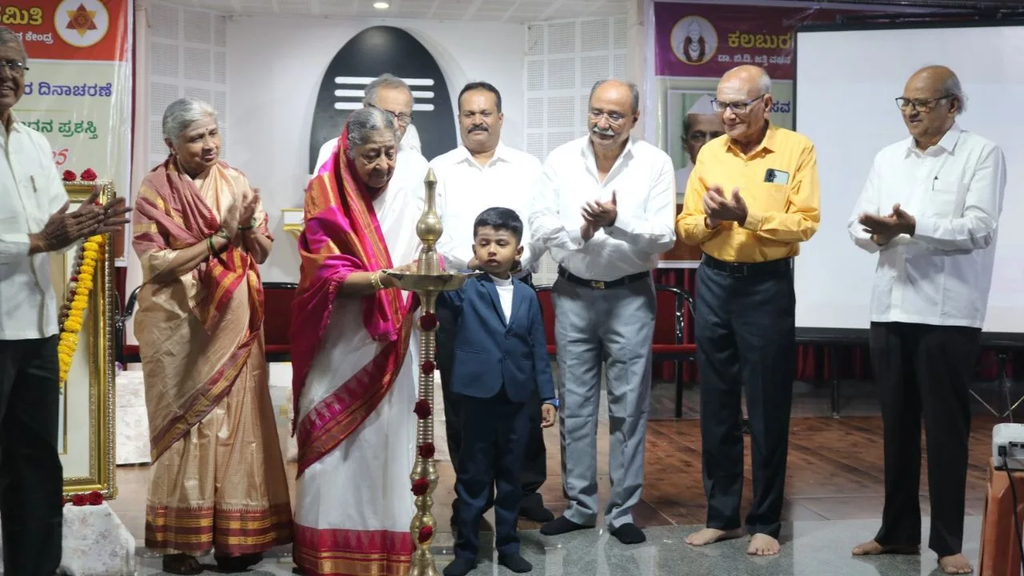
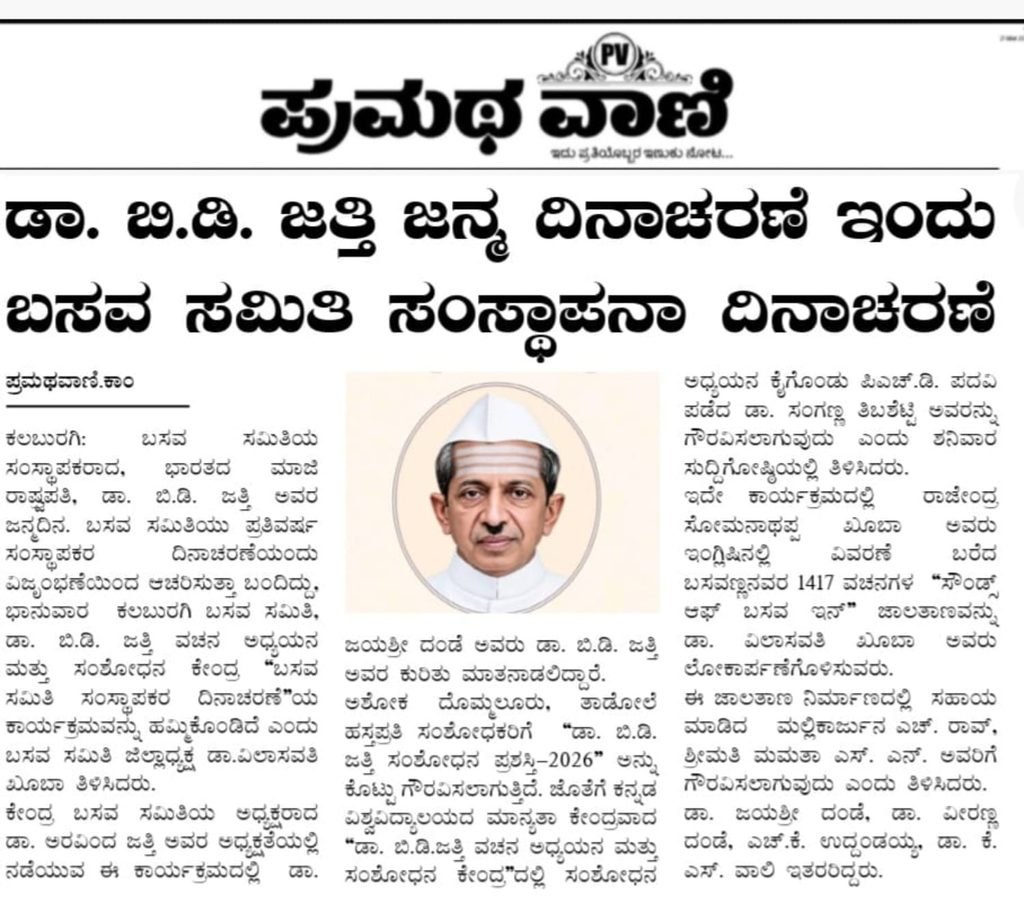
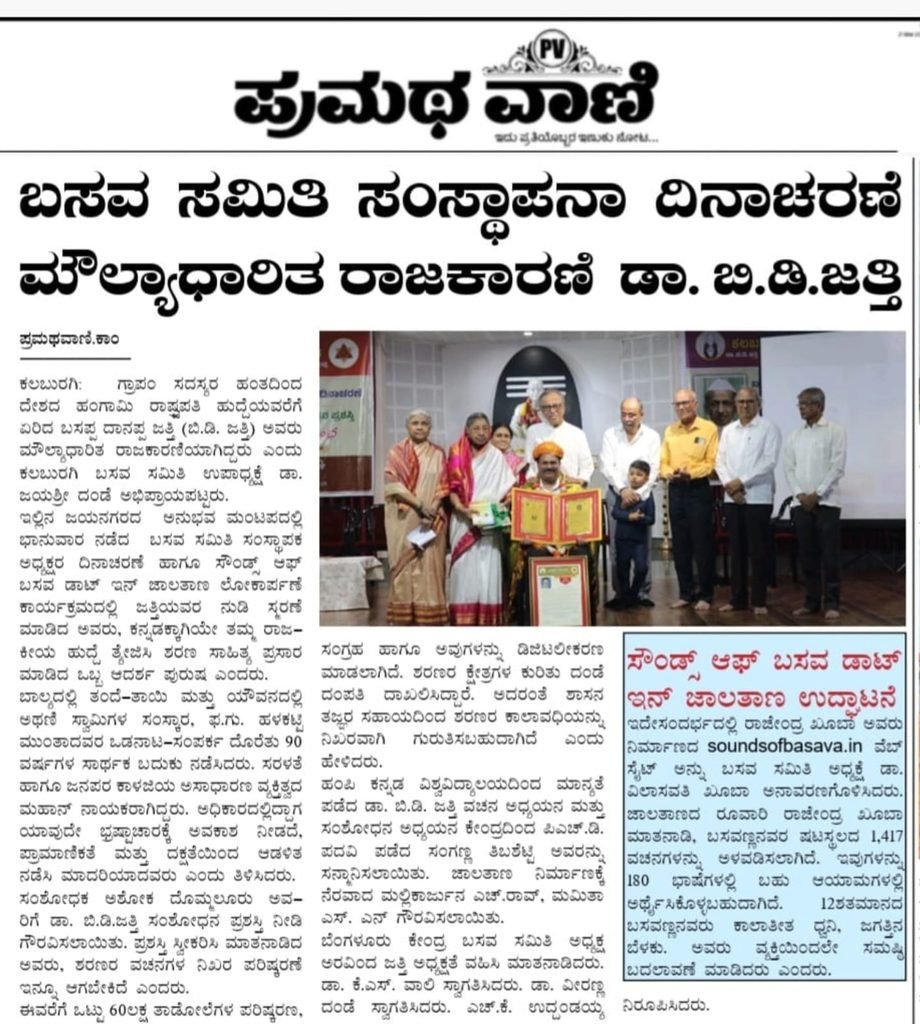
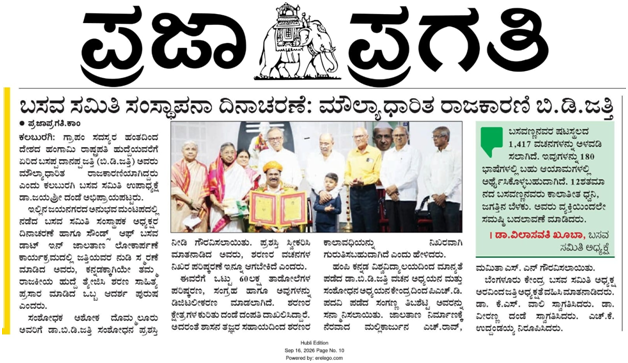
The work was dedicated at Basava Samithi, Kalaburagi, on 13 September 2026.
The dedication is not merely because he was my grandfather.
His life demonstrated that high responsibility and personal humility need not stand apart, and that Basavanna’s message can travel from ordinary life to the highest institutions without losing its simplicity.
Contemporary press coverage of the occasion is also preserved in the accompanying material, together with a Basava Media reference.
A Personal Offering
This work could never have developed through individual effort alone.
I remain deeply grateful to all those who preserved, studied, interpreted, voiced, supported and carried the Vachanas across generations.
Above all:
The honour belongs to Basavanna.
I do not see myself as the source of this wisdom.
I am only an instrument in trying to carry it forward.
If this work helps even one person become more truthful in speech, honest in work, compassionate in relationships, responsible in earning, humble in giving and more conscious of the Divine presence in life, it will have served its purpose.
Basavanna’s Vachanas began as living sound born from Anubhava.
May they never become silent words resting on a page.
May Arivu become Achara.
May Achara guide Kayaka.
May Kayaka flower into Dasoha.
May Anga turn towards Linga.
May Linga be recognised in Jangama.
May surrender mature into non-separation.
And may every seeker discover for oneself what Basavanna’s Vachana is asking us to recognise, correct and live.
Acknowledgements
This work is offered with humility and gratitude. The wisdom belongs to Basavanna; I have only tried to serve as an instrument in carrying his Vachanas forward.
I bow with deep respect to Vachana Pitamaha Dr. Phakirappa Gurubasappa Halakatti, whose extraordinary efforts in discovering, preserving and publishing the Vachanas made their continued study possible.
My sincere gratitude to Shri Arvind Jatti for his guidance; Dr. Veeranna Dande, Shri Uddanadayya and Shri Veerabaswantaraya for their valuable contribution to my understanding and study; and Shri Bapu Padmanabh for his association with the earlier Angadinda Lingada Kadege journey.
Special thanks to Smt. Mamatha S. N. for rendering the Kannada Vachanas with devotion, and to Shri Mallikarjun H. for developing and supporting the digital platform. Their contribution reflects the spirit of Kayaka and Dasoha.
I remain deeply grateful to Basava Samithi, my mother Dr. Vilasavathi Somanathappa Khuba, my family, scholars, seekers and everyone who has supported this journey.
Above all, I bow to Basavanna and the Sharanas, whose lived Anubhava gave humanity the Vachanas.
Rajendra S. Khuba
www.khuba.in
Kalaburagi, Karnataka, India
Sounds of Basava
https://basavamedia.com/basava-samiti-samstapa/
Part I The Sixfold Path
Part II Fields of Bondage — 24 Principal + 7 Subtler = 31 Fields
Part III From Anga to Lingayoga — The Living Relational Core
Part IV The Fulfilment of Shatsthala — From Ripening to Linga-Aikya and Niravaya
Part V Vachana Distribution at a Glance