

Summary
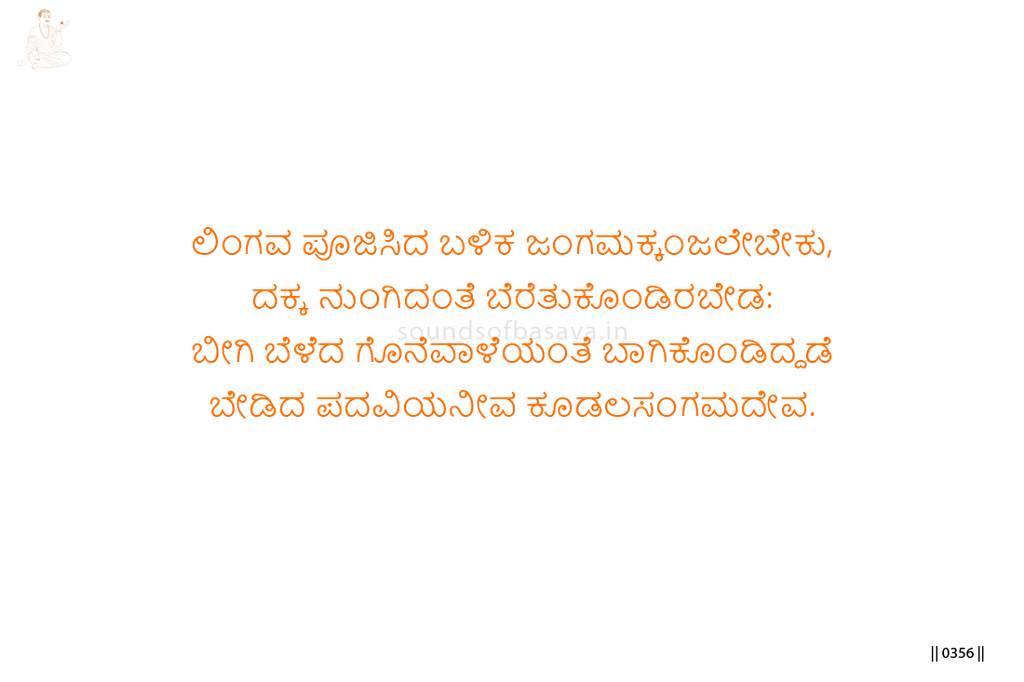
In this vachana, Basavanna teaches that worship of the Linga must be followed by reverence to the Jangama. The act of worship does not end with the Linga alone. What is received in Linga-worship must continue as humility before the living presence of Jangama.
Basavanna warns against standing rigid, like something stiffened and swollen within. Such hardness contradicts the fruit of worship. If worship has truly ripened, the seeker bends naturally.
The ripened stalk gives the central image. When grain has grown full, the stalk bows by its own weight. In the same way, spiritual ripeness appears as humility. One who bows in this ripened manner receives the state sought from Kudalasangama Deva.
Imagery & Symbolic Relevance
The first movement is Linga worship. This is the beginning of the sacred act. The seeker turns toward the Linga and performs worship, but Basavanna immediately shows that this must not remain confined to one form of reverence.
The second movement is fear before the Jangama. This fear is not terror, but reverent awe and deep respect, expressed through humility and bowed attention. After worship of the Linga, the seeker must approach the Jangama with the same sacred regard.
The image of stiffness shows the danger after worship. A person may worship and still remain inwardly hard, swollen, or self-held. Such rigidity prevents worship from becoming humility.
The ripened stalk is the corrective image. A green or empty stalk may stand upright, but a ripened stalk bends. Its bowing is not weakness; it is the sign of fullness. Basavanna uses this image to show that maturity is recognized through humility.
The final promise is the state granted by Kudalasangama Deva. The desired state is not gained through rigid standing, but through ripened bowing.
Lingayoga
In Lingayoga, this vachana shows that Linga worship must flow into Jangama reverence. The seeker cannot keep worship enclosed within an inward or symbolic act while failing to bow before living presence.
For Prasadi Sthala, the relevance lies in right receiving. What is received through Linga worship must soften the seeker. If worship produces humility, it has begun to ripen. If it leaves the seeker rigid, its fruit has not yet appeared.
Editorial Commentary
The key movement of the vachana is from Linga to Jangama. Basavanna does not allow worship to stop at the first act. Linga worship must become living reverence.
The ripened stalk clarifies the nature of humility. Bowing is not merely an outer gesture. It is the natural sign of inward fullness. The one who has truly received does not stand stiff; he bends before Jangama and thereby becomes fit for the state granted by Kudalasangama Deva.
Related Vachana
Supporting Vachana
Maheshwara Sthala Vachana 978 — Beyond Mechanical Worship
Maheshwara Vachana 978 supports this vachana by exposing the incompleteness of worship that neglects the living Jangama. In Vachana 189, Basavanna says that after worshipping the Linga, one must offer reverence to the Jangama. In Maheshwara Vachana 978, daily worship, bathing, and adorning the Linga do not reach Kudalasangama Deva when the living Jangama is ignored. The support is direct: worship becomes whole only when Linga reverence continues into Jangama reverence.
Advancing Vachana
Pranalingi Sthala Vachana 177 — The Dawn Beyond Fate
Pranalingi Vachana 177 advances this movement by carrying the relation between Linga and Jangama into daily spiritual continuity. In Vachana 189, Basavanna teaches that after Linga worship the seeker must bow before Jangama like a ripened stalk. In Vachana 177, remembrance of the Linga at dawn becomes true offering, surrender becomes adornment, and walking with the Jangama becomes the sacred way. Thus the Prasadi teaching of humble reverence advances into Pranalingi as continuous Linga-remembrance and Jangama-walk before Kudalasangama Deva.
