

Summary
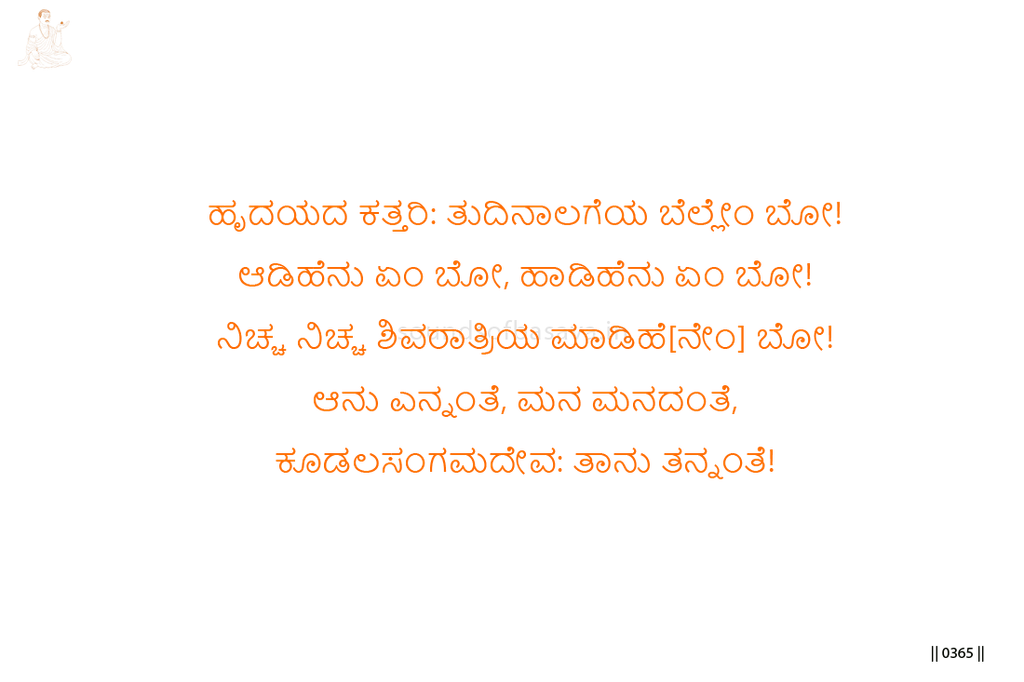
In this vachana, Basavanna exposes the difference between devotional expression and inward change. The tongue may be sweet, but the heart may still carry a blade. The speaker sings, dances, and observes Shivaratri again and again, yet the inner condition remains unchanged.
The sharpness of the vachana lies in the final contrast. “I am as I am; the mind is as it is; Kudalasangama Deva is as He is.” Outward acts have occurred, but the speaker has not been transformed by them. The Divine remains true, but the seeker remains unaltered.
The teaching is direct: song, dance, and vigil have meaning only when they touch the heart and mind. If the heart remains sharp and the mind remains unchanged, devotional performance does not become realization.
Imagery & Symbolic Relevance
The first image is the blade in the heart. It shows hidden sharpness, division, or hardness within. The problem is not visible from outside; it is concealed in the inner seat.
The second image is sweetness on the tongue. The tongue may speak pleasingly, sing devotionally, or utter sacred words. Yet sweetness of speech does not prove purity of heart.
The next images are singing, dancing, and daily Shivaratri observance. Basavanna does not reject these acts. He tests them. If they leave the seeker unchanged, they remain outward expressions rather than inward transformation.
The final line is the governing insight. The speaker remains as he was, the mind remains as it was, and Kudalasangama Deva remains as He is. Devotional action has not bridged the gap. What should have transformed the seeker has only passed over the surface.
Lingayoga
In Lingayoga, this vachana shows that practice must reach the inner condition. Singing, dancing, vigil, and devotional speech cannot remain separate from the heart and mind.
For Prasadi Sthala, the relevance lies in receiving worship rightly. The seeker must not receive devotional acts as proof of attainment. He must see whether they have softened the heart, steadied the mind, and brought him nearer to Kudalasangama Deva in truth.
Editorial Commentary
The contrast between heart and tongue is central. Sweet words may arise while the heart remains sharp. Basavanna therefore measures devotion not by sound, expression, or religious intensity, but by inward alteration.
The repeated claims — “I danced,” “I sang,” “I observed Shivaratri” — are placed under examination. The question is not whether the acts were done, but whether the one who did them changed.
The closing line keeps the teaching exact. Kudalasangama Deva does not change because the seeker performs. The mind also does not change merely because performance occurs. The seeker must allow devotion to enter the heart, or he remains as he was.
Related Vachana
Supporting Vachana
Maheshwara Sthala Vachana 409 — The Burn of Seeing Hollow Devotion
Maheshwara Vachana 409 supports this vachana by asking what fruit can come from Linga-worship when speech and living are divided. In Vachana 280, the speaker sings, dances, and observes Shivaratri, but remains unchanged within. In Maheshwara Vachana 409, worship without unity between word and way of life is shown to be fruitless. The support is direct: devotion must become lived truth, not separated expression.
Advancing Vachana
Pranalingi Sthala Vachana 648 — The Body as the Sacred Field
Pranalingi Vachana 648 advances this movement by showing worship as integrated life. In Vachana 280, devotional acts remain incomplete because the heart, tongue, mind, and person are not transformed together. In Vachana 648, the body becomes the sacred field, the Linga in the hand becomes immediate presence, the Guru’s word lives on the tongue, and conduct must not turn toward injustice. Thus the Prasadi critique of outward devotion advances into Pranalingi as unbroken worship lived through body, speech, action, and awareness before Kudalasangama Deva.
