

Summary
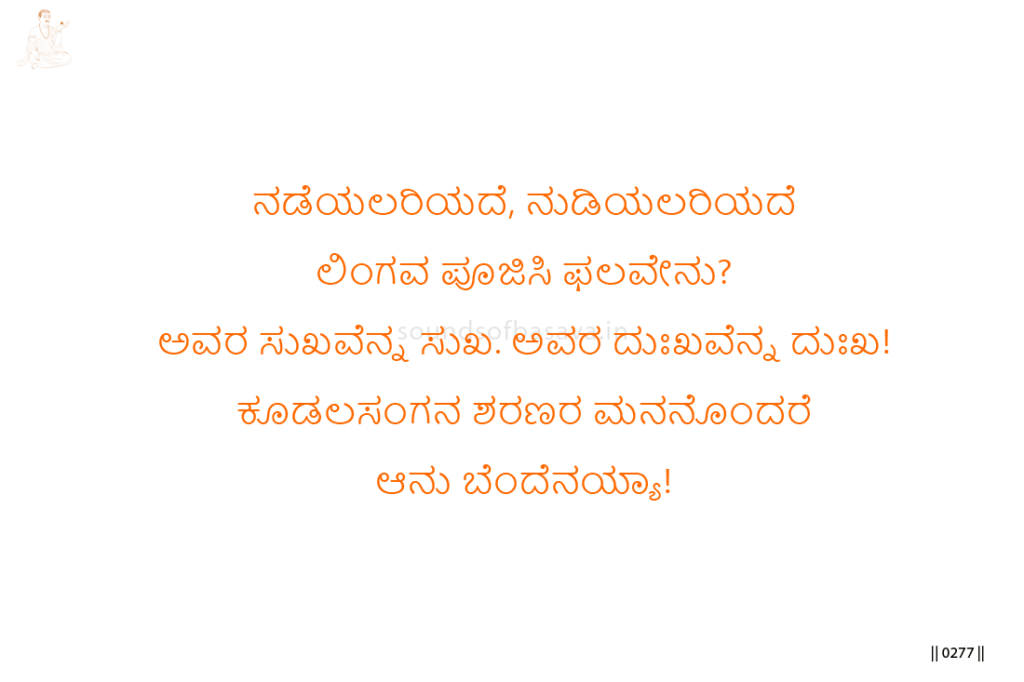
In this vachana, Basavanna asks what fruit can come from worshipping the Linga without knowing how to walk and without knowing how to speak. Conduct and speech must become truthful before worship can bear fruit.
He then says that the sorrow of Kudalasangama’s Sharanas is his sorrow, and their joy is his joy. He does not stand apart from them.
The final line deepens this bond. If the mind of Kudalasangama’s Sharanas is hurt, Basavanna burns. The teaching is clear: Linga worship without right conduct and speech is fruitless, while true devotion shares the inner condition of the Sharanas.
Imagery & Symbolic Relevance
The first image is not knowing how to walk. This means conduct has not become aligned. The path is not lived through action.
The second image is not knowing how to speak. Speech has not become truthful, measured, or joined to the path.
The third image is Linga worship without fruit. Basavanna does not reject Linga worship. He asks what fruit it can bear if conduct and speech are not rightly known.
The fourth image is the Sharanas’ sorrow becoming his sorrow. Basavanna identifies himself with their condition rather than remaining separate.
The fifth image is the Sharanas’ joy becoming his joy. Their blessedness, steadiness, and well-being are not external to him.
The final image is burning when the Sharanas’ mind is hurt. This is the deepest sign of relation. Injury to the Sharanas is felt as inward burning.
Together, these images show the measure of living devotion. Worship must be joined to conduct and speech. The seeker must not merely perform before Linga; he must become inwardly bound to the Sharanas’ sorrow, joy, and well-being.
Lingayoga
In Lingayoga, this vachana tests whether worship has become life. The Linga may be worshipped, but if walking and speech remain uncorrected, practice has not matured.
Conduct, speech, and relation to the Sharanas must align. The seeker’s action must not contradict worship, and speech must not stand apart from lived truth.
The practical movement here is integration. Basavanna asks the seeker to move from ritual act into conduct, truthful speech, and living sensitivity to Kudalasangama’s Sharanas.
Editorial Commentary
This vachana should be read carefully because its force is not merely criticism of hollow worship. It also reveals Basavanna’s bond with the Sharanas.
The first half asks whether Linga worship has fruit when conduct and speech are not known. The second half shows what true relation looks like: the sorrow of the Sharanas is his sorrow, their joy is his joy, and their hurt burns him.
The reader should therefore see both sides together. Devotion is not only correct worship before Linga; it is also right conduct, right speech, and inward participation in the living field of the Sharanas.
Related Vachana
Supporting Vachana
Bhakta Sthala Vachana 233 — Spiritual Automation
Bhakta Sthala Vachana 233 supports this vachana by teaching that repeated action fails when the mind is absent, and repeated giving fails when truth is absent. Vachana 409 carries the same principle into Maheshwara Sthala: Linga worship cannot bear fruit when conduct and speech are not rightly known. Both vachanas insist that the outer act must carry inward truth.
Advancing Vachana
Prasadi Sthala Vachana 853 — The Flood of Love
Prasadi Sthala Vachana 853 advances this movement by showing the fulfilled integration that Vachana 409 seeks. Vachana 409 exposes the danger of worship without right conduct and speech, while also showing deep participation in the sorrow and joy of the Sharanas. Vachana 853 carries this into Prasadi Sthala, where eyes, ears, hands, and heart overflow in one current of remembrance, and action is no longer divided from devotion before Kudalasangama Deva.
