

Summary
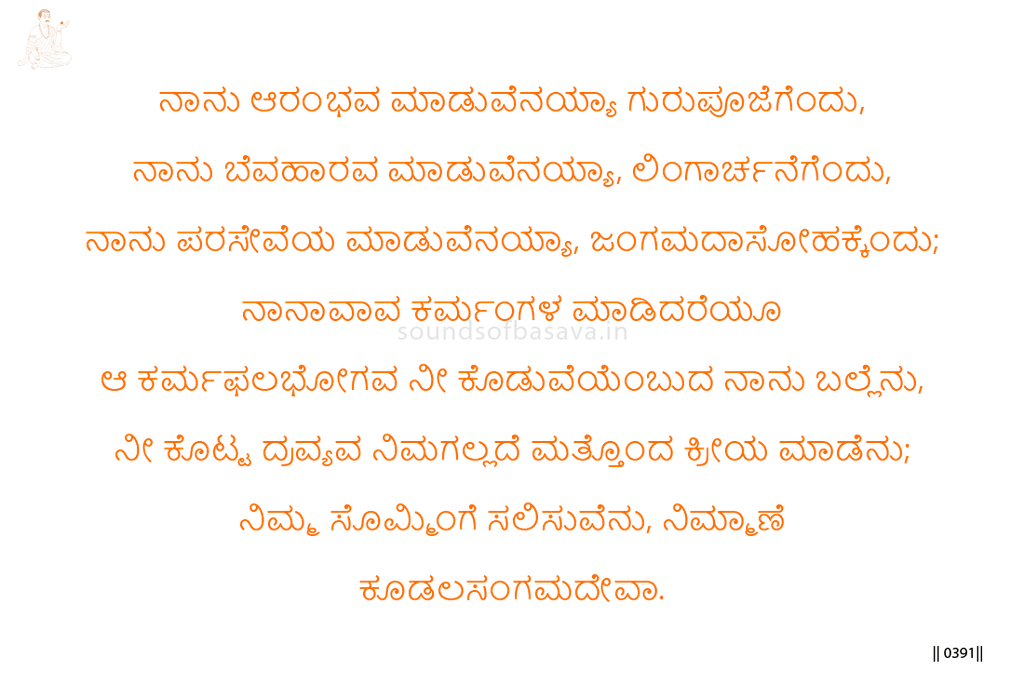
In this vachana, Basavanna offers every action to Kudalasangama Deva.
Whatever he begins, he begins for the Divine. If he performs Guru-pūjā, it is for Kudalasangama Deva. If he performs Linga-archane, it is for Kudalasangama Deva. If he performs Jangama-dāsoha, it is for Kudalasangama Deva.
Whatever actions he performs, and whatever fruits arise from those actions, he knows that the fruit is given by Kudalasangama Deva.
What the Divine has given cannot be used for another purpose. It must be returned to the Divine treasury. Therefore Basavanna says: what You have given, I will not spend elsewhere; I will offer it back to You.
Imagery & Symbolic Relevance
The vachana moves through the full field of sacred action: beginning, Guru-pūjā, Linga-archane, Jangama-dāsoha, and all karma.
Basavanna does not separate these actions into different possessions. They all belong to one movement of offering.
Guru-pūjā represents reverence to the source of instruction.
Linga-archane represents direct worship of the Divine presence.
Jangama-dāsoha represents service to the living movement of that same presence.
All three are brought under one principle: nothing is mine.
The fruit of action is also not claimed. Basavanna does not say, “I performed, therefore I possess.” He says that the fruit is given by Kudalasangama Deva.
The image of “Your wealth” is important. The body, action, ability, opportunity, and result are all treated as the wealth of Kudalasangama Deva. What belongs to the Divine must not be diverted elsewhere.
Lingayoga
In Lingayoga, this vachana teaches that action itself becomes pure when ownership is removed.
Kayaka is not merely work. It becomes sacred when it is done without self-claim.
Dasoha is not merely giving away what one owns. It is returning what was never truly one’s own.
For Prasadi Sthala, the teaching is that received grace must be handled as Divine wealth. The seeker receives, acts, and offers back. Nothing is retained as personal possession.
Editorial Commentary
The structure of the vachana should be preserved. Basavanna first names sacred actions, then extends the principle to all actions, then surrenders the fruit.
The line on karma-phala is central. The fruit of action is not self-created property. It is given by Kudalasangama Deva.
The phrase “what You have given” should be read as total dependence. Whatever comes through the seeker has already come from the Divine.
The final movement is surrender of ownership. Basavanna will not use Divine wealth for another purpose. He will return it to Kudalasangama Deva.
Related Vachana
Supporting Vachana
Maheshwara Sthala Vachana 213 — The Spark That Consumes the Haystack
Maheshwara Vachana 213 supports this vachana by warning that what belongs to Shiva must not be diverted toward personal claim. In Vachana 709, Basavanna says that what Kudalasangama Deva has given will not be used elsewhere but returned to Him. In Vachana 213, when Shiva’s wealth is not returned to Shiva, devotion collapses from within. Both vachanas teach that sacred gain must return to its source through Dasoha.
Advancing Vachana
Pranalingi Sthala Vachana 1272 — Established in Prāṇa-Linga
Pranalingi Vachana 1272 advances this teaching by showing a life established in Prāṇa-Linga, where nothing is accepted or enjoyed without being offered first. In Vachana 709, Basavanna offers Guru-pūjā, Linga-archane, Jangama-dāsoha, action, and fruit back to Kudalasangama Deva. In Vachana 1272, this becomes continuous consecration, where the whole life is lived as Lingārpita.
