

Summary
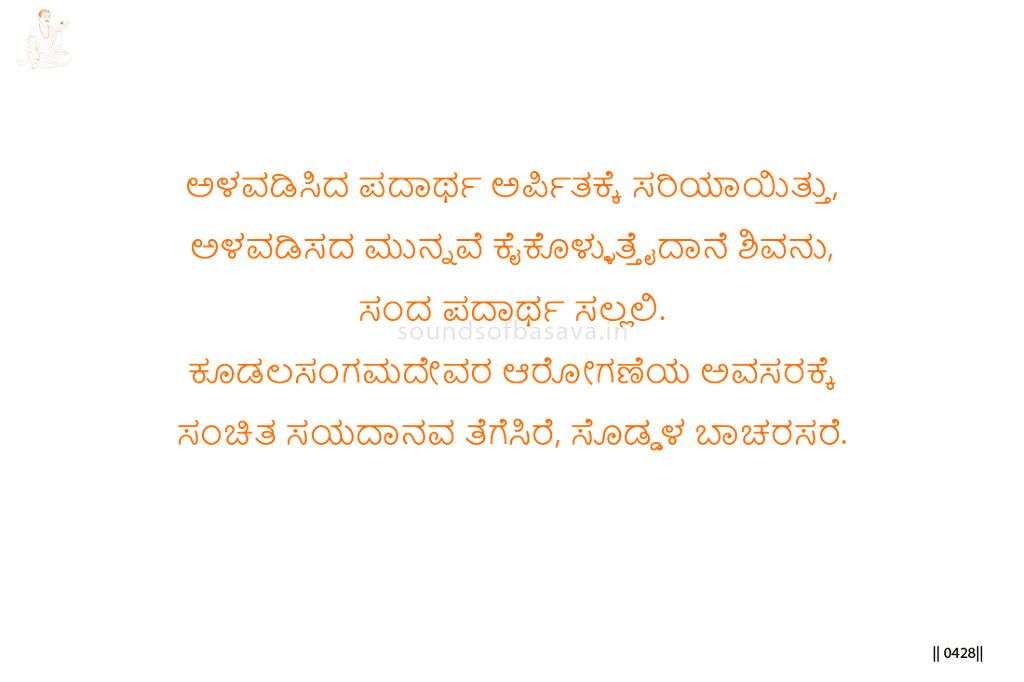
In this vachana, Basavanna teaches that a true offering is not measured only by the visible moment of giving. The substance that has been rightly prepared for offering has already become fit for Arpita, meaning that which is fully dedicated or offered to the Divine.
Even before it is taken into the hand, Shiva has accepted it. The worthy substance does not go astray.
Basavanna then speaks of the occasion connected with Kudalasangama Deva’s sacred receiving. When the stored act of giving is brought forth for that purpose, it reaches its proper fulfillment.
The teaching is direct: offering is not made worthy by display, delay, or outward handling alone. What is truly fit for the Divine is already accepted by Shiva and does not lose its direction.
Imagery & Symbolic Relevance
The first image is the offered substance. Basavanna does not treat it as ordinary material. Once it is rightly prepared for offering, it has already entered the field of Arpita.
The second image is the hand. Ordinarily, one may think that the offering begins only when the substance is placed in the hand and formally given. Basavanna overturns this sequence. Shiva accepts before the hand completes the outward act.
The worthy substance is the next image. Its worth does not lie in quantity or external value alone. Its worth lies in its fitness for offering. Such a substance does not go astray because it is already directed toward Shiva.
The stored giving is the final movement. What has been accumulated for Kudalasangama Deva’s sacred purpose is not wasted when it is brought forth rightly. It becomes part of the proper act of offering.
The closing address to Bacharasa gives the vachana the tone of instruction. Basavanna is clarifying the nature of true offering: what is inwardly fit has already reached Shiva before outward completion.
Lingayoga
In Lingayoga, this vachana teaches purity in offering. The hand may perform the outward act, but the offering is determined by its sacred fitness before it reaches the hand.
For Prasadi Sthala, the point lies in right offering and right receiving. The seeker does not treat the gift as personal possession waiting for public transfer. Once it is truly offered, it belongs to Shiva.
The practice-related teaching is therefore simple: do not measure offering only by visible action. Let the substance, the hand, and the intention remain aligned toward Kudalasangama Deva.
Editorial Commentary
“Arpita” means what is offered or dedicated. In this vachana, Basavanna says that the prepared substance has already become fit for Arpita.
The phrase that Shiva accepts before the hand takes the offering should be kept central. It shows that Divine acceptance is not dependent only on the outward sequence of handling.
The statement that the worthy substance does not go astray protects the teaching from anxiety. A true offering reaches its proper destination because it has already been directed toward Shiva.
Related Vachana
Supporting Vachana
Maheshwara Sthala Vachana 65 — The Cry of the Ego and the Silence of Grace
Maheshwara Vachana 65 supports this vachana by showing that Divine acceptance is not governed by outward correctness alone. It recalls those whose offerings were received by the Lord even though their manner did not fit ordinary measure.
In Vachana 1031, Shiva accepts the offering even before it is placed in the hand. In Maheshwara Vachana 65, Kudalasangama Deva’s grace and acceptance are shown to exceed the seeker’s ordinary calculation of rightness. Both vachanas direct attention away from external sequence and toward Divine receiving.
Advancing Vachana
Pranalingi Sthala Vachana 1272 — Established in Prāṇa-Linga
Pranalingi Vachana 1272 advances this teaching by showing the mature state in which nothing is touched or received before being offered to the Linga.
In Vachana 1031, the worthy substance is already accepted by Shiva before the hand completes the act. In Vachana 1272, this becomes continuous Pranalingi discipline: nothing is used as personal possession, and every act of receiving is first consecrated to the Linga. Thus the Prasadi teaching of already-accepted offering advances into Pranalingi as uninterrupted consecrated living.
