

Summary
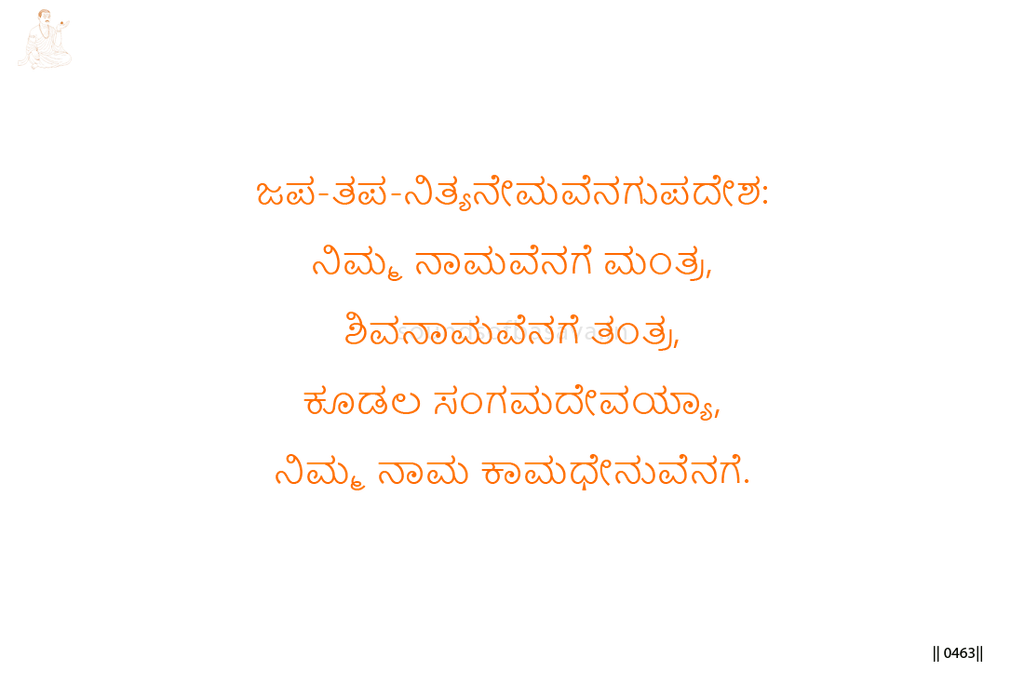
In this vachana, Basavanna gathers spiritual discipline into Kudalasangama Deva’s Name. Japa, tapa, and daily observance are not left as separate supports; their force is drawn into remembrance of the Lord.
The Lord’s Name becomes mantra. Shiva’s Name becomes tantra. What is usually sought through sacred utterance and method is contained in the Name itself.
The vachana ends with Kāmadhenu. Basavanna says that Kudalasangama Deva’s Name is his wish-fulfilling source. The Name becomes instruction, mantra, method, and fulfillment.
Imagery & Symbolic Relevance
Japa, tapa, and nitya-nema form the opening movement. Basavanna does not dismiss them, but gathers them into the higher simplicity of the Name.
The Lord’s Name as mantra is the first inward concentration. The Name is not one formula among many; it is the sacred utterance to be held.
Shiva’s Name as tantra deepens the same teaching. Tantra here means the living means or method. Basavanna does not turn toward many techniques; he makes the Name the path.
Kāmadhenu is the final image. It signifies complete sufficiency. By identifying Kudalasangama Deva’s Name with Kāmadhenu, Basavanna shows that the seeker’s true need is fulfilled through the Name.
Lingayoga
In Lingayoga, this vachana teaches gathered practice. The seeker is not asked to scatter attention among many supports when the Name itself has become the center.
For Pranalingi Sthala, the Name must become inwardly alive. It is not merely sound on the tongue, but remembrance joined to life-force, awareness, and practice.
The practice-point is direct: let japa, tapa, observance, mantra, and method settle into Kudalasangama Deva’s Name. Do not seek elsewhere when the Name itself has become sufficient.
Editorial Commentary
Kāmadhenu should be read as the image of complete sufficiency. In this vachana, it does not point to worldly desire, but to fullness available in Kudalasangama Deva’s Name.
The sequence should remain clear: discipline becomes instruction, the Name becomes mantra, Shiva’s Name becomes method, and Kudalasangama Deva’s Name becomes the all-sufficient source.
Related Vachana
Supporting Vachana
Prasadi Sthala Vachana 84 — One Name Enough
Prasadi Vachana 84 supports this vachana by showing the saving power of Shiva’s Name and Hara’s Name before vast sin and bondage. There, Basavanna asks whether one Name is not enough, and places the bound condition before Kudalasangama Deva.
Vachana 76 carries this Prasadi trust into Pranalingi Sthala by making the Name the center of all practice. What Prasadi 84 shows as the Name’s power to overcome bondage becomes here the full sufficiency of the Name as mantra, tantra, instruction, and Kāmadhenu.
Advancing Vachana
Sharana Sthala Vachana 79 — Refuge in the Name Alone
Sharana Vachana 79 advances this teaching by turning the sufficiency of the Name into refuge. In Vachana 76, Kudalasangama Deva’s Name contains practice, method, and fulfillment. In Vachana 79, “Om Namah Shivaya” becomes refuge against bhava-bandhana and durita, and the seeker takes refuge through Hara, Shiva, and Shankara.
Thus the Pranalingi confidence in the all-sufficient Name advances into Sharana Sthala as complete surrender into the Name. The Name is no longer only the gathered center of practice; it becomes the refuge by which bondage and wrongdoing are released before Kudalasangama Deva.
