

Summary
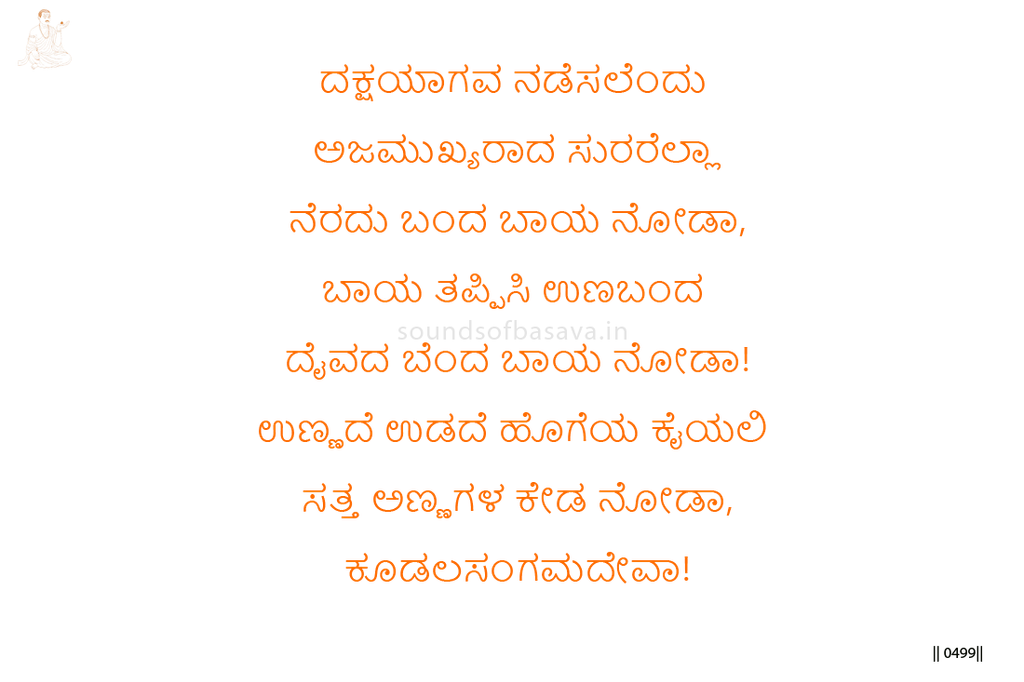
In this vachana, Basavanna recalls the gathering for Daksha’s sacrifice. The foremost gods came together for the rite, and he asks the listener to look at their faces.
The reversal is sharp. Those who came with expectation did not receive fulfilment. Their faces were scorched, and the act that appeared sacred ended in burning and loss.
Before Kudalasangama Deva, Basavanna shows that a grand rite does not become true merely because many gather for it. When sacred action lacks right recognition, its visible result becomes ruin.
Imagery & Symbolic Relevance
Daksha’s sacrifice is the first image. It represents a public sacred act surrounded by religious expectation.
The gathered gods form the second image. Basavanna stresses the scale of the assembly so that the act may be tested by its result, not by its grandeur.
The face is the central bodily image. Basavanna repeatedly asks the listener to look at the face because the face carries the visible consequence of what has been done.
The scorched face gives the reversal. Those who came for sacred gain are marked by burning instead of fulfilment.
The final image is smoke and ruin. What was expected to yield sacred benefit becomes the sign of loss when the act is severed from living truth.
Lingayoga
In Lingayoga, this vachana teaches that outer scale is not the measure of realization. A rite may be large, public, and honored, yet still fail if it is not joined to living awareness of Kudalasangama Deva.
For Pranalingi Sthala, the emphasis is inward recognition. Action must not remain performance. What is done must be held by awareness, humility, and direct relation to the Lord.
The practice-point is direct: do not mistake gathering for realization, rite for truth, or public sacredness for inner alignment. Sacred action must be tested by its living relation to Kudalasangama Deva.
Editorial Commentary
The repeated attention to the face should be preserved. Basavanna is not describing the sacrifice only as an event; he is showing its consequence.
Daksha’s sacrifice functions here as a warning against ritual pride. The problem is not sacred action itself, but action that becomes empty when it lacks right recognition.
The vachana should remain sharp and simple: grandeur without truth burns; gathering without realization collapses; only living awareness before Kudalasangama Deva gives sacred action its worth.
Related Vachana
Supporting Vachana
Prasadi Sthala Vachana 900 — Divine Paradox
Prasadi Vachana 900 supports this vachana by questioning worship that has lost living understanding. There, a flower is taken from a tree and offered back to the tree, river water is taken and poured back into the river, and milk is taken while the calf cries and the mother grieves.
Vachana 574 carries this Prasadi correction into Pranalingi Sthala through the image of Daksha’s sacrifice ending in scorched faces and ruin. Both vachanas show that an act may appear sacred while its inner truth is lost. Thus Prasadi 900 supports the Pranalingi warning that worship must not become mechanical, contradictory, or blind to living awareness before Kudalasangama Deva.
Advancing Vachana
Sharana Sthala Vachana 1337 — Show Me the Difference Between Prana and Prana-Linga
Sharana Vachana 1337 advances this teaching by carrying the critique of outward sacred action into the heart of realization. In Vachana 574, Basavanna shows that a great ritual collapses when it lacks right recognition. In Vachana 1337, the seeker confesses that he did not understand the intimate relation between Prana and Linga, and that by making a hollow form and worshipping outwardly, his days passed in vain.
Thus the Pranalingi warning against ritual pride advances into Sharana Sthala as the prayer for living Prana-Linga realization. The seeker must not remain with outer rite, hollow form, or sacred appearance alone; he must know the life within worship before Kudalasangama Deva.
