

Summary
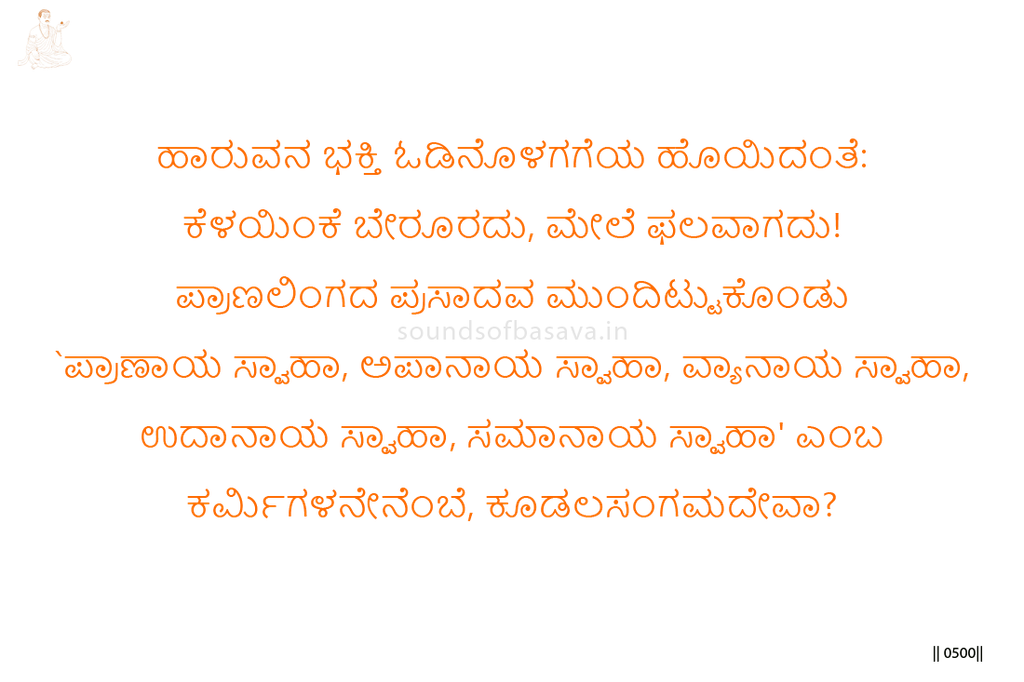
In this vachana, Basavanna compares barren devotion to a lifeless thing placed in the soil. It may be buried in the earth, but it will not root below, and it will not bear fruit above.
He then turns to Prana-Linga Prasada. Even while Prana-Linga is placed before them, the karmis (those who perform ritual actions mechanically) continue reciting: “Pranaya svaha, Apanaya svaha, Vyanaya svaha, Udanaya svaha, Samanaya svaha.” The names of the pranas are spoken, but speech alone does not prove living realization.
Basavanna asks what such karmis are to be called. The teaching is that practice without living inward contact is barren. Only what is alive in relation to Prana-Linga can take root and bear fruit before Kudalasangama Deva.
Imagery & Symbolic Relevance
The first image is something lifeless placed in the soil. Soil can receive life, but it cannot make a dead thing sprout. Basavanna uses this image to test devotion.
The failure to root below is important. A practice without living substance has no inward grounding. It does not enter the depth of the seeker.
The failure to bear fruit above completes the image. If there is no root, there can be no fruit. Outer result cannot appear where inward life is absent.
Prana-Linga Prasada is the central sacred presence in the vachana. Basavanna places it before the recitation of the five pranas. The living reality is already near, yet the practitioner remains with formula.
The recitation of “Pranaya svaha, Apanaya svaha, Vyanaya svaha, Udanaya svaha, Samanaya svaha”—offerings made respectively to Prana (the inward and sustaining life-force), Apana (the downward-moving force of elimination), Vyana (the force that circulates throughout the body), Udana (the upward-moving force associated with speech and ascent), and Samana (the balancing force that governs digestion and assimilation)—shows ritual speech directed toward the pranas. Basavanna does not treat the naming itself as sufficient. The question is whether the one who speaks has realized the living relation to Prana-Linga.
The karmi is the final figure. He performs and recites, but Basavanna questions the worth of such action when it does not become rooted in living awareness.
Lingayoga
In Lingayoga, this vachana teaches that practice must have living seed. Recitation, offering, and ritual formula cannot bear fruit if they remain external.
For Pranalingi Sthala, the word Prana-Linga is decisive. The seeker must not merely name prana or perform offerings to the pranas. The relation between life-breath and Linga must become inwardly alive.
The practice-point is direct: do not mistake sound for growth. Let practice become rooted in Prana-Linga, or it remains like a lifeless thing placed in soil.
Editorial Commentary
The root-and-fruit image should be preserved. Basavanna’s teaching depends on the organic law that only what has life can grow.
The five “svaha” utterances should not be treated as the goal of the vachana. They are the field being tested. Speech about prana must become living awareness of Prana-Linga.
Related Vachana
Supporting Vachana
Prasadi Sthala Vachana 864 — When the Covering is Removed, the Fruit is Revealed
Prasadi Vachana 864 supports this vachana by teaching that fruit appears only when the covering is removed and word, conduct, and inner truth become steady in Kudalasangama Deva. There, the fruit is not forced from outside; it is revealed when obstruction falls away.
Vachana 592 says that lifeless practice does not root below or bear fruit above. Vachana 864 supports this by showing the positive condition for fruit: the covering must be removed, and the seeker’s life must become true in Kudalasangama Deva. Thus Prasadi Sthala prepares the Pranalingi teaching that practice bears fruit only when it becomes inwardly alive.
Advancing Vachana
Sharana Sthala Vachana 808 — The Measure of True Dasoha
Sharana Vachana 808 advances this teaching by carrying Prana-Linga into lived service. There, service of the body, service of life, service of the inner being, and service of speech are each named, but the way of Prana-Linga is said to be rare and known among Kudalasangama Deva’s Sharanas.
In Vachana 592, Basavanna questions those who recite the names of the pranas while failing to realize Prana-Linga. In Vachana 808, this matures into Sharana Sthala as integrated living: body, life, inner being, and speech must all come under the measure of Prana-Linga. Thus the Pranalingi critique of barren recitation advances into Sharana life as rare and complete Dasoha before Kudalasangama Deva.
