

Summary
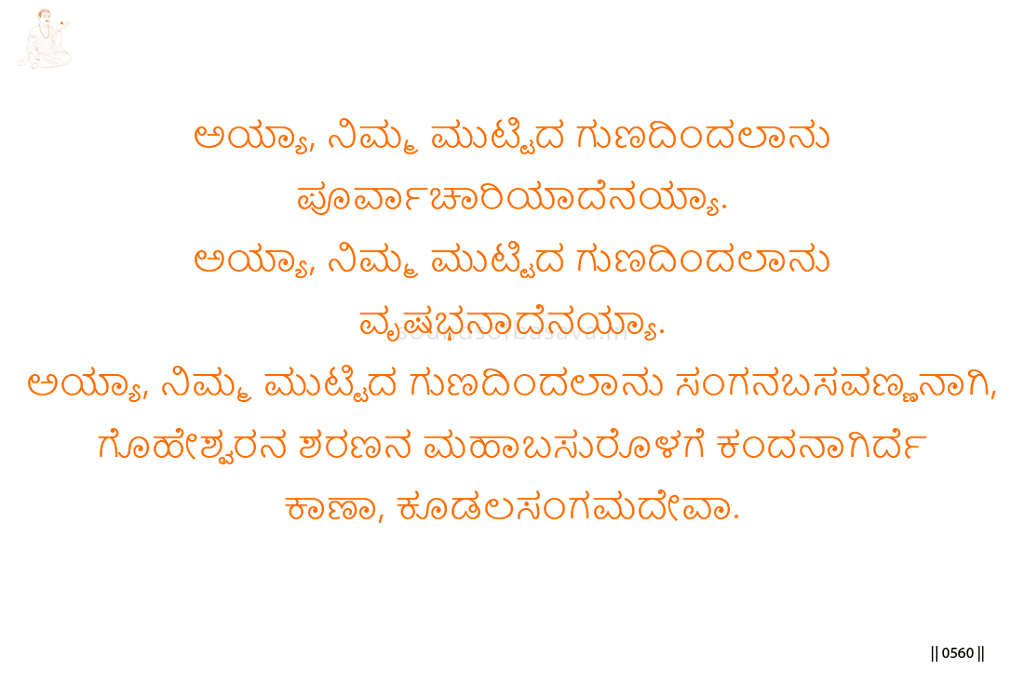
In this vachana, Basavanna speaks of transformation through Kudalasangama Deva’s muttida guṇa — the quality, force, or grace of Divine touch. Through that touch, he says he became Pūrvāchāri.
He then says that through the same touch, he became Vṛṣabha. This indicates a transformation into firmness, strength, and sacred steadiness. The change is not self-produced; it arises through the Lord’s touch.
Basavanna then says that through the same touch, he became Sangana Basavanna. In the Mahābasuru — the great womb or great bearing — of Goheshwara’s Sharana, he became a child. The image is one of rebirth through Sharana-related grace.
The spiritual concern placed before Kudalasangama Deva is therefore transformation through contact with grace. The seeker is not merely improved; he is re-formed, made steady, renamed, and reborn within the living field of the Sharana.
Imagery & Symbolic Relevance
The first image is muttida guṇa. Muttida means touched, and guṇa here points to the quality, power, or transforming virtue of that touch. Basavanna repeats this phrase to show that every transformation in the vachana arises from Kudalasangama Deva’s touch.
The second image is becoming Pūrvāchāri. Pūrvāchāri may be understood as one aligned with the earlier, original, or ancient path of right conduct. Through grace, Basavanna is not merely given an idea; he is placed into a lineage of truthful conduct.
The third image is becoming Vṛṣabha. Vṛṣabha, the bull, carries the image of steadiness, strength, and sacred bearing. Basavanna uses this to show that the Lord’s touch makes the seeker firm and able to bear the path.
The fourth image is becoming Sangana Basavanna. This is not presented as self-invention. Through the Lord’s touch, the seeker receives a transformed identity connected with Sangana Basavanna.
The fifth image is the Mahābasuru of Goheshwara’s Sharana. Mahābasuru should not be reduced to “radiance” without support. It carries the sense of a great womb or great bearing. Basavanna says he became a child within it, showing rebirth within the living Sharana-field.
The final image is Kudalasangama Deva as the source of the whole transformation. The repeated “through Your touch” makes clear that the movement is grace-led, not self-achieved.
Lingayoga
In Lingayoga, this vachana teaches that transformation is not only inner understanding, but living contact with grace. The Lord’s touch changes the seeker’s conduct, steadiness, identity, and birth-condition within the Sharana-field.
For Pranalingi Sthala, the point is precise. Grace must become embodied transformation. The seeker must not merely speak of realization; he must become changed by the touch of Kudalasangama Deva.
The practice-point is clear: receive the Lord’s touch as transforming grace. Let it restore the path of conduct, establish steadiness like Vṛṣabha, and bring about rebirth within the living relation of the Sharana.
Editorial Commentary
The Kannada terms should be kept close to the source. Muttida guṇa is the transforming quality of the Lord’s touch. Pūrvāchāri refers to alignment with the prior or ancient path of conduct. Vṛṣabha should be read as sacred steadiness and strength. Mahābasuru should be handled carefully as great womb or great bearing, because the line says Basavanna became a child within it. This makes the final image one of rebirth, not merely illumination.
Related Vachana
Supporting Vachana
Prasadi Sthala Vachana 990 — Transformed Through the Touch of Grace
Prasadi Vachana 990 supports this teaching by showing the transforming power of realized company and Sharana-grace. Through the company of Kudalasangama Deva’s Mahānubhāvas, the body becomes pure, the mind becomes pure, wealth becomes pure, and the whole being becomes purified. Through the grace of Sharana Prabhudeva, a greatness arises that cannot be fully compared or described.
Vachana 991 carries this into Pranalingi Sthala as personal transformation through the touch of Kudalasangama Deva. The seeker becomes Pūrvāchāri, Vṛṣabha, Sangana Basavanna, and a child within the Mahābasuru of Goheshwara’s Sharana. What Prasadi 990 shows as purification through realized company becomes, here, rebirth through the Lord’s transforming touch.
Advancing Vachana
Sharana Sthala Vachana 1085 — Made Worthy Through Madivala
Sharana Vachana 1085 advances this teaching by showing the effect of realized Sharana-grace on the whole person. Through Madivala’s grace, the body is purified, the mind is made stainless, the inner being is illumined, the outer life is opened, and the seeker is made worthy of Kudalasangama Deva.
In Vachana 991, Basavanna is transformed through the touch of Kudalasangama Deva and reborn within the living field of Goheshwara’s Sharana. In Vachana 1085, this matures into Sharana Sthala as complete purification through the grace of the realized Sharana. The Pranalingi transformation through Divine touch advances into Sharana life as body, mind, inner being, and outer life are made worthy before Kudalasangama Deva.
