

Summary
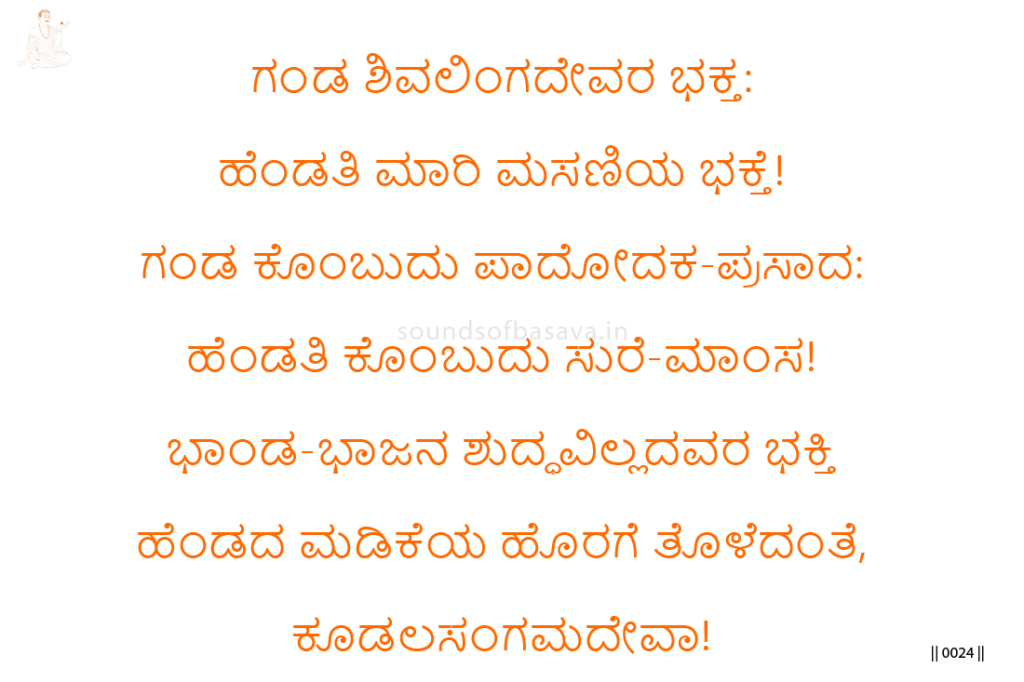
In this vachana, Basavanna presents a divided household. The husband is a devotee of Shiva-Linga, while the wife is devoted to Māri and Maśaṇi.
Their receptions differ. One receives pādodaka and prasāda; the other receives liquor and meat.
The contrast exposes a divided life. Basavanna compares such bhakti to a liquor vessel washed only on the outside. The surface may appear clean, but the inner condition remains unchanged.
Imagery & Symbolic Relevance
The husband and wife form the first image. Together they show a single household pulled in two contrary directions.
Pādodaka and prasāda represent consecrated reception. They belong to the discipline of devotion and sacred relation.
Liquor and meat represent contrary appetite. Basavanna places them beside sacred offerings to expose the contradiction.
The liquor vessel is the concluding image. Washing the outside does not remove the stain, smell, or impurity within.
This image gives the vachana its force. Devotion cannot be judged by the outer surface while the inner vessel remains unclean.
Lingayoga
In Lingayoga, the Anga must not remain divided between Linga and appetite.
Outer participation in sacred practice is insufficient when the inner vessel still holds contrary tendencies.
This vachana asks the practitioner to examine whether worship and conduct belong to one direction.
Practice matures when the whole life becomes fit to receive Kudalasangama Deva, not merely the visible surface.
Editorial Commentary
This vachana uses household division to test inward unity.
Basavanna’s concern is whether devotion has entered the vessel itself, not whether its exterior has been washed.
Related Vachana
Supporting Vachana
Vachana 103 — The Blind Who Seek with Open Eyes
Vachana 103 criticizes divided devotion after worshipping Kudalasangama Deva. Vachana 104 brings that division into the image of a household where sacred reception and contrary appetite remain side by side.
Advancing Vachana
Maheshwara Vachana 114 — The Ashes of Affection
The divided household of Vachana 104 advances into the divided stream of Maheshwara Vachana 114. What appears here as contradiction within devotional life becomes, in the next movement, a current that cannot flow wholly toward Kudalasangama Deva.
