
Summary
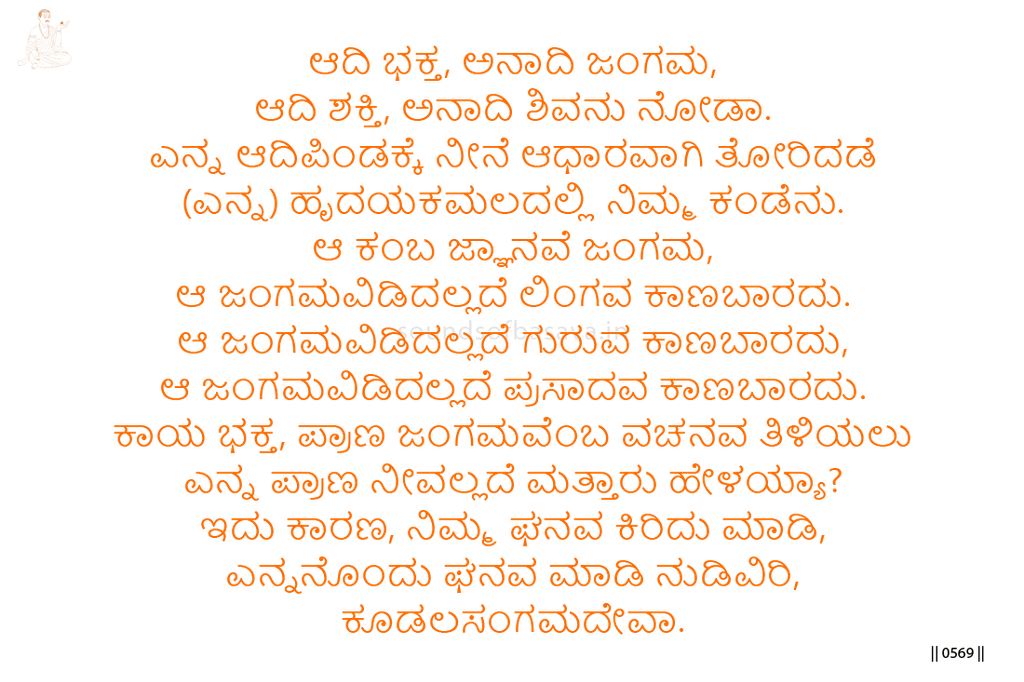
In this vachana, Basavanna names Bhakta, Jangama, Shakti, and Shiva as belonging to the beginningless order of realization. He then turns inward: when Kudalasangama Deva revealed Himself as the support of his primordial being, Basavanna saw Him in the heart-lotus.
That seeing becomes radiant knowledge, and Basavanna calls that knowledge Jangama. Without this Jangama, Linga cannot be seen; without it, Guru and Prasada also remain unknown.
The central statement is: body is Bhakta, prana is Jangama. The body becomes the field of devotion, while prana becomes the living movement through which Linga, Guru, and Prasada are recognized.
Basavanna finally asks Kudalasangama Deva to make this vast truth speakable. The Lord alone can reduce His greatness and make the seeker understand.
Imagery & Symbolic Relevance
Adi Bhakta, Anadi Jangama, Adi Shakti, and Anadi Shiva form the opening image. Basavanna is not arranging a historical sequence. He is naming the deep order in which devotion, living realization, power, and Shiva stand together.
The heart-lotus is the inward field of seeing. Kudalasangama Deva is not found as a distant object, but as the support of the seeker’s own being.
Radiant knowledge as Jangama is the decisive image. Jangama is not only outer movement here; it is the living awareness through which sacred reality becomes visible.
The repeated phrase “without that Jangama” gives the vachana its structure. Linga, Guru, and Prasada are not denied, but they cannot be truly seen without living Jangama-awareness.
The phrase “body is Bhakta, prana is Jangama” gathers the teaching. The body serves as the devotional field; prana becomes the living movement of realization.
Lingayoga
In Lingayoga, this vachana teaches that realization must become inwardly alive. Linga, Guru, and Prasada cannot remain as names or external categories. They are known through awakened Jangama-awareness.
For Pranalingi Sthala, the role of prana is central. Prana is not treated as ordinary breath alone; it becomes the living movement through which the seeker recognizes Kudalasangama Deva.
The practice-point is direct: let the body become Bhakta, let prana become Jangama, and let inward seeing reveal Linga, Guru, and Prasada.
Editorial Commentary
The phrase “body is Bhakta, prana is Jangama” should remain central. It does not separate body and prana into opposition. It shows their right relation in realized practice.
The body becomes the field of devotion. Prana becomes living Jangama-awareness. Through that awareness, Linga, Guru, and Prasada become visible.
Related Vachana
Supporting Vachana
Prasadi Sthala Vachana 1350 — Is Vachana Prana-Linga, or Is Dasoha Prana-Linga?
Prasadi Vachana 1350 supports this vachana by asking whether Vachana, attainment, or Brahmavidya can truly be called Prana-Linga if they do not become lived Dasoha. It identifies the Jangama-Dasohis as those who truly know.
Vachana 1041 carries this Prasadi teaching into Pranalingi Sthala. There, Basavanna says that body is Bhakta and prana is Jangama, and that without Jangama, Linga, Guru, and Prasada cannot be seen. Thus Prasadi 1350 prepares the Pranalingi insight that Prana-Linga must become living awareness and lived relation with Jangama, not speech or knowledge alone.
Advancing Vachana
Sharana Sthala Vachana 1271 — Salutations to Chennabasavanna, the Embodiment of Prasada
Sharana Vachana 1271 advances this teaching by showing the realized Sharana as the living embodiment of Prasada. Chennabasavanna is not described merely as one who receives grace; he becomes the expression of grace itself.
In Vachana 1041, Jangama is the living awareness through which Linga, Guru, and Prasada are known. In Vachana 1271, this matures into Sharana Sthala as reverence before the Guru-Sharana through whom Prasada becomes visible and active. Thus the Pranalingi recognition of Jangama within prana advances into Sharana reverence for realized grace embodied in Chennabasavanna before Kudalasangama Deva.
