

Summary
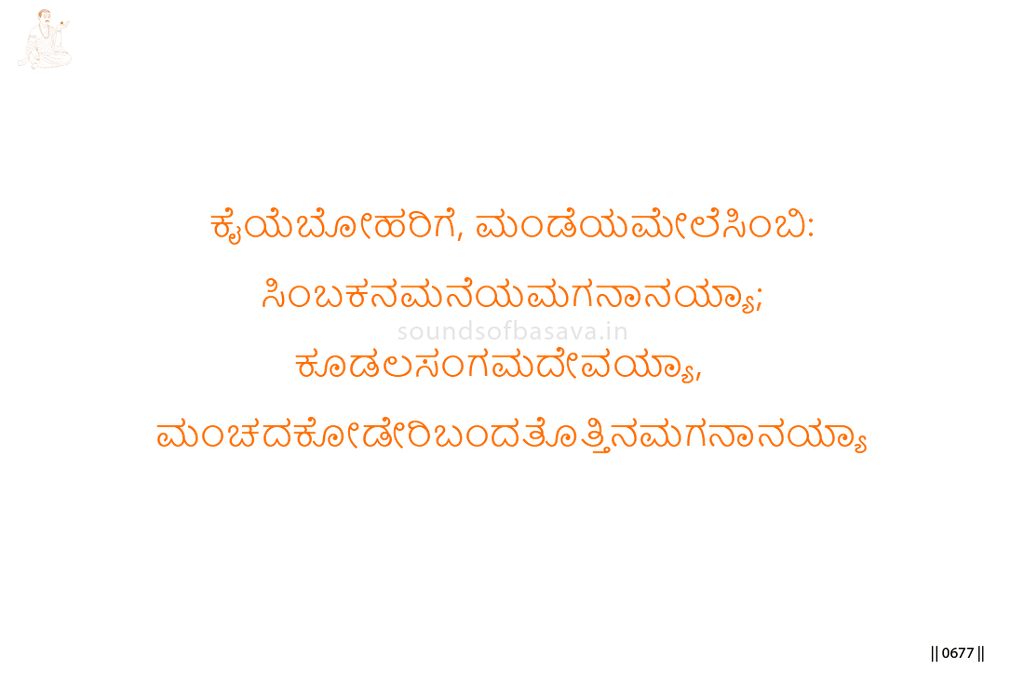
In this vachana, Basavanna places a broom in the hand and a load upon the head.
He names himself as the son in the house of the servant. The image is one of work, burden, and servant-belonging.
He then says that he is the son of the servant who came from the couch of Kudalasangama Deva. The teaching joins humble service with Divine origin: the one who serves in the house is not cut off from the Lord’s source.
Imagery & Symbolic Relevance
The broom in the hand is the first image. It points to ordinary service, cleaning, and humble work.
The load upon the head is the second image. It shows burden carried openly, not hidden.
The servant’s house gives the field of life. Basavanna does not place himself in a house of status, but in the house of service.
The son of that servant is his first self-placement. Service is not accidental; it becomes his lineage.
The couch of Kudalasangama Deva gives the deeper source. It is the Lord’s place of rest and origin from which the servant has come.
The son of the servant who came from that couch is the final identity. Basavanna holds both truths together: he belongs to service, and that service itself arises from Kudalasangama Deva.
Lingayoga
In Lingayoga, this vachana teaches that work and origin must not be separated.
The practice-point is direct: carry the broom and the load without shame. Let servant-conduct become the way in which belonging to Kudalasangama Deva is lived.
For Sharana Sthala, this is humble service grounded in the Lord’s own house.
Editorial Commentary
The clarity of the vachana lies in the two linked images: the servant with broom and burden, and the servant who comes from Kudalasangama Deva’s couch. Basavanna does not reject the servant-state. He receives it as his own lineage and places it within the Lord’s presence.
Related Vachana
Supporting Vachana
Pranalingi Sthala Vachana 1049 — The Service of Undivided Devotion
Pranalingi Vachana 1049 supports this teaching by defining true service as undivided bhṛtyācāra, where Bhakti, Yukti, and Virakti shape the heart, and whatever comes in service is to be received as Kudalasangama Deva Himself. Vachana 355 gives the Sharana form of that servant-conduct: the broom, the load, and the servant’s house are not outside the path, because service itself belongs to the Lord.
Advancing Vachana
Aikya Sthala Vachana 4 — The Seven Becomings
Aikya Vachana 4 advances this teaching by showing Basavanna shaped, named, called, and placed by Kudalasangama Deva through successive becomings, including the state of servant and the state of bearing. Vachana 355 says that he is the son of the servant who came from the Lord’s couch; Aikya Vachana 4 carries this into Aikya, where every becoming is received from Kudalasangama Deva and nothing is claimed as independent selfhood.
