

Summary
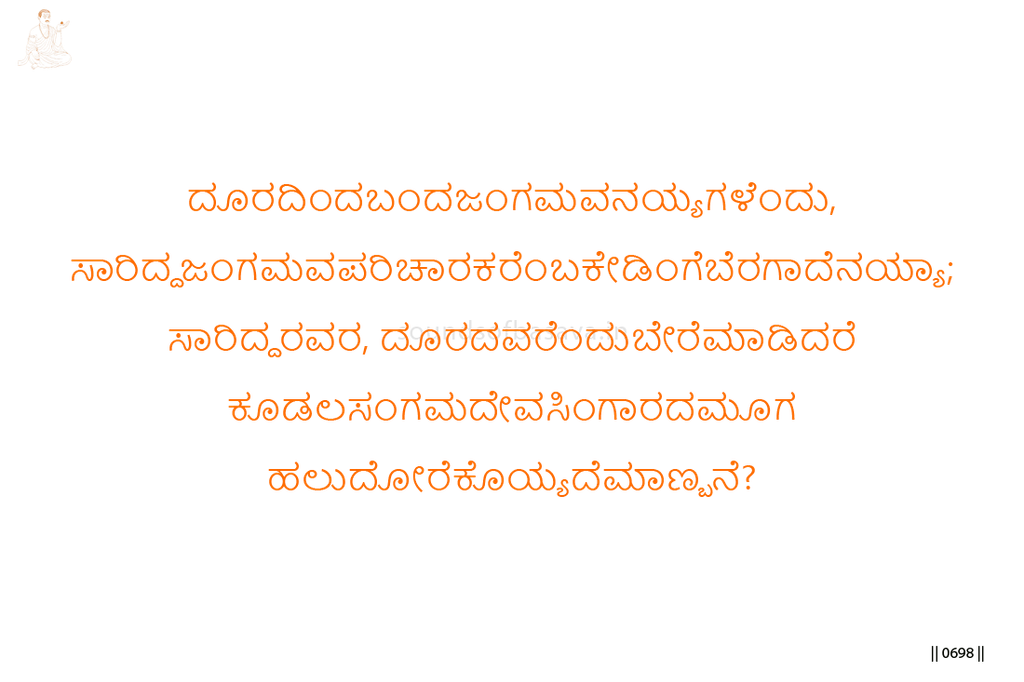
In this vachana, Basavanna speaks with astonishment about those who come from afar and are called Jangamas, while those who speak around them or speak of them are also treated as attendants of Jangama.
The concern is discernment. If the one who has truly seen and the one who has not seen are not distinguished, then sacred presence may remain unrecognized even while it is near.
Basavanna does not deny Jangama. He warns against confusing title, speech, and association with actual realization. Before Kudalasangama Deva, the living truth must not be lost because speaking is mistaken for seeing.
Imagery & Symbolic Relevance
The Jangama coming from afar is the first image. It shows visible arrival and public recognition. A person may be called Jangama, but Basavanna’s concern is whether the living essence is truly known.
Those who speak or announce around Jangama form the second image. Speech may accompany truth, but it is not the same as realization. Basavanna is astonished when speaking and seeing are not distinguished.
The distinction between those who have seen and those who have not seen gives the vachana its central test. The path becomes obscured when direct realization and verbal proximity are treated alike.
The silent presence of Kudalasangama Deva is the final concern. The Divine is not absent, but it may go unrecognized when discernment fails.
The imagery therefore moves from visible arrival, to naming, to speech, to the distinction between seeing and not seeing, and finally to the danger that living presence remains unseen.
Lingayoga
In Lingayoga, this vachana teaches discernment between speech and realization.
The practice-point is direct: do not mistake one who speaks of Jangama for one who has seen. Do not reduce Jangama to title, travel, appearance, or public association. Seek the living truth that reveals Kudalasangama Deva.
For Sharana Sthala, this is a warning against failed recognition. The Sharana must learn to see where realization is alive, not merely where spiritual speech is present.
Editorial Commentary
The strongest concern in this vachana is not outer fraud alone, but the collapse of discernment. Basavanna is alarmed that those who have seen and those who have not seen may be treated alike. When that happens, the silent presence of Kudalasangama Deva is not absent; it is simply not recognized.
Related Vachana
Supporting Vachana
Pranalingi Sthala Vachana 403 — The Heart’s Hidden Truth
Pranalingi Vachana 403 supports this teaching by warning that another person’s inward state cannot be fully known through surface judgment. There, Basavanna says one should not quickly call a Shiva-bhakta good or bad, because the heart is hidden and Jangama is Linga. Vachana 415 carries this concern into Sharana Sthala by asking for sharper discernment: the seeker must not confuse one who merely speaks with one who has truly seen, or the living presence of Kudalasangama Deva will remain unrecognized.
Advancing Vachana
Aikya Sthala Vachana 429 — The Mutual Dissolution of Roles
Aikya Vachana 429 advances this teaching by showing Jangama as living movement, stillness, and speech in which the devotee and Jangama no longer stand apart as fixed roles. Vachana 415 warns that Jangama may be reduced to title or speech when discernment fails. Aikya Vachana 429 carries this into Aikya, where the movement, stillness, and word of Jangama are recognized as living reality, and separation no longer obscures Kudalasangama Deva.
