

Summary
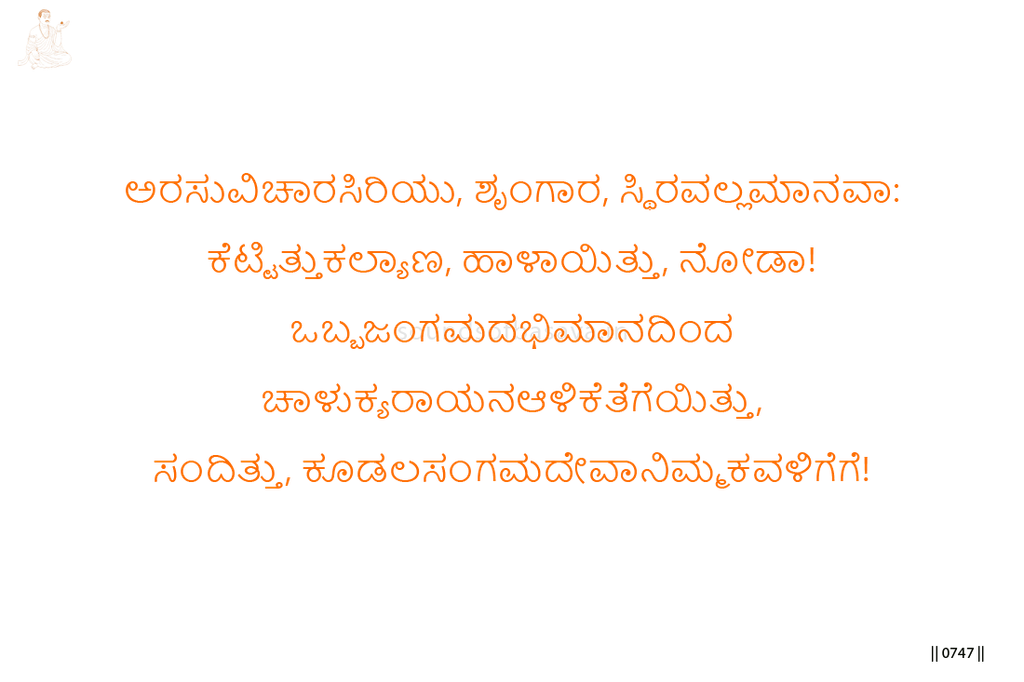
In this vachana, Basavanna warns that power, wealth, and pleasure do not remain stable.
He names arasu, siri, and śṛṅgāra. Arasu means rule, authority, or kingly power. Siri means wealth, prosperity, or abundance. Śṛṅgāra means beauty, ornament, pleasure, or sensual refinement. Basavanna addresses the human being directly and says that none of these is lasting.
He then points to Kalyana. The source says that Kalyana was built, and then it was ruined. Kalyana becomes the concrete example of worldly greatness that cannot hold itself together when it is treated as final.
The vachana also refers to the rulership of the Chalukya king being taken away and coming to Kudalasangama Deva’s bowl. The bowl is the central reversal. A kingdom appears great because it gathers power, wealth, and prestige. The bowl appears humble because it receives without possession. Basavanna places the kingdom before the bowl and shows which remains spiritually true.
The teaching is clear: rule, prosperity, beauty, and public greatness are unstable. What is built can fall. What is held can pass away. The seeker must not mistake worldly structure for eternal ground. Before Kudalasangama Deva, all possession must end in humility.
Imagery & Symbolic Relevance
Power is the first image. It includes command, rule, authority, and political control. Basavanna does not say that power has no effect. He says it is not stable. It may rise strongly, but it cannot guarantee permanence.
Wealth is the second image. Wealth appears to give security, status, and influence. Yet it also scatters, changes hands, and creates attachment. It cannot become the final refuge of the seeker.
Śṛṅgāra is the third image. It represents beauty, ornament, pleasure, and refined enjoyment. These may decorate life, but they do not hold life. Basavanna includes them with power and wealth to show that even the attractive and celebrated parts of life are passing.
Kalyana is the named example. The vachana does not need added historical explanation to carry force. Its point is already direct: even what is built, ordered, and made great can become ruined.
The Chalukya king’s rule gives the royal image its sharpness. Kingship is not spoken of as distant theory. Rulership itself is shown as something that can be taken away. Authority that appears firm is still within time.
The bowl of Kudalasangama Deva is the final image. A bowl receives; it does not boast of ownership. It is the opposite of kingdom, throne, and accumulation. The bowl represents humility, dependence on grace, and the end of grasping.
The movement of the vachana is therefore precise: power, wealth, and pleasure are named; Kalyana is shown as fallen; royal rule is brought down; and everything returns to the Lord’s bowl.
Lingayoga
In Lingayoga, this vachana teaches freedom from false stability.
The practice-point is direct: do not build spiritual identity on power, wealth, social standing, pleasure, beauty, or institutional greatness. These may appear strong, but they cannot give final ground.
For Sharana Sthala, the bowl is important. The Sharana does not stand before Kudalasangama Deva as an owner of kingdoms, wealth, or status. The Sharana stands as one who has learned to receive, offer, and remain humble.
Editorial Commentary
Editorial Commentary
This vachana should remain close to its own images: power, wealth, pleasure, Kalyana, rulership, and the bowl. Basavanna is not merely saying that empires fall. He is correcting the seeker’s scale of value.
The kingdom is large but unstable. The bowl is humble but spiritually true. The reader should feel that reversal clearly.
Related Vachana
Supporting Vachana
Pranalingi Sthala Vachana 340 — The Vigilance of the True Sharanas
Pranalingi Vachana 340 supports this teaching by describing the true Sharanas of Kudalasangama Deva as those who move above the hold of body, mind, and wealth. Body, thought, and possession remain present in life, but they no longer govern the Sharana.
This supports Vachana 625 because Vachana 625 shows the instability of outer power, wealth, and pleasure. Pranalingi Vachana 340 shows the inner correction: the true Sharana is not ruled by these forces. Even if body, mind, and wealth remain active, remembrance is guarded, humility returns quickly, and life itself is known as belonging to Kudalasangama Deva.
Advancing Vachana
Aikya Sthala Vachana 216 — The Rightful Harmony of Body, Mind, and Wealth
Aikya Vachana 216 advances this teaching by showing body, mind, and wealth crossed and brought into rightful harmony. It does not reject embodied life, thought, or resources. It teaches that they must not dominate one another or become false centers.
Vachana 625 warns that power, wealth, pleasure, and kingdom cannot stand as final refuge. Aikya Vachana 216 carries that warning into completion. Body serves truth, mind remains clear, and wealth supports dharmic life without becoming the master. When these stand in harmony, Kudalasangama Deva abides there.
Thus the fall of worldly greatness in Vachana 625 advances into Aikya as freedom from identification. The kingdom of grasping falls; the rightly ordered life becomes the place where the Divine is recognized.
