

Summary
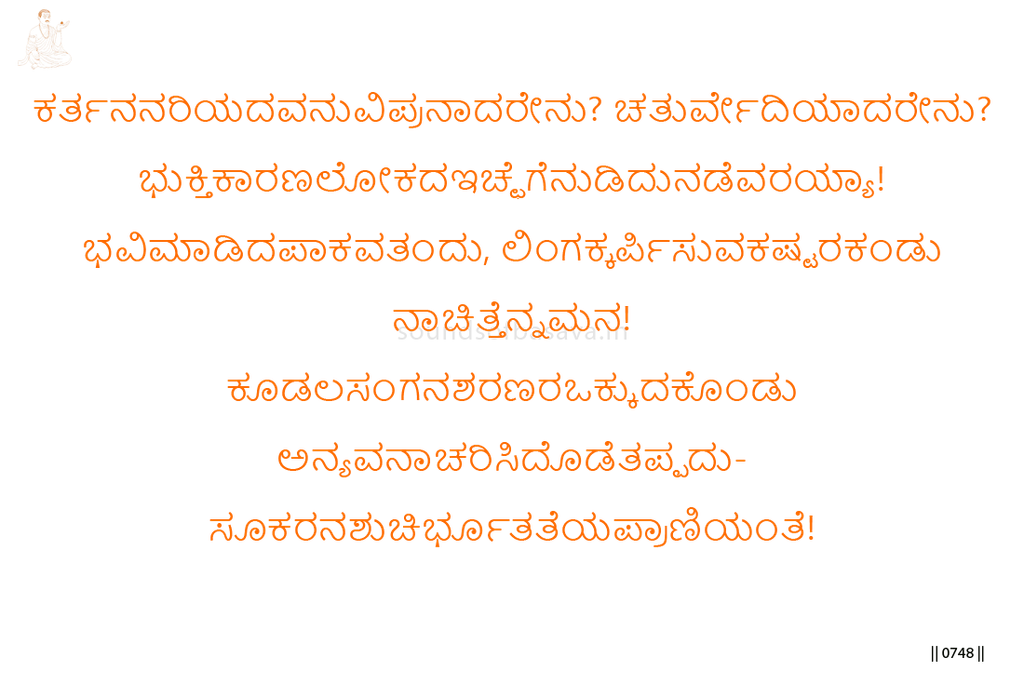
In this vachana, Basavanna tests religious learning, ritual offering, and conduct by one measure: whether the true Lord is known and whether the Sharana-relation is honored.
He asks: what use is it if a person is a Vipra? What use if he is a Chaturvedi? Vipra means one associated with learned or ritual authority. Chaturvedi means one who knows the four Vedas. Basavanna’s point is direct: scripture and status do not become realization by themselves.
He then says that such people speak and act according to the world’s desire for the sake of bhukti. Bhukti means enjoyment, consumption, or worldly gratification. The problem is not learning alone; it is learning used while life still follows desire.
Basavanna then turns to offering. Food prepared in a bhavi condition is brought and offered to Linga. Bhavi here means a condition not awakened into living Linga-Sharana relation. Seeing such difficulty, Basavanna says his mind is ashamed. The outer act of offering is present, but the inward fitness is missing.
The final image is severe and must remain clear. One may take the relation of Kudalasangama Deva’s Sharanas and yet practice another conduct. Such a person is compared to Sukara, a pig, an unclean animal. Basavanna is not making a casual insult. He is showing the degradation of divided conduct: to claim Sharana-relation while living otherwise is to fall into an unclean spiritual condition.
The teaching is clear: learning must become knowing, offering must arise from fitness, and Sharana-belonging must govern conduct.
Imagery & Symbolic Relevance
The Vipra is the first image. Basavanna uses this figure to question inherited religious authority. A sacred title does not prove that the Lord is known.
The Chaturvedi gives the second image. Mastery of the four Vedas appears high in the world’s measure, but Basavanna asks what use it has when realization is absent. Learning must become lived truth.
Bhukti is the next image. It reveals why the learned person remains divided. Speech and conduct are shaped by the world’s desire for enjoyment. The mouth may carry religious language, but life still moves toward gratification.
The bhavi-prepared food brought to Linga is the central ritual image. The issue is not food alone. The question is whether the one who prepares and offers stands in the right relation. If the condition is unawakened, the offering becomes difficult before Linga.
Basavanna’s ashamed mind is important. He is not merely criticizing others from a distance. His own mind recoils when sacred offering is handled without inward truth.
The Sharana-relation gives the decisive test. To take the bond of Kudalasangama Deva’s Sharanas means to enter a life shaped by refuge, humility, and realized conduct. If one then practices another way, the contradiction cannot be hidden.
The Sukara image completes the vachana. The pig, named as an unclean animal, symbolizes a life that has fallen below its claimed sacred relation. The comparison is harsh because the contradiction is harsh: to receive Sharana-relation and then turn to other conduct is not a small inconsistency; it is spiritual pollution.
The movement of the vachana is precise: learning is questioned, worldly desire is exposed, offering is tested, Sharana-relation is invoked, and divided conduct is condemned through the image of the unclean pig-animal.
Lingayoga
In Lingayoga, this vachana teaches that sacred identity must become sacred conduct.
The practice-point is direct: do not rely on scriptural knowledge, ritual status, or outward offering while conduct remains governed by worldly desire. Examine whether the act arises from Linga-awareness and Sharana-reverence.
For Sharana Sthala, this vachana is especially strict. Sharana-relation is not a name to carry while living by another rule. To belong to Kudalasangama Deva’s Sharanas is to let that belonging reshape food, speech, action, and desire.
Editorial Commentary
The final phrase should not be softened. Sukara means pig, and Basavanna’s comparison is to an unclean animal. The image is meant to shock the reader into seeing the seriousness of divided conduct.
The vachana is not rejecting Veda, learning, or offering in themselves. It rejects their misuse when the true Lord is not known, when bhukti governs conduct, and when the Sharana-relation is claimed but not lived.
Related Vachana
Supporting Vachana
Pranalingi Sthala Vachana 603 — Beyond Measure — The Exposure of False Purity
Pranalingi Vachana 603 supports this teaching through the image of the unfit vessel. It uses the dog’s skull, the Agama question, and the rule that bhavi-seen food does not automatically become Linga-offered.
This supports Vachana 627 closely. Vachana 627 shows bhavi-prepared food being brought for Linga-offering and exposes the shame of offering without inward fitness. Vachana 603 gives the underlying principle: sacred procedure cannot purify an unfit condition. The vessel, the act, and the relation must be true before Kudalasangama Deva.
Advancing Vachana
Aikya Sthala Vachana 1242 — Beyond the “I” Before the Linga
Aikya Vachana 1242 advances this teaching by distinguishing the realized Sharana from ordinary bodily identity. It asks where the “I” can remain before the great reality called Linga. It then says that even if the Sharana still bears a body, such a one is not ordinary, because the way of Kudalasangama’s Sharanas is different.
This is a strong continuation from Vachana 627. Vachana 627 warns that one who claims Sharana-relation but practices another conduct becomes like an unclean pig-animal. Aikya Vachana 1242 shows the opposite state: the true Sharana may still live in the body, but is no longer reducible to bodily condition. The false claimant falls into unclean conduct; the realized Sharana stands beyond ordinary body-bound identity through Linga-realization.
Thus Vachana 627’s warning advances into Aikya as clarity about the Sharana’s true state. Sharana is not an outer label. It is the transformed condition in which body remains, but egoic separateness no longer governs before Kudalasangama Deva.
