

Summary
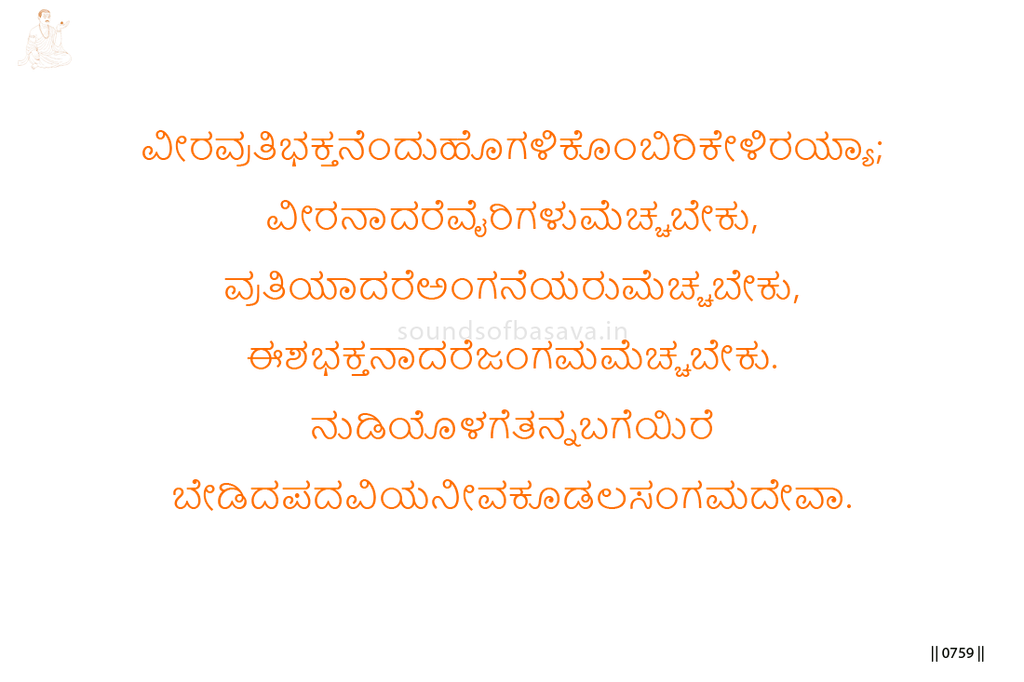
In this vachana, Basavanna rejects self-praise and tests each claimed identity by the witness qualified to judge it.
He names three claims: vīra, vratī, and bhakta. Vīra means brave one or warrior. Vratī means one who keeps a vow or lives under discipline. Bhakta means devotee.
If one is truly a warrior, even the enemy must acknowledge it. If one is truly a vratī, women must acknowledge it. If one is truly a Bhakta, Jangama must acknowledge it.
This is not about seeking public admiration. Basavanna is saying that a quality must be proven in the field where it is tested. Courage is tested before opposition. Vow is tested in relationship and restraint. Bhakti is tested before Jangama, the living presence of the Linga-path.
The final line gives the rule: if one’s own state truly stands within these words, Kudalasangama Deva grants the sought padavi. Padavi means state, position, or spiritual standing.
The teaching is direct: do not claim a state by speech. Let the proper witness reveal whether the claim is true.
Imagery & Symbolic Relevance
The first image is the warrior before the enemy. A warrior cannot prove courage by praising himself among friends. The enemy’s acknowledgment matters because opposition tests fear, steadiness, and strength.
The second image is the vratī before women. This should be read carefully. Basavanna is not making women the fault. He is saying that a vow-holder’s discipline is tested in living relationship, especially where desire, conduct, restraint, and respect are exposed. If women themselves can approve his conduct, the vow has become real.
The third image is the Bhakta before Jangama. This is the highest test in the vachana. A Bhakta cannot be established by self-declaration. Jangama, the living sacred presence, must acknowledge the truth of that Bhakti.
The repeated word mechchabeku means “must approve,” “must acknowledge,” or “must be pleased.” Basavanna repeats it to show that each claim must pass through its proper field of verification.
The final phrase “within these words” is important. If the word “warrior,” “vow-holder,” or “Bhakta” truly fits the person’s own state, then the word is no longer empty. It has become lived reality.
The movement of the vachana is precise: public praise is questioned, three claims are tested, the proper witness is named for each, and Kudalasangama Deva grants the true state only where word and reality meet.
Lingayoga
In Lingayoga, this vachana teaches freedom from self-certification.
The seeker should not ask, “What do I call myself?” The better question is: “Does my life stand true where it is tested?” Courage must stand before opposition. Vow must stand in relationship. Bhakti must stand before Jangama.
For Sharana Sthala, this is a discipline of humility and verification. The Sharana does not live by spiritual title. The Sharana becomes readable through tested conduct before Kudalasangama Deva.
Editorial Commentary
The three terms should remain distinct. Vīra is not the same as vratī, and vratī is not the same as Bhakta. Each is tested by a different witness.
The final teaching should also remain clear. Basavanna is not saying that human approval is the goal. He is saying that a claim becomes true only when it stands in the field where it is tested.
Related Vachana
Supporting Vachana
Pranalingi Sthala Vachana 824 — The Moment That Cannot Be Lost
Pranalingi Vachana 824 supports this teaching by making the relation to Jangama spiritually decisive. Basavanna says that if Guru is displeased, he can bear it for a day; if Linga is displeased, he can bear it for a day; but if Jangama is displeased even for a moment, his prana departs.
This supports Vachana 672 directly. Vachana 672 says that if one is truly a Bhakta, Jangama must acknowledge it. Vachana 824 gives the deeper reason: Jangama is not a casual observer, but the living sacred presence before which Bhakti is tested.
Together, the two vachanas teach that Bhakti cannot remain private claim. It must stand rightly before Jangama.
Advancing Vachana
Aikya Sthala Vachana 1235 — The Symphony of the Integrated Self
Aikya Vachana 1235 advances this teaching by joining speech and conduct completely. It says that conduct must show the beauty of speech, and speech must show the beauty of conduct. It honors those who have become complete without inner division.
Vachana 672 tests the words “warrior,” “vow-holder,” and “Bhakta” by the proper witness. Aikya Vachana 1235 carries this further: speech and conduct no longer need separate proof because they reveal each other.
Thus Vachana 672’s threefold test advances into Aikya as complete integration. The word is no longer a claim; the life itself speaks before Kudalasangama Deva.
