

Summary
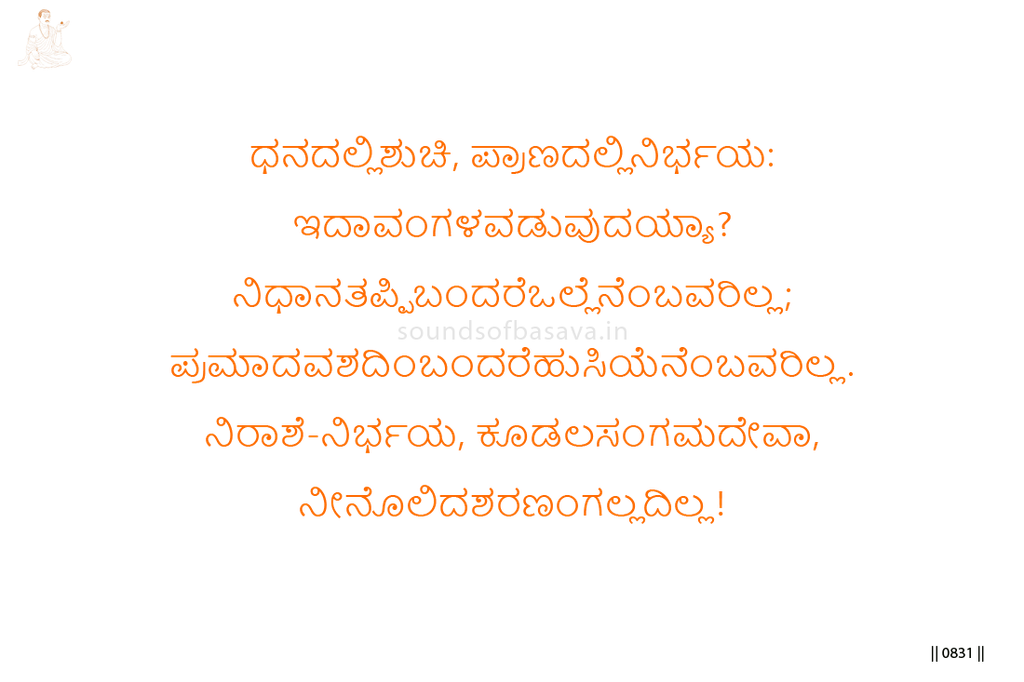
Basavanna names two great measures: purity in wealth and fearlessness in life. Wealth must not be stained by wrongful holding, and life must not be ruled by fear. These two together form a rare inner wealth.
He then exposes a worldly contradiction. When treasure or gain comes wrongly, unexpectedly, or through error, people do not refuse it. When gain comes through carelessness or accident, they do not call it false. The world easily accepts what benefits it, even when the inward ground is impure.
The final line gives the true measure. Desirelessness and fearlessness belong only to the Sharana whom Kudalasangama Deva has accepted. The teaching is direct: the true Sharana is not measured by possession, success, or gain, but by purity in relation to wealth, fearlessness in life, and freedom from craving before the Lord.
Imagery & Symbolic Relevance
Purity in wealth is the first image. Basavanna does not condemn wealth as such. He tests the condition in which wealth is held, received, and used. Wealth becomes pure only when it does not strengthen falsehood, greed, or concealment.
Fearlessness in life is the second image. Life becomes fearless when it no longer depends upon possession for security. Fear arises where the self clings to gain, status, or survival as its ground.
The question “what can surpass these?” gives weight to the teaching. Basavanna does not present purity and fearlessness as minor virtues. He places them among the highest marks of spiritual worth.
The worldly response to questionable gain is the next image. People rarely refuse gain that comes to them, even when its coming is not clean. This exposes the mind’s compromise with truth when benefit is involved.
The phrase “desireless and fearless” is the decisive inward mark. Desirelessness removes grasping; fearlessness removes anxiety over loss. Together they show freedom from the two movements by which wealth binds the seeker.
The Sharana whom Kudalasangama Deva has accepted is the final image. Such a Sharana is not authenticated by society’s measure of value. He is known by purity, non-craving, and fearlessness before the Lord.
Lingayoga
In Lingayoga, this vachana teaches right relation to wealth and life. The practitioner must examine whether wealth is cleanly held and whether life is governed by fear.
For Sharana Sthala, the practice-point is direct: do not accept gain merely because it benefits the self. Let wealth remain pure, and let life become fearless through freedom from craving.
This also clarifies Dasoha. Giving is not true when wealth itself is impure or when fear and desire govern the giver. The Sharana gives, receives, and lives from the state of being desireless and fearless before Kudalasangama Deva.
Editorial Commentary
The Kannada vachana centers on purity in wealth, fearlessness in life, refusal or acceptance of gain, and the final mark of the accepted Sharana: nirāśe and nirbhaya, desireless and fearless.
Related Vachana
Supporting Vachana
Pranalingi Sthala Vachana 340 — The Vigilance of the True Sharanas
Pranalingi Vachana 340 supports this teaching by describing the true Sharanas as those who move above the hold of body, mind, and wealth, and who know life itself as belonging to Kudalasangama Deva, the Lord of prana. This prepares Vachana 855 directly. In Vachana 340, wealth and life-force do not govern the Sharana; in Vachana 855, that maturity appears as purity in wealth, fearlessness in life, and desire lessness before Kudalasangama Deva.
Advancing Vachana
Aikya Sthala Vachana 887 — Beyond Claim, Beyond Attainment
Aikya Vachana 887 advances this teaching by taking the freedom from craving and fear into the subtler freedom from spiritual ownership itself. There, Basavanna refuses to claim purity or attainment as his own; what is given is simply received as it comes. This is the natural Aikya fulfillment of Vachana 855. In Sharana Vachana 855, the accepted Sharana is desireless and fearless in relation to wealth and life; in Aikya Vachana 887, even the claim “I am pure” or “I have attained” disappears before Kudalasangama Deva.
