

Summary
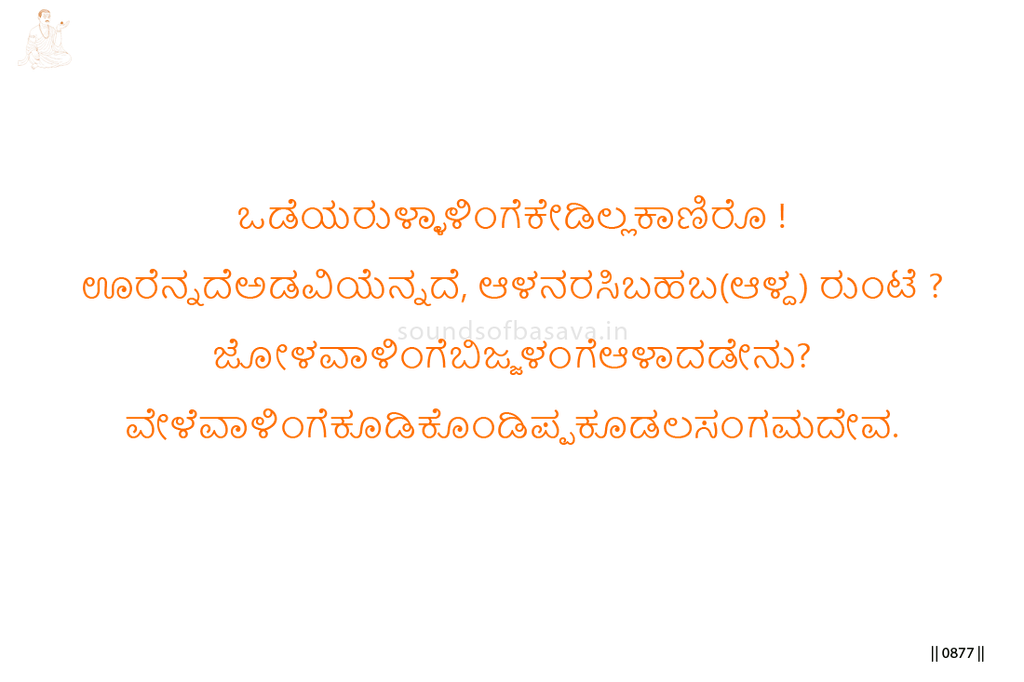
Basavanna declares the fearlessness that belongs to one held in the Lord’s protection. For such a one, harm does not have the final word. The question is not whether the world contains danger, but whether danger can truly master the one who belongs to Kudalasangama Deva.
The contrast between town and forest removes dependence on place. A town may appear safe and a forest may appear dangerous, but Basavanna refuses to let external location decide the devotee’s security. The real shelter is not geography. It is Divine belonging.
The reference to Jōḷavāḷi and Bijjala brings worldly authority into the vachana. Even if one becomes subject to a king or temporal power, that outward subjection is not the final truth. The devotee’s deeper belonging remains with Kudalasangama Deva.
The closing declaration gives the center: the one joined to the proper refuge, the appointed Lord, belongs only to Kudalasangama Deva. Fearlessness arises from that belonging.
Imagery & Symbolic Relevance
The first image is the Lord’s protection. Basavanna does not begin with the strength of the devotee. He begins with being held. The security of the Sharana is received, not self-manufactured.
The second image is harm. The question, “What harm can come?” should not be softened into a promise that no outward difficulty will ever arise. Its force is deeper. Harm may touch circumstance, body, or status, but it cannot sever the one who belongs to the Lord.
The third image is town and forest. These two places represent ordinary measures of safety and danger. The town suggests shelter, order, and society. The forest suggests exposure and uncertainty. Basavanna makes them equal before Divine refuge.
The fourth image is Jōḷavāḷi becoming subject to Bijjala. This points to the reality of worldly power. Kings may rule, command, and subordinate. Yet Basavanna asks, “What of it?” The question does not deny temporal authority; it denies its finality.
The final image is proper refuge. The devotee who is rightly joined does not belong ultimately to town, forest, king, danger, or circumstance. He belongs to Kudalasangama Deva.
Lingayoga
In Lingayoga, this vachana teaches steadiness within changing conditions. The seeker must examine where security is being placed: in place, ruler, social order, bodily safety, or Kudalasangama Deva.
For Sharana Sthala, the practice-point is direct: do not let external circumstance become the measure of refuge. Town and forest, safety and exposure, worldly authority and worldly vulnerability are all secondary before Divine belonging.
Fearlessness here is not boldness of temperament. It is the fruit of belonging. The Sharana does not stand fearless because he controls events, but because his true refuge is fixed in Kudalasangama Deva.
Editorial Commentary
The reference to Jōḷavāḷi and Bijjala should be kept concrete and restrained. Basavanna’s point is precise: even worldly subjection does not decide the inner belonging of the one who has taken refuge in Kudalasangama Deva.
Related Vachana
Supporting Vachana
Pranalingi Sthala Vachana 691 — The One-Pointed Alignment
Pranalingi Vachana 691 supports this teaching by saying that outer injury and loss are not the deepest measure. Even if the head is broken, the body torn, or possessions lost, the decisive question is whether chitta, mind, and buddhi remain one without separation before Kudalasangama Deva. This prepares Vachana 1113 directly. In Vachana 691, outer harm and loss are made secondary to inward steadiness; in Vachana 1113, town, forest, and even worldly subjection become secondary to the devotee’s belonging to Kudalasangama Deva.
Advancing Vachana
Aikya Sthala Vachana 1070 — The Fearless Refuge
Aikya Vachana 1070 advances this teaching by carrying fearlessness into the recognition that no external power stands above Kudalasangama Deva. There, Māri, Brahma, the noose, and the staff lose their power to terrify because the Lord is known as the champion within and the sovereign who fills the sky. This is the natural Aikya fulfillment of Vachana 1113. In Sharana Vachana 1113, the devotee belongs to the proper refuge and therefore need not fear town, forest, or worldly authority; in Aikya Vachana 1070, fear itself loses its ground because Kudalasangama Deva is realized as both inward protector and all-pervading Lord.
