

Summary
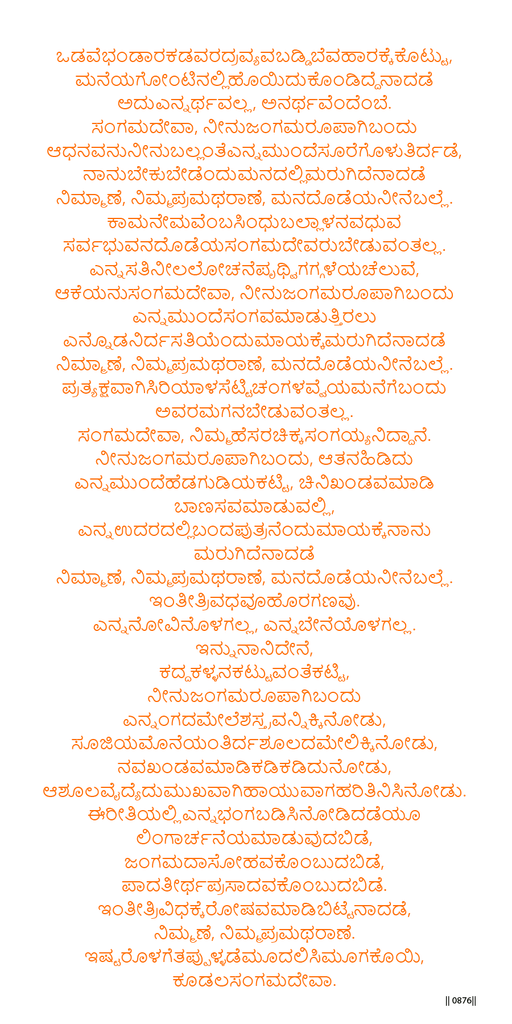
Basavanna examines the final trace of possessiveness. Ornaments, treasure, wealth, and stored possessions may be accumulated, lent for profit, guarded in the house, and called “mine.” But such possession is not fortune. It is misfortune when it strengthens ownership and closes the heart.
The decisive test comes when Sangamadeva Himself appears in the form of Jangama and takes that wealth before the devotee’s eyes. The issue is not the external loss of wealth. The issue is the inward hesitation that may arise at the moment of giving.
If the heart wavers between “give” and “do not give,” Basavanna places himself under Divine judgment. This is not fear of poverty. It is fear of hidden attachment.
The final appeal is severe and transparent: by the witness of the Pramathas, You alone know the truth of my heart. The devotee may appear generous outwardly, but only Kudalasangama Deva knows whether the claim of “mine” has truly ended.
Imagery & Symbolic Relevance
The first image is accumulated wealth: ornaments, treasure, stored possessions, and money set into circulation for gain. These are not condemned merely because they exist. Their danger lies in being guarded and claimed as one’s own.
The second image is the locked house. Wealth kept inside the house becomes an extension of the self. The house becomes not only a place of shelter, but a chamber of possessiveness.
The phrase “not fortune, but misfortune” reverses ordinary judgment. What society may call prudence, prosperity, or success becomes anartha when it deepens ownership and obstructs offering.
The central image is Sangamadeva coming as Jangama. The Jangama is not treated as an ordinary petitioner. The Lord Himself comes in that living form to claim what was never truly the devotee’s private possession.
The next image is the wealth being taken before the devotee’s eyes. This makes the test direct. It is easy to speak of surrender in abstraction; it is harder to remain inwardly free when the possession is visibly leaving.
The hesitation between “give” and “do not give” is the hidden knot. Even if the hand gives, the heart may still bargain. Basavanna asks that this inner wavering be judged by the Lord.
The Pramathas as witness give the vachana its solemnity. Basavanna does not trust public appearance or self-assessment. The truth of the heart is placed before Sangamadeva, who alone knows.
Lingayoga
In Lingayoga, this vachana teaches the purification of ownership. Wealth must not remain a private fortress of identity. When the Lord comes as Jangama, what is held must be returned without inner resistance.
For Sharana Sthala, the practice-point is direct: do not call accumulated wealth “mine.” Do not treat the Jangama’s asking as an interruption or loss. Recognize it as the Lord’s claim upon what already belongs to Him.
Dasoha becomes complete only when hesitation ends. Giving is not full while the heart still debates, protects, calculates, or grieves. The Sharana’s concern is not merely whether wealth leaves the hand, but whether possessiveness leaves the heart.
Editorial Commentary
The vachana should not be reduced to a general criticism of wealth. Its sharper concern is ownership tested by Jangama. Wealth becomes misfortune when it is locked away and called “mine.” Giving becomes truthful only when the Lord, appearing as Jangama, can claim it without inner hesitation.
Related Vachana
Supporting Vachana
Pranalingi Sthala Vachana 788 — The Tremor and the Steadying
Pranalingi Vachana 788 supports this teaching by showing the inward difficulty of offering. There, Basavanna speaks of holding a substance in the hand and feeling fear at the burden of giving it to Kudalasangama Deva. He asks the Lord, who knows him, to protect and sustain him. This prepares Vachana 1111 directly. In Vachana 788, the hand holds what must be given and the heart trembles; in Vachana 1111, the test becomes sharper: if Sangamadeva comes as Jangama and takes the wealth, even the inward hesitation between “give” and “do not give” must be placed under Divine judgment.
Advancing Vachana
Aikya Sthala Vachana 1226 — The Final Offering into Purity
Aikya Vachana 1226 advances this teaching by carrying the surrender of wealth into complete self-offering. There, wealth is exhausted and the body is offered; the body is exhausted and the mind is offered; the mind is exhausted and bhava is offered; bhava is exhausted and nirbhava is offered; finally, after Chennabasavanna makes the crossing possible, the self is offered completely and becomes pure in Kudalasangama Deva. This is the natural Aikya fulfillment of Vachana 1111. In Sharana Vachana 1111, the claim of “mine” is judged when the Lord comes as Jangama to take wealth; in Aikya Vachana 1226, even the one who could claim wealth, body, mind, or inner state is offered without remainder.
