

Summary
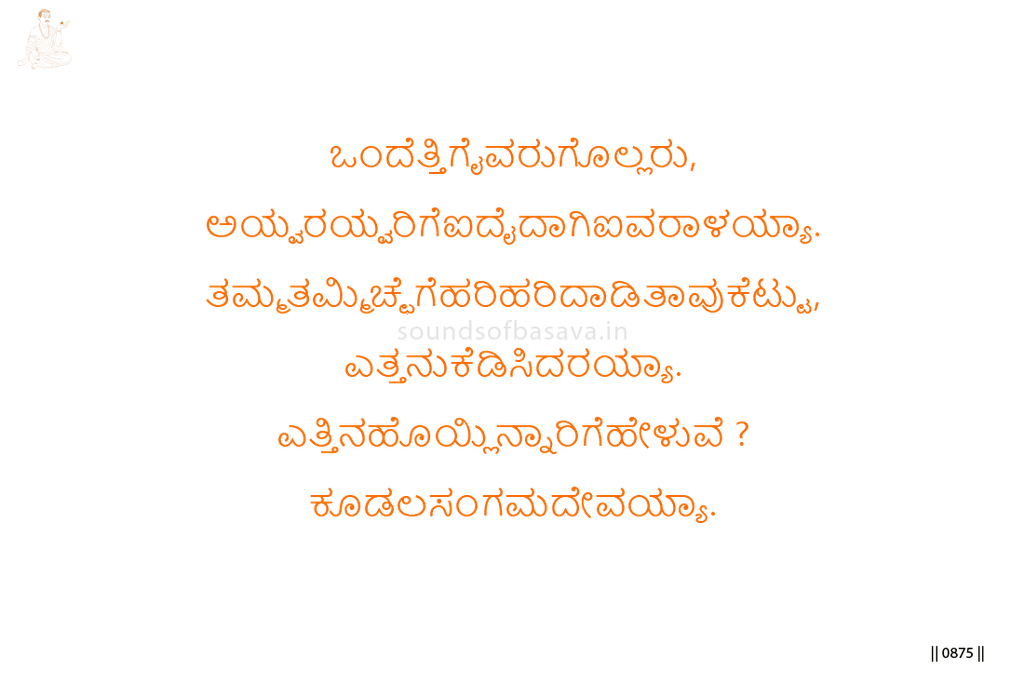
Basavanna gives the image of one herd governed by five shepherds. The herd is one, yet those who direct it are many. Each follows its own desire, pulls in its own direction, ruins itself, and scatters the herd.
The teaching is a lament over inward fragmentation. The seeker’s life is one, but its faculties, impulses, and desires do not always move as one. When each force claims authority for itself, the whole life is pulled apart.
The suffering of the herd is therefore not caused by an outer enemy alone. It arises because there is no single governing orientation toward Kudalasangama Deva. The many movements do not serve one center.
The final question, “To whom shall I speak of the suffering of the herd?” becomes the heart of the vachana. Basavanna brings the condition of scattering before Kudalasangama Deva, the only one before whom the divided life can be gathered again.
Imagery & Symbolic Relevance
The first image is the single herd. The herd represents one life, one embodied field, one inward being that ought to move in a gathered way. Its nature is not to be torn apart.
The second image is the five shepherds. They point to the faculties and forces that claim to guide the life. Instead of serving the herd together, they pull separately.
The third image is multiplication: to each shepherd belong five and five. Fragmentation does not remain small. Once the one life is given over to divided guidance, division multiplies into many directions and claims.
The fourth image is desire. Each shepherd follows its own wish. The problem is not guidance itself, but guidance ruled by private inclination. When each faculty pursues its own object, the whole being loses direction.
The fifth image is pulling this way and that way. This makes the suffering visible. The herd is not merely confused; it is dragged into conflicting movement.
The sixth image is ruin and scattering. The shepherds ruin themselves and scatter the herd. The forces that try to govern separately do not truly preserve even themselves. Their divided movement damages the whole.
The final question gives the devotional movement. Basavanna does not present himself as able to gather the herd by his own strength. He speaks the suffering to Kudalasangama Deva.
Lingayoga
In Lingayoga, this vachana teaches the danger of scattered faculties. Seeing, hearing, desire, impulse, and inward movement must not be left to pull the whole life in separate directions.
For Sharana Sthala, the practice-point is direct: recognize the suffering of inward division and bring it before Kudalasangama Deva. The seeker should not merely try to appoint better shepherds among the competing impulses. The one life must be gathered under one Divine orientation.
The movement is therefore from fragmentation to refuge. The many pulls are seen clearly, the suffering is confessed, and the cry is addressed to Kudalasangama Deva.
Editorial Commentary
The herd and shepherds should remain the central images. The vachana should not be expanded into a complex symbolic system. Its source-bound force is clear: the one life is scattered when many desire-driven faculties try to govern it.
Related Vachana
Supporting Vachana
Pranalingi Sthala Vachana 1370 — The Sharana Must Be a Brahmachari in the Five Senses
Pranalingi Vachana 1370 supports this teaching by requiring discipline in all five senses: hearing, touch, sight, tongue, and smell. It teaches that the senses must not remain scattered openings but must be gathered into Kudalasangama Deva. This prepares Vachana 1107 directly. In Vachana 1370, the sensory field is disciplined and integrated; in Vachana 1107, Basavanna shows what happens when the same field is governed by many desire-driven shepherds and the one herd is scattered.
Advancing Vachana
Aikya Sthala Vachana 1299 — The Two Headed Bird Within
Aikya Vachana 1299 advances this teaching through the image of one bird with two heads. If one head is fed milk and the other poison, the single body still suffers. This is the natural Aikya fulfillment of Vachana 1107. In Sharana Vachana 1107, one herd suffers when many shepherds pull it apart; in Aikya Vachana 1299, the one body suffers when division is made between Linga and Jangama. The movement into Aikya is the recognition that what is one cannot be safely divided before Kudalasangama Deva.
