
Summary
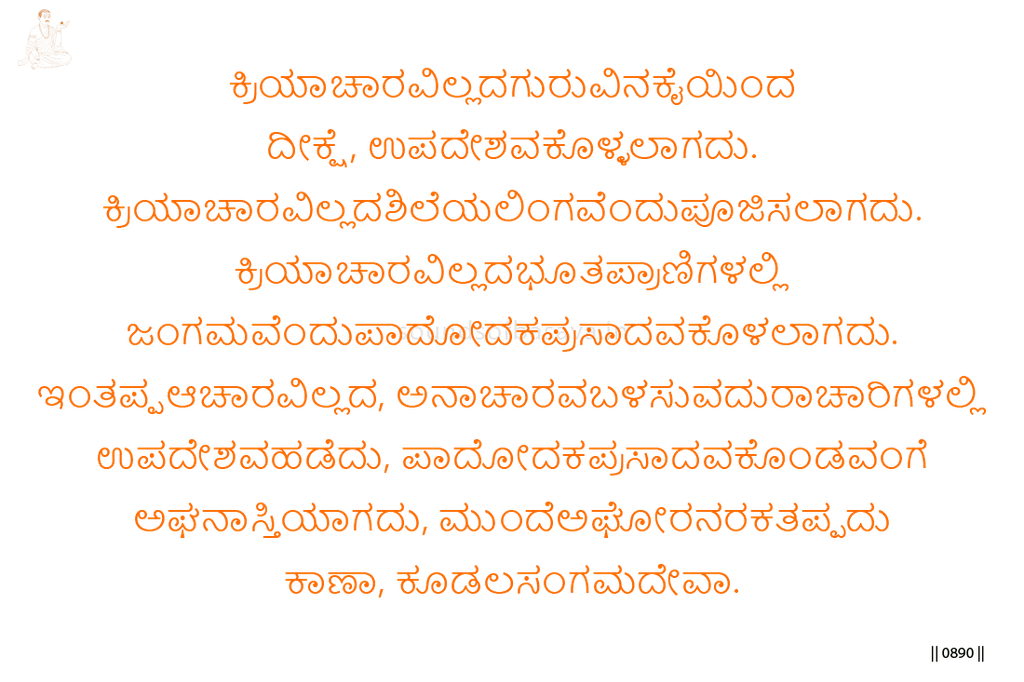
Basavanna makes Achara the test of sacred validity. From a Guru without Kriyachara, initiation cannot be received and instruction cannot be accepted. A stone without Kriyachara cannot be worshipped as Linga. Among beings without Kriyachara, Jangama cannot be recognized, nor can Padodaka and Prasada be rightly received.
The vachana does not reject Guru, Linga, Jangama, Padodaka, or Prasada. It protects them from misuse. Sacred forms remain sacred only when they are joined to right conduct, right practice, and inner integrity.
Basavanna then sharpens the warning. From those without Achara, practicing Anachara, and living in Durachara, if one receives instruction or accepts Padodaka and Prasada, sin does not depart. The forms may appear sacred, but they cannot purify when their source is corrupt.
The final warning is severe: ahead lies dreadful hell. This is the consequence of mistaking empty form for living truth. Before Kudalasangama Deva, Achara is not optional; it is the condition by which sacred life remains real.
Imagery & Symbolic Relevance
The first image is the Guru without Kriyachara. Guruhood is not validated by title, seat, lineage, or speech alone. If right conduct and lived practice are absent, initiation and instruction lose their authority.
The second image is the stone called Linga. Basavanna does not deny the sanctity of Linga. He warns that without Kriyachara, meaning the disciplined practice of right conduct aligned with spiritual realization, what is approached as Linga remains spiritually ineffective for the seeker. Worship requires living alignment, not merely object and gesture.
The third image is the living being without Kriyachara. Not every embodied person can be recognized as Jangama merely by appearance. Jangama is living sacred presence, and that recognition cannot be separated from Achara.
Padodaka and Prasada are then brought into the same test. These are not ordinary substances or social tokens. They are sacred only when they arise from a life aligned with truth. Without right conduct aligned with spiritual discipline, receiving them does not remove sin.
The progression from Achara to Anachara (deviation from right conduct) and Durachara (corrupt conduct hardened into practice) gives the vachana its moral severity. Achara is right conduct aligned with truth. Anachara is deviation from that conduct. Durachara is corrupt conduct hardened into practice.
The final image is Aghora Naraka, the dreadful hell ahead. Basavanna’s warning is not casual. To receive sacred transmission from corrupt sources is not neutral; it leads the seeker deeper into confusion while appearing religious.
Lingayoga
In Lingayoga, this vachana teaches that sacred form and lived conduct cannot be separated. Guru, Linga, Jangama, Padodaka, and Prasada must remain grounded in Kriyachara and Achara.
For Sharana Sthala, the practice-point is direct: do not receive initiation, instruction, Padodaka, or Prasada merely because the outer form is present. Examine whether Achara is present. Without Achara, the form cannot carry its sacred force.
This is discernment, not disrespect. Basavanna is not weakening reverence for Guru, Linga, and Jangama. He is making reverence exact. What is sacred must not be handled through Anachara or Durachara.
Editorial Commentary
The phrase “without Kriyachara” should remain central. It is the repeated measure by which Guru, Linga, Jangama, Padodaka, and Prasada are tested. The vachana should not be softened into a general moral lesson. Its sharper teaching is that sacred transmission itself becomes invalid when detached from Achara before Kudalasangama Deva.
Related Vachana
Supporting Vachana
Pranalingi Sthala Vachana 648 — The Body as the Sacred Field
Pranalingi Vachana 648 supports this teaching by joining worship with truthful conduct. There, Linga is held in the palm, Guru-vachana is placed on the tongue, and nitya-nema is joined to walking in truth. Basavanna warns that Linga-worship followed by injustice causes the seeker to fall away from Kudalasangama Deva. This prepares Vachana 1165 directly. In Vachana 648, worship must pass into aligned conduct; in Vachana 1165, that same principle becomes uncompromising: without Kriyachara and Achara, Guru, Linga, Jangama, Padodaka, and Prasada cannot function as living sacred realities.
Advancing Vachana
Aikya Sthala Vachana 1154 — The Revelation of Linga-Aikya
Aikya Vachana 1154 advances this teaching by showing Achara restored in its full sacred foundation. There, Chennabasavanna descends because the world has fallen through ignorance of Shivachara; he establishes the Fivefold Achara of Guru, Linga, Jangama, Padodaka, and Prasada, makes the Shatsthala path firm, removes delusion, and reveals Linga-Aikya. This is the natural Aikya fulfillment of Vachana 1165. In Sharana Vachana 1165, Basavanna warns that sacred forms collapse without Achara; in Aikya Vachana 1154, Achara is fully restored, delusion is removed, and the path opens into Linga-Aikya before Kudalasangama Deva.
