

Summary
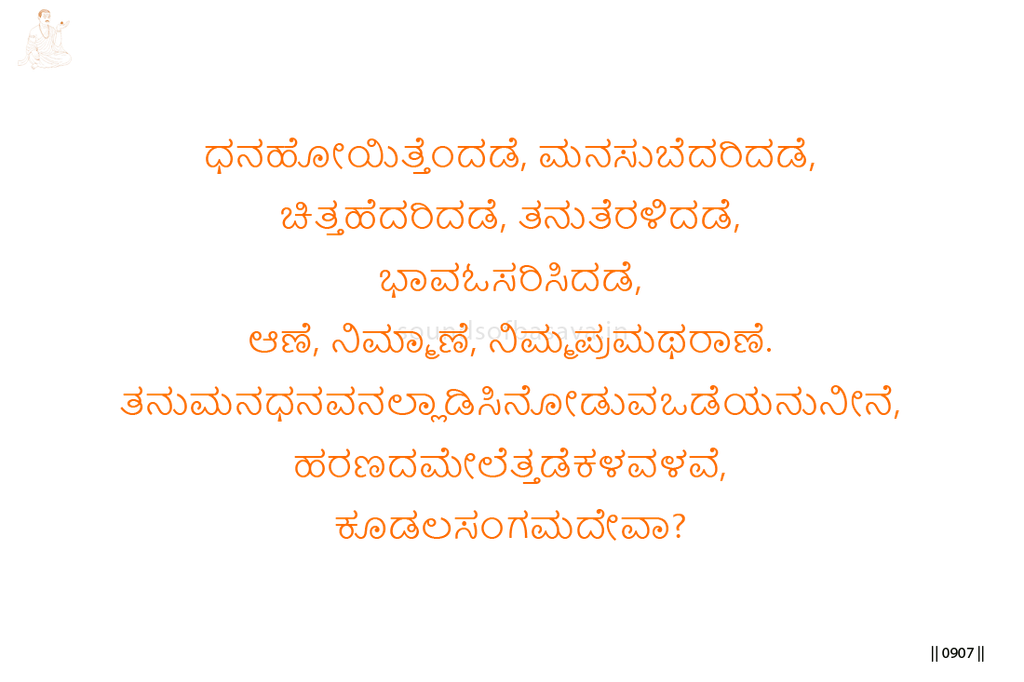
Basavanna traces the chain of fear. When wealth is lost, the mind trembles. When the mind trembles, chitta trembles. When the body is shaken or begins to fail, bhava withdraws. What appears as spiritual steadiness is tested by loss.
He then places the matter under oath: by You, and by Your Pramathas. The seriousness of the statement is not casual. The test concerns the whole field of embodied life.
Kudalasangama Deva alone is the Lord who shakes and examines body, mind, and wealth. What the seeker calls loss is also a test that reveals where security truly rests.
The final question cuts through fear: when danger rises upon life itself, why this agitation? If body, mind, and wealth are under the Lord’s testing, panic has no final ground before Kudalasangama Deva.
Imagery & Symbolic Relevance
The first image is wealth disappearing. Wealth represents external support, stored capacity, security, and worldly continuity. Its loss exposes dependence.
The second image is the mind trembling. Wealth is outward, but its loss quickly enters inward life. The mind’s fear shows that possession had become psychological ground.
The third image is chitta trembling. The disturbance deepens beyond surface thought into the subtler field of consciousness, memory, tendency, and inward steadiness.
The fourth image is the body failing. When bodily certainty is threatened, the fear becomes more immediate. The body is the nearest field of self-identification, and its instability exposes attachment at the root.
The fifth image is bhava withdrawing. Even devotional feeling may weaken when external and bodily supports collapse. Basavanna shows how fragile bhava can be when it has not become steady in the Lord.
The oath by Kudalasangama Deva and by the Pramathas intensifies the teaching. Basavanna is not making a casual observation about fear. He is placing the whole sequence before the Lord and His sacred assembly.
The Lord who shakes body, mind, and wealth is the central image. Testing is not merely punishment. It reveals what the seeker is attached to, what trembles first, and what still seeks protection outside the Lord.
The final question about agitation is the cure of the vachana. When life itself is threatened, fear seems natural. Yet Basavanna asks why fear should rule if Kudalasangama Deva is the one who examines the whole field.
Lingayoga
In Lingayoga, this vachana teaches steadiness under testing. Body, mind, wealth, chitta, and bhava must not remain dependent on outer security.
For Sharana Sthala, the practice-point is direct: observe what trembles when wealth is lost, when the body is threatened, and when life itself is shaken. What trembles reveals what is still held as support.
The seeker must not wait for loss to discover refuge. Kudalasangama Deva is already the Lord who examines body, mind, and wealth. To know this is to begin moving beyond agitation.
Editorial Commentary
The vachana should not be softened into a general lesson on courage. Its structure is sharper: loss of wealth disturbs the mind; disturbed mind shakes chitta; bodily threat weakens bhava; then Basavanna invokes the Lord and the Pramathas and asks why agitation remains when Kudalasangama Deva Himself tests body, mind, and wealth.
Related Vachana
Supporting Vachana
Pranalingi Sthala Vachana 691 — The One-Pointed Alignment
Pranalingi Vachana 691 supports this teaching by showing the steadiness required when the field of life is shaken. There, Basavanna says that mind must become one with mind, wealth with wealth, prana with prana, and auspicious knowing must remain one. He then asks what it matters if the head is broken, the body is torn, or all possessions are lost, provided chitta, mind, and buddhi remain one and do not separate. This prepares Vachana 1227 directly. In Vachana 691, outer loss is not decisive if inward alignment remains unbroken; in Vachana 1227, Basavanna exposes the chain by which loss shakes mind, chitta, body, and bhava, and then asks why agitation should remain before the Lord who tests body, mind, and wealth.
Advancing Vachana
Aikya Sthala Vachana 1228 — The Tree Between Earth and Sky
Aikya Vachana 1228 advances this teaching by showing the deeper fruit hidden within the collapse of outward supports. There, the tree between earth and sky bears branches, leaves, flowers, and one nectar-filled fruit; when the leaves wither and fall, the fruit drops away and becomes formless, and Kudalasangama Deva receives the seeker into the lotus of His own heart. This is the natural Aikya fulfillment of Vachana 1227. In Sharana Vachana 1227, loss makes the mind tremble and the body’s threat exposes agitation; in Aikya Vachana 1228, the falling away of supports becomes the condition through which the single fruit of realization is released into formless union.
