
Summary
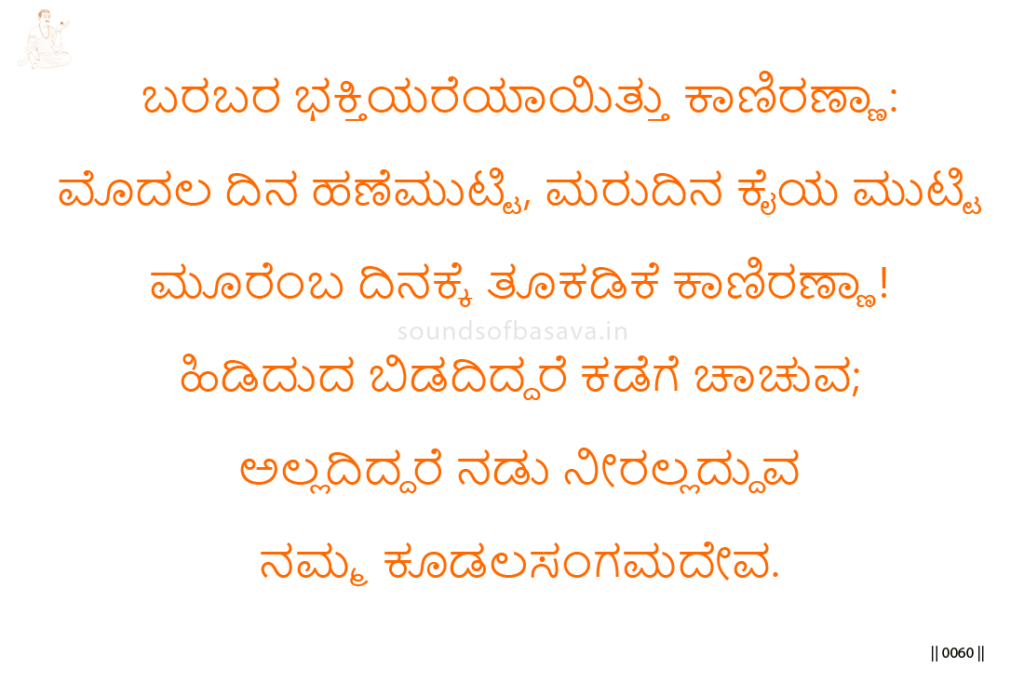
In this vachana, Basavanna shows how bhakti may begin with full bodily involvement and then gradually weaken.
On the first day, the head bows. On the second day, the hands continue. By the third day, the eyes grow heavy. The sequence points directly to the condition of practice: reverence begins, ritual action continues, but the gaze loses wakefulness.
This is especially important for Lingayoga. The seeker may sit before the Linga, continue the hand movements, and maintain the outer form, yet if the eyes and awareness become dull, the living center of practice is lost. Basavanna therefore gives the image of crossing water. If one holds firmly, the crossing is possible; if not, one is swept away in midstream.
Imagery & Symbolic Relevance
The bowed head shows the first force of devotion. The whole person bends before the Linga in humility and reverence.
The continuing hands show outward practice still remaining. Worship has not stopped, but it has begun to narrow into action.
The heavy eyes are the decisive image. In Lingayoga, the eyes are not incidental. The gaze before the Linga carries attention, steadiness, and inward alertness.
When the eyes grow heavy, the problem is not only physical sleep. It is the weakening of drishti. The seeing no longer holds the mind firmly before the Linga.
Basavanna’s sequence therefore shows the decline of practice from living reverence to mechanical action and then to dull awareness.
The stream-crossing image completes the warning. The seeker has entered the path but has not yet reached the far shore. In the middle, firmness is required. If the hold remains, the crossing is made; if the hold fails, the current carries the seeker away.
Lingayoga
This vachana is a practical instruction for Lingayoga.
In Lingayoga, the practitioner sits before the Ishtalinga with body, hand, eye, breath, and awareness gathered into one field. The head may bow in reverence, and the hands may perform worship, but the practice becomes alive through steady seeing.
Drishti is therefore central. The eye must remain awake before the Linga so that the mind does not scatter, sink, or become dull. Trataka-like steadiness sharpens this discipline by holding the gaze without wandering.
The warning about drooping eyes should be read as a warning about loss of inner wakefulness. Once the gaze weakens, the mind begins to drift away from the Linga even though the body may still appear to be practicing.
The instruction is to hold firmly. In Lingayoga, this means holding the gaze, holding remembrance, holding awareness, and holding the living relation between Anga and Linga until the crossing becomes possible.
Editorial Commentary
This vachana should not be read merely as a general warning against laziness.
Basavanna is pointing to the practical discipline by which bhakti is sustained: the body bows, the hands serve, the eyes remain awake, and the mind holds to the Linga without slipping.
Related Vachana
Supporting Vachana
Vachana 212 — The Double-Edged Blade
Vachana 212 shows that bhakti is sharp and demanding. Vachana 220 continues by showing how that bhakti must be guarded in practice, especially through wakeful seeing and firm holding before the Linga.
Advancing Vachana
Maheshwara Vachana 45 — The One and the Many
Vachana 220 warns that devotion can weaken from bowed head to continuing hands and then to heavy eyes. Maheshwara Vachana 45 advances this into the lamp in the wind, where the flame of awareness must be protected from disturbance. What is taught here as steady drishti in Lingayoga becomes, in the next movement, the guarding of inner light before Kudalasangama Deva.
