
Summary
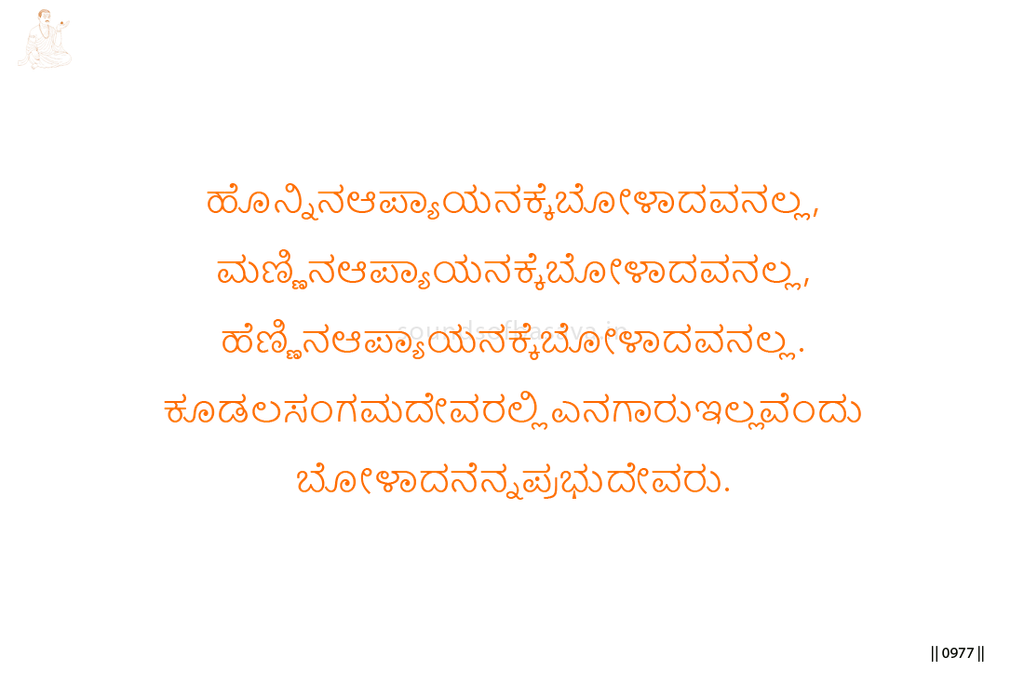
Basavanna says that true emptiness is not caused by the loss of gold, land, or sensual attachment. These may be given up outwardly, yet the deeper sense of possession may still remain. The real emptiness is the removal of the thought that anything belongs to the self apart from Kudalasangama Deva.
The vachana therefore moves from outer renunciation to inward non-possession. Prabhudeva has emptied Basavanna not merely of objects, but of ownership itself. Nothing remains as “mine” before Kudalasangama Deva.
Imagery & Symbolic Relevance
The first image is gold. Gold represents wealth, attraction, security, and the glittering power of possession. Basavanna says he is not emptied merely by being separated from gold.
The second image is land. Land represents grounded possession, status, inheritance, and worldly claim. Losing land may remove outer ownership, but it does not by itself remove the owner-making mind.
The third image is woman. This should be read as sensual and relational attachment, not as contempt toward women. Basavanna names the field of desire and emotional possessiveness, showing that even release from such attachment is not yet the deepest emptiness.
The fourth image is being emptied in Kudalasangama Deva. This emptiness is not poverty or lack. It is inner spaciousness created when the claim of “mine” has been removed.
The final image is Prabhudeva as the one who emptied him. Prabhudeva’s grace does not merely take away external objects. It removes the root-thought that anything exists for Basavanna as personal possession apart from Kudalasangama Deva.
Lingayoga
In Lingayoga, this vachana teaches that renunciation must reach the sense of ownership. Gold, land, and desire may be given up outwardly, but the path is incomplete if the mind still says “mine.”
For Sharana Sthala, the practice-point is direct: do not mistake external loss for spiritual emptiness. Let the thought of possession itself be dissolved. When everything is known only in relation to Kudalasangama Deva, the Sharana becomes empty of self-claim and full of Divine belonging.
Editorial Commentary
This vachana should not be read as praise of deprivation. Basavanna is not saying that loss itself liberates. He is saying that outer loss does not equal inner freedom. The decisive transformation is the removal of the possessive thought that anything apart from Kudalasangama Deva can be called one’s own.
Related Vachana
Supporting Vachana
Pranalingi Sthala Vachana 1272 — Established in Prāṇa-Linga
Pranalingi Vachana 1272 supports this teaching by showing Chennabasavanna established in Prāṇa-Linga and abiding in Prasada. There, nothing is touched, received, used, or enjoyed unless it has first become Lingārpita; nothing enters life as private possession. This prepares Vachana 1413 directly. In Vachana 1272, receiving itself is freed from ownership through offering to Linga; in Vachana 1413, Basavanna shows the Sharana form of that freedom by declaring that Prabhudeva has emptied him of the thought that anything apart from Kudalasangama Deva belongs to him.
Advancing Vachana
Aikya Sthala Vachana 960 — Inner and Outer, Self and World: One Alone
Aikya Vachana 960 advances this teaching by carrying non-possession into complete indivisible recognition. In Sharana Vachana 1413, Basavanna is emptied of the claim that gold, land, desire, or anything else can be called his own apart from Kudalasangama Deva. In Aikya Vachana 960, inner and outer, self and world are seen as one, and Kudalasangama Deva alone is the primal ground beyond all subtle origins. Thus the Sharana-stage dissolution of ownership advances into Aikya as the state where nothing stands apart to be possessed.
