

Summary
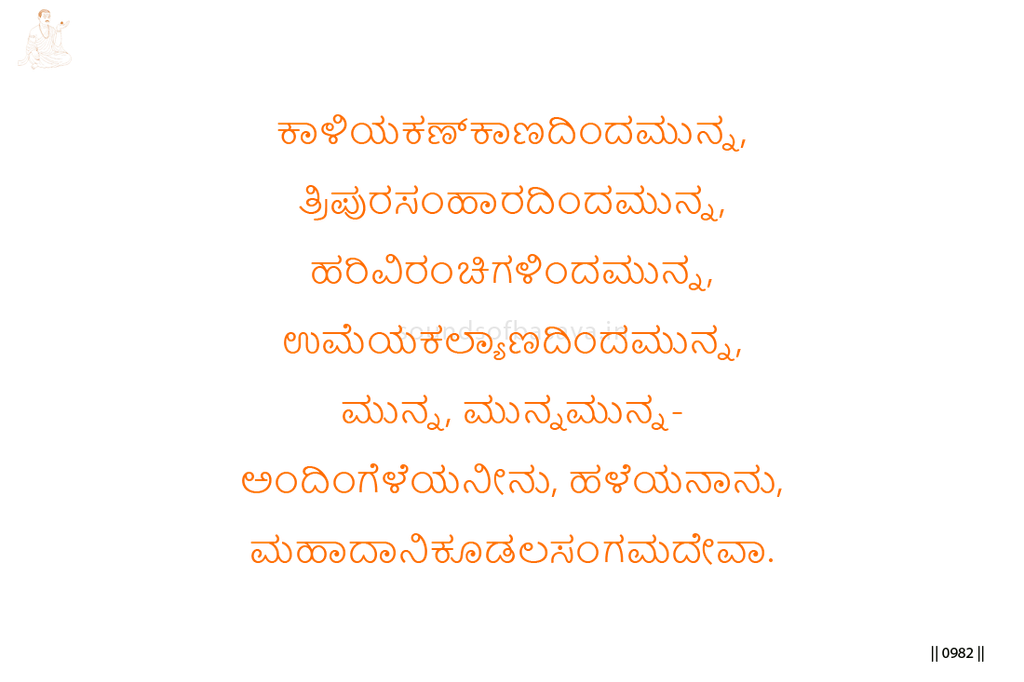
Basavanna places Kudalasangama Deva before all beginnings: before the primal waters, before Tripura’s destruction, before Hari and Brahma, and before the union of Umā. The repeated “before” removes creation, divine function, form, relation, and sequence as points of reference. What remains is the beginningless presence of Kudalasangama Deva.
The speaker’s declaration that he too is ancient does not present an ordinary individual ego as old. It shows the Aikya recognition in which Anga is no longer seen as separate from Linga. The source states that Anga and Linga are not newly joined here; they are recognized as never separate.
This vachana therefore stands as a direct Aikya teaching. Kudalasangama Deva is not approached as a distant goal, but revealed as the beginningless ground before even the idea of beginning arises.
Imagery & Symbolic Relevance
The repeated image of “before” governs the whole vachana. Basavanna does not move forward through a sequence; he moves behind every sequence. Each reference is placed after Kudalasangama Deva’s prior presence.
The primal waters indicate the earliest imagined field of arising. By placing Kudalasangama Deva before them, the vachana removes even the first possibility of creation as the final ground.
Tripura’s destruction refers to divine action. By placing Kudalasangama Deva before that act, the vachana shows that the Lord is not limited to the role of destroyer or actor within cosmic events.
Hari and Brahma represent differentiated divine functions. By placing Kudalasangama Deva before them, Basavanna points to a presence prior to preservation, creation, and all functional distinction.
Umā’s union is also placed after this prior presence. The image therefore reaches beyond relation itself. Before union, before form, before divine function, and before time, Kudalasangama Deva is.
The final movement, “You were; I was ancient,” completes the imagery. The source clarifies that this “I” is not the separate individual, but the same presence recognizing itself without division. The image is therefore not personal antiquity, but Aikya recognition.
Lingayoga
In Lingayoga, this vachana marks the point where practice cannot be described as movement toward the Linga. The source states that Anga does not turn inward as a movement, but stands as that which was never apart from Linga. Arivu is not newly arising; it is recognized as prior to all knowing.
Achara, Kayaka, and Dasoha do not take active form here because the vachana stands before the field of action, offering, relation, and distinction. The Jangama is not encountered as another presence, because no other has yet emerged in the vachana’s vision.
The practice-relevance is therefore restrained: this is not attainment through effort, but unveiling. The seeker is brought to the recognition that origin is not found in time, and that Kudalasangama Deva is the beginningless ground in which Anga and Linga were never separate.
Editorial Commentary
This vachana should be read as a source-bound Aikya statement, not as ordinary self-assertion. The “ancient I” is meaningful only within the source’s clarification that the separate individual is not being praised. Basavanna is pointing to the recognition in which the distinction between seeker and beginningless Linga no longer stands.
Related Vachana
Supporting Vachana
Sharana Sthala Vachana 3 — The Divine Vehicles
Sharana Vachana 3 supports this Aikya vachana by preparing the surrender of independent identity. There, the self has no separate role apart from Kudalasangama Deva: when the Lord is formless, the speaker is knowledge; when He dances, the speaker is consciousness; when He takes form, the speaker becomes the bull; and when He comes as Jangama, the speaker becomes servant. The Sharana teaching is that the self does not define itself, possess its function, or stand apart, but becomes available to Kudalasangama Deva. This prepares Vachana 2, where even responsive identity is surpassed and Anga is recognized as never separate from the beginningless Linga.
Advancing Vachana
Aikya Sthala Vachana 4 — The Seven Becomings
Aikya Vachana 4 advances this teaching within Aikya Sthala itself. In Vachana 2, the timeless ground is revealed before all beginnings. In Vachana 4, that timeless ground is expressed through successive becomings, where the Anga does not arise by its own movement but is shaped, named, held, and dissolved through Kudalasangama Deva’s will. The source directly links Vachana 2 to Vachana 4 by stating that the timeless ground of Vachana 2 is expressed in Vachana 4 through successive dissolving becomings.
