

Summary
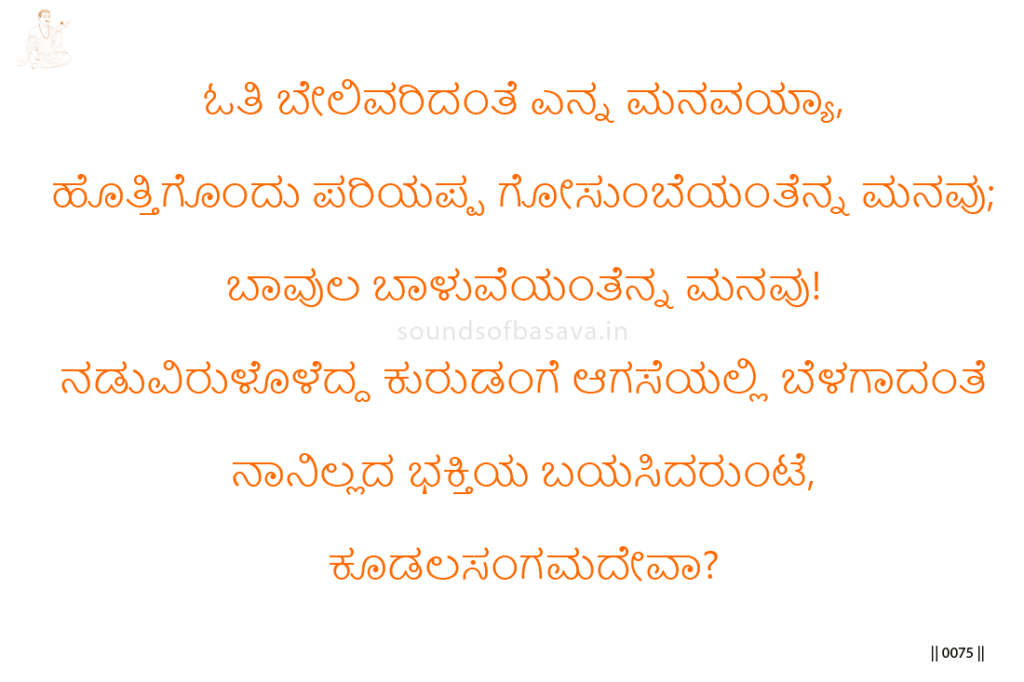
In this vachana, Basavanna confesses the instability of his mind before Kudalasangama Deva.
The mind is like the Othi, the colored tree-lizard, changing its hue according to where it rests. It is like a restless, shifting creature and like the life of a bat, moving without clear daylight.
He then gives the strongest image: a blind man in the middle of night imagining dawn. If such is the condition of the mind, how can true bhakti arise? The vachana exposes imagined light without real seeing.
Imagery & Symbolic Relevance
The Othi, or Othikattu, is the first image. This colored tree-lizard changes according to its surroundings. Basavanna uses it to show a mind that takes the color of circumstance instead of remaining steady in truth.
The next image continues the same instability. The mind moves from one condition to another without settled clarity. It adapts, shifts, and becomes shaped by what it touches.
The bat-like life adds the sense of darkness. A bat does not live in clear daylight; it moves in dimness and uncertainty. This shows a mind that has not entered open awareness.
The blind man at midnight is the most severe image. Blindness already removes sight; midnight removes outer light as well. If such a person imagines dawn, that imagined brightness is not true seeing.
Basavanna therefore questions his own bhakti. If the mind is color-changing, darkened, and self-deceived, how can living devotion be born without the grace of Kudalasangama Deva?
Lingayoga
In Lingayoga, the mind must stop taking the color of every passing condition.
The Anga may sit before the Linga, but if the mind shifts like the Othi and moves in dimness like the bat, drishti cannot deepen.
The image of the blind man at midnight warns against imagined illumination. A mental picture of light is not awakened seeing.
Practice matures when the gaze, mind, and awareness become steady enough to receive real light before Kudalasangama Deva.
Editorial Commentary
This vachana is a confession of unstable perception.
Basavanna does not trust a mind that changes color with circumstance and imagines dawn while still unable to see.
Related Vachana
Supporting Vachana
Vachana 281 — The Warrior of Straw
Vachana 281 exposes outer spiritual appearance without inner life. Vachana 288 continues inwardly by showing that the mind itself may remain shifting, darkened, and falsely luminous.
Advancing Vachana
Maheshwara Vachana 279 — The Disciplined Heart
Vachana 288 shows the mind changing like the Othi, moving in dimness, and imagining dawn in darkness. Maheshwara Vachana 279 advances this into inner silence, where the mind’s projections must fall quiet before Kudalasangama Deva.
