

Summary
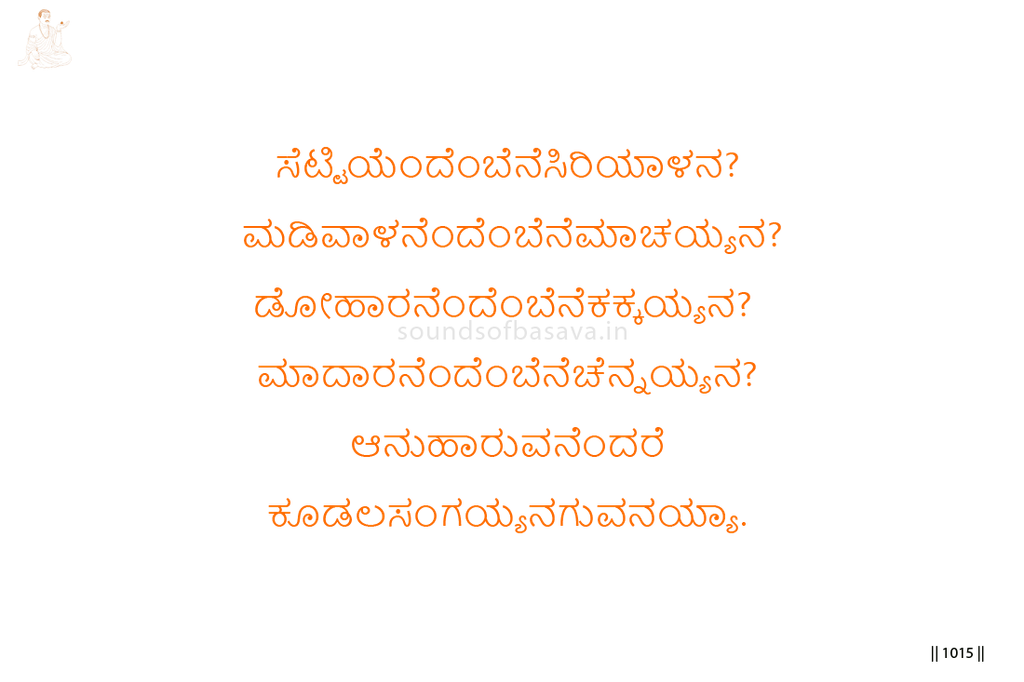
Basavanna asks whether Siriyala, Machayya, Kakkayya, and Chennayya can be reduced to caste or occupational names. Each question rejects the habit of seeing a realized Sharana through social label rather than through devotion.
The force of the vachana lies in its reversal. Basavanna does not merely criticize others for caste-thinking. He turns the test upon himself: if he says, “I am high-born,” Kudalasangama Deva laughs.
The Aikya source states that this vachana exposes caste identity as absurd when placed beside lived realization. Realization alone defines stature; inherited claims to superiority become laughable before Kudalasangama Deva.
Imagery & Symbolic Relevance
The question “Shall I call Siriyala a Setti?” gives the first image. Siriyala cannot be contained within the label of merchant or caste-identity. His devotion and surrender make the social label inadequate.
The question “Shall I call Machayya a washerman?” gives the second image. Machayya may be named through an occupation by society, but Basavanna refuses to let the occupation become the measure of the person. The Aikya source explains that true cleansing here is not cloth, but consciousness.
The question “Shall I call Kakkayya a Dohara?” gives the third image. Kakkayya is associated with leatherwork, a field judged by society through impurity. Basavanna overturns that judgment by placing realization above material association. Purity is not decided by the work named from outside.
The question “Shall I call Chennayya a Madara?” gives the fourth image. Chennayya too cannot be reduced to an inherited or occupational category. His life as Sharana exceeds the label imposed upon him.
The four names together form a living argument. Basavanna does not make an abstract statement first. He places realized lives before us and asks whether any social label can contain them.
The final line turns the teaching inward: “If I say I am high-born, Kudalasangayya laughs.” Basavanna does not merely defend the dignity of others; he exposes the absurdity of his own possible pride.
The laughter of Kudalasangama Deva is divine exposure. Before the Lord, caste-pride is not only false; it is ridiculous because it mistakes birth for realization.
Together, the lines dismantle caste-labeling from both sides. One must not reduce the Sharanas to caste names, and one must not raise oneself through birth-name. Both errors collapse before Kudalasangama Deva.
Lingayoga
In Lingayoga, this vachana teaches that the seeker must stop measuring spiritual worth through birth, occupation, social rank, or inherited identity.
The practice-point is direct: see the Sharana through devotion, not through caste-name. See oneself also without birth-pride. The source states that once divine realization manifests, social labels become spiritually meaningless.
This is not merely social correction; it is inner purification. The mind that labels another by caste and the mind that claims superiority through birth are both still divided. Before Kudalasangama Deva, both must fall.
Editorial Commentary
This vachana should be read as a sharp correction of caste-pride. Basavanna’s method is exact: he first shows how inadequate it is to reduce realized Sharanas to social labels, then shows that his own claim to high birth would be equally empty before Kudalasangama Deva.
The final laughter should remain close to the source. It is not casual humor; it is the Lord’s exposure of spiritual falsehood. Birth-pride cannot stand where realized devotion is the true measure.
Related Vachana
Supporting Vachana
Sharana Sthala Vachana 589 — The Lineage of Realization
Sharana Vachana 589 supports this Aikya vachana by rejecting birth-based worth. There, Basavanna names revered figures whose greatness cannot be confined by caste-origin and asks why one should speak of caste or boast of birth. The final declaration says that even one called Shvapacha is truly Kulaja if that person is a Shiva-bhakta.
Aikya Vachana 345 carries this same teaching into sharper self-examination. In Sharana Vachana 589, devotion to Shiva becomes the true lineage. In Aikya Vachana 345, Basavanna shows the error of calling realized Sharanas by caste labels and the equal error of calling oneself high-born before Kudalasangama Deva.
Advancing Vachana
Aikya Sthala Vachana 1064 — Beyond the Threefold Impurity
Aikya Vachana 1064 advances this teaching within Aikya Sthala. In Vachana 345, caste labels are exposed as spiritually empty before realized devotion. In Vachana 1064, this movement reaches a fuller Aikya condition: when Shiva-bhakti itself has become the body and the worshipper has attained Linga-Aikya, former caste, former stage of life, and ritual impurity no longer apply.
Thus Vachana 345 breaks the authority of caste through Kudalasangama Deva’s laughter, while Vachana 1064 shows the state in which such distinctions have lost all ground. Caste-pride gives way to complete freedom from inherited classification before Kudalasangama Deva.
