Poetic Rendering

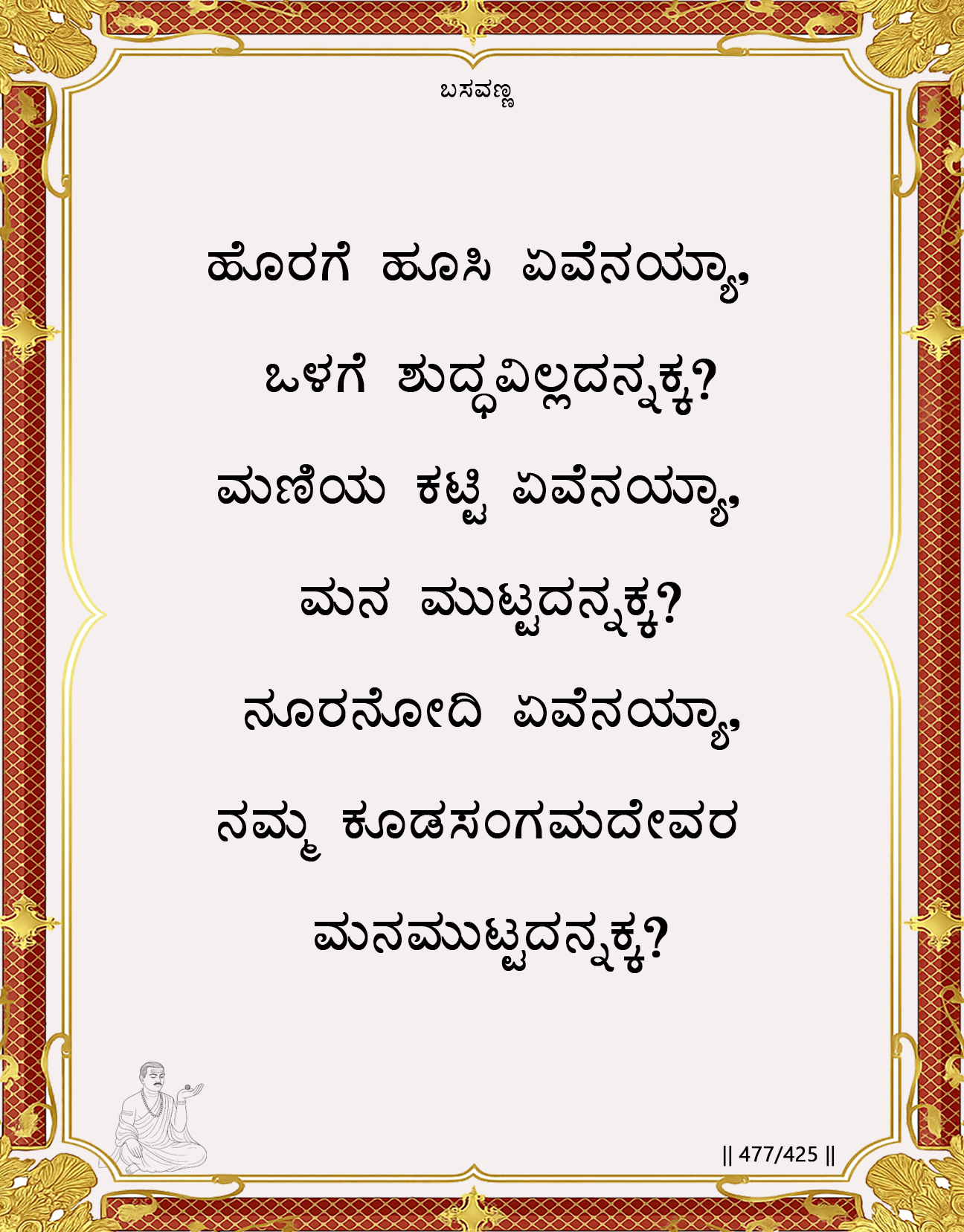
What use is whitewash outside, if the inside is unclean?
What use is the Linga around the neck, if the heart does not shine?
What use is reading a hundred texts,
if Koodalasangama’s truth does not touch the soul?
The Primacy of Inner Transformation. This vachana is a powerful and concise critique of spiritual hypocrisy and empty ritualism. Basavanna systematically dismantles the three pillars of external religiosity: pious appearance, sacred symbols, and scholarly knowledge. He declares that without an inner, transformative realization, these externalities are not just useless they are a deception, a “whitewash” that hides inner decay. In the Liṅgāyata Darśana, where the goal is the direct experience (Anubhava) of the Divine within (Liṅga), this vachana serves as the ultimate criterion for authentic spirituality. It is a call to move from performance to essence, from the outer shell to the inner sanctum of the heart.
Spiritual Context
Core Spiritual Principle: Antahkarana Shuddhi – The Primacy of Inner Instrument Purification. The heart-mind (antahkarana) is the sole locus of transformation. All external practices (bahya kriya)conduct, ritual, study are valid only as tools for this inner purification. When treated as ends in themselves, they become spiritual obstacles, reinforcing the ego’s sophistication.
Cosmic Reality Perspective: In Shiva-Shakti non-duality, Shakti as manifestation (the outer form, the ritual, the text) exists solely to lead back to Shiva as pure consciousness (the inner truth). To become attached to Shakti’s forms while ignoring her essential movement toward Shiva is to worship the reflection and deny the light. True practice uses the form to transcend the form.
Historical Reality (Anubhava Mantapa Context): This was Basavanna’s direct challenge to the religious establishment of his day, which prioritized Vedic ritual purity, caste-based eligibility, and scholarly pedantry. It established the Lingayoga path as one of anubhava (experiential realization) over agamika (scriptural dogma). It empowered the common devotee to validate their spirituality by their inner state, not by external approval.
Interpretation
The “whitewash” is the ego’s most basic strategy: presenting a virtuous facade (sattvic ahamkara) to the world while inner impurities (mala) remain unaddressed. The “Linga around the neck” represents the ultimate spiritual symbol rendered inert by lack of bhava (feeling, essence). It highlights the danger of the sacred becoming mundane through mechanical habit. The “hundred texts” symbolize the intellect’s capacity to build a sophisticated fortress of concepts that actually protects the ego from the vulnerable, direct encounter with truth (“touch the soul”).
Practical Implications: Constant self-auditing is required. One must ask: “Is my practice softening my heart, quieting my mind, and exposing my hidden faults? Or is it bolstering my self-image as a ‘spiritual person’?” The measure of practice is its fruit in character, not its complexity or visibility.
The Cosmic Reality
Anga (Human Dimension): The composite of inner space (“inside”), the emotional-intellectual core (“heart”), and the seat of consciousness (“soul”). In its impure state, it is a chamber of mirrors (ego), but it is designed to become a transparent window to the Divine.
Linga (Divine Principle): Koodalasangamadeva as the illuminating truth-consciousness. It is not an object “around the neck” but the subject within the heart. Its “truth” is the direct knowing of non-dual reality, which cannot be read about but must be intimately “touched.”
Jangama (Dynamic Interaction): The Jangama is the alchemical process where the outer practice successfully catalyzes inner change. It is the moment the ritual ignites devotion, the symbol triggers remembrance, or the scripture sparks insight. Without this dynamic interaction, the triad is disconnected: a decorated Anga, a distant Linga, and a stagnant, non-bridging Jangama.
Shata Sthala
Primary Sthala: Bhakta. This vachana is the supreme instruction for the Bhakta. It warns that devotion can be falsified by focusing on its expressions rather than its essence. True Bhakti is the “shining heart” and the “soul touched by truth,” a state of inner yielding and love that precedes and validates all external action.
Supporting Sthala: Maheshwara. The stage of Maheshwara involves righteous action and duty. This vachana prevents that stage from degenerating into empty ritualism. It insists that the discipline of Maheshwara (wearing the Linga, studying texts, maintaining conduct) must be fueled by the inner aspiration of the Bhakta, or it becomes a dead structure.
Practical Integration
Arivu (Awareness Practices): Prioritize practices that cultivate inner seeing: meditation, silent self-inquiry, and contemplative walks. Before any external ritual, pause to connect with the inner feeling. Let arivu be the foundation that gives life to achara.
Achara (Personal Discipline): Simplify your external disciplines to those that genuinely support inner stillness and integrity. The test of a good discipline is whether it makes you more honest, compassionate, and less self-absorbed, not whether it appears impressive.
Kayaka (Sacred Action): Let your work be a field for inner purification. Observe your motivations, reactions, and attachments during labor. The sacredness of kayaka lies in this inner scrutiny and offering, not in the job title.
Dasoha (Communal Offering): Offer the gift of authentic presence, not just correct words or actions. In community, foster an environment where people can share their inner struggles without fear of judgment, valuing heart-to-heart connection over doctrinal debate.
Modern Application
We live in an age of spiritual consumerism and performance: curated meditation apps, designer meditation cushions, Instagram-worthy yoga poses, and deep knowledge of philosophies without a trace of humility or kindness. The “whitewash” is our personal brand of wellness; the “unilluminated Linga” is wearing spiritual symbols as fashion; the “hundred texts” are the podcasts and books consumed without integration.
This vachana liberates by cutting through the overwhelming noise of spiritual options. It provides a single, uncompromising criterion: Does this practice change me from the inside out? It grants permission to drop complex routines that don’t serve inner peace and to find the profound in simple, sincere attention. It solves spiritual anxiety by redirecting focus from “am I doing it right?” to “is my heart becoming right?”
Essence
A palace built for all to see,
With crumbling walls of vanity.
A lantern carried in the night,
Whose keeper has no inner light.
A library of holy lore,
Outside a locked and bolted door.
The work begins where none can gaze
To clean the heart, to shift the blaze.
This vachana describes the metaphysics of spiritual coherence versus decoherence. External practice without inner realization creates a decoherent state: the wave function of the seeker’s identity splits into a public “spiritual” persona and a private, unchanged self. These states cannot superpose; they create existential dissonance. True practice is the measurement (the conscious observation) that collapses the wave function into a single, coherent state of integrity, where the inner and outer are one expression of awakened consciousness.
You can paint a schoolhouse wall (external practice), but if you don’t send the children to class (inner work), they remain uneducated. The painting is for the parents’ pride; the education transforms the child. Stop admiring the paint job. Go inside and learn.
We fear the vulnerability of looking within at our own mess, so we focus on perfecting the exterior our behavior, our knowledge, our spiritual resume. This vachana reveals that this fear is the very wall we must break down. The inner sanctum may seem dark and chaotic at first, but it is the only place where the true, enduring light can be kindled. The outside is just borrowed light.

Views: 4