

Summary
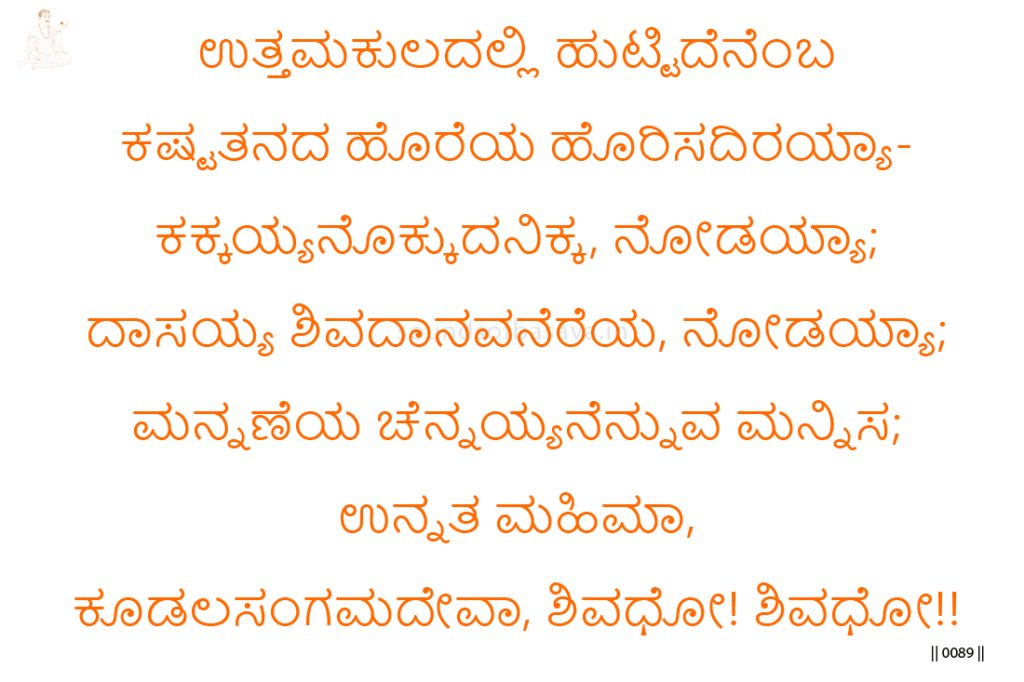
In this vachana, Basavanna asks Kudalasangama Deva not to burden him with the pride of having been born in a so-called noble family.
Birth, lineage, and social rank are not spiritual attainment. If they create superiority, they become an obstacle to seeing the greatness of the Sharanas.
He turns toward Kakkayya, Dāsayya, and Chennayya as living measures of devotion. Before such Sharanas, inherited status loses its authority. The vachana teaches that true nobility belongs to realized devotion, not to birth.
Imagery & Symbolic Relevance
The burden of noble birth is the opening image. Basavanna does not treat high birth as a spiritual advantage. He sees it as a weight if it produces pride.
This is why he asks Kudalasangama Deva not to place that burden upon him. The danger is inward: caste-pride can prevent the seeker from recognizing truth when it appears outside inherited status.
Kakkayya represents devotion made real through life, labor, and surrender. Dāsayya represents service and offering transformed into Shiva-dāna. Chennayya represents the dignity of the Sharana beyond social ranking.
Basavanna asks that these Sharanas be seen properly. Their greatness is not dependent on the world’s measure of caste or family. It arises from their relation to Kudalasangama Deva.
The cry “Shiva! Shiva!” marks the collapse of birth-pride before living bhakti. Once the Sharanas are seen as they are, social superiority becomes spiritually empty.
Lingayoga
In Lingayoga, the Anga must be freed from inherited self-importance.
The body may be born into a certain family, caste, or social order, but awareness must not be bound by that identity.
Linga does not awaken through birth-pride. Jangama cannot be recognized if the seeker looks through social hierarchy.
Practice matures when the seeker bows to realized presence wherever it appears. The Sharanas become the corrective field that breaks false superiority and turns the Anga toward true humility.
Editorial Commentary
This vachana rejects birth as a measure of spiritual worth.
Basavanna does not ask to be honored for noble birth; he asks to be freed from the arrogance that prevents him from seeing the nobility of the Sharanas.
Related Vachana
Supporting Vachana
Vachana 333 — The Unripe Seed
Vachana 333 shows the seeker unable to claim true bhakti before Kudalasangama Deva’s Sharanas. Vachana 344 continues this humility by showing that even noble birth gives no authority before realized Sharanas such as Kakkayya, Dāsayya, and Chennayya.
Advancing Vachana
Maheshwara Vachana 433 — The Robe Without Inquiry
Vachana 344 removes birth-pride and places true nobility in lived devotion. Maheshwara Vachana 433 advances this into the robe without inquiry, where outward identity is tested more sharply before Kudalasangama Deva.
