
Summary
In this vachana, Basavanna remembers those whom Kudalasangama Deva has already blessed.
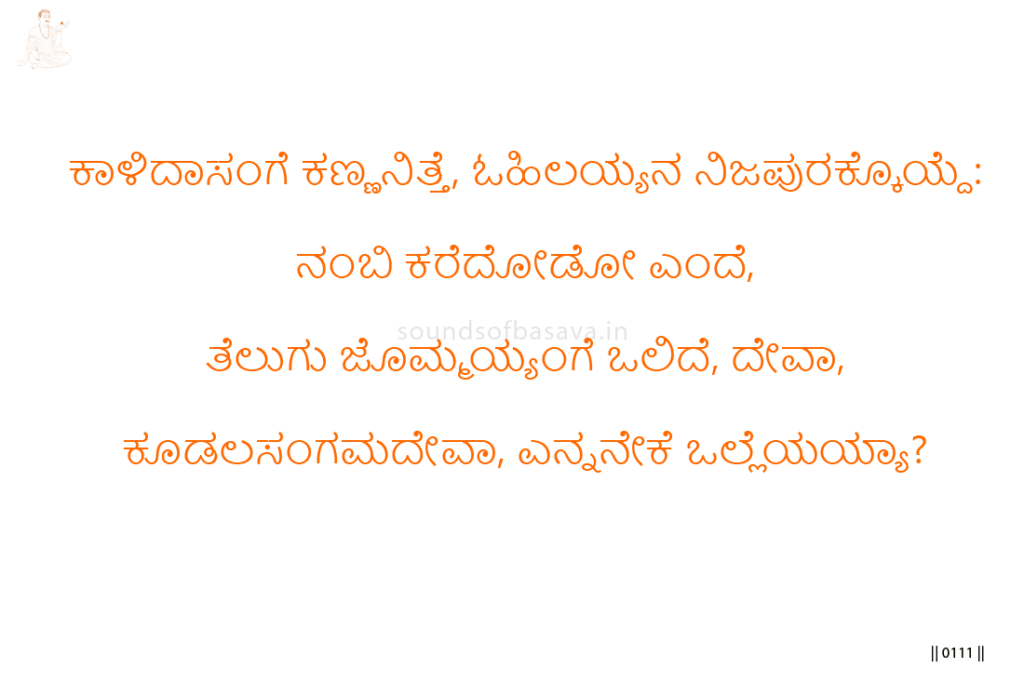
To Kalidasa, the eye was opened. To Ohilayya, the true dwelling was given. When Nambi called in trust, and when Telugu Jommayya called, the Lord responded with grace.
Basavanna then turns the remembrance into a question: if You received them, why do You not receive me? The vachana teaches longing through remembered grace. The seeker does not doubt the Lord’s compassion; he asks to be included in the same current of grace.
Imagery & Symbolic Relevance
Kalidasa represents opened sight. The eye that was closed is made capable of seeing.
Ohilayya represents entry into the true dwelling. This suggests being brought into the right place, the true belonging, and the inner home of devotion.
Nambi represents trusted calling. The one who calls with trust is heard.
Telugu Jommayya represents another life received by grace. Basavanna recalls him as one toward whom Kudalasangama Deva turned with favor.
These names function as witnesses. They show that grace has already moved in the lives of devotees.
Basavanna’s question arises from that memory. He does not accuse Kudalasangama Deva; he pleads from the evidence of the Lord’s own compassion.
The final question carries both humility and pain. “Why do You not receive me?” is the cry of one who knows grace is real, yet still feels outside its embrace.
Lingayoga
In Lingayoga, remembrance of the Sharanas and earlier devotees strengthens longing.
The seeker does not walk by isolated effort alone. He remembers those whose eyes were opened, whose trust was answered, and whose lives were received.
Such remembrance prevents despair. If grace has touched others, the seeker can turn that memory into prayer.
Practice matures when remembered grace becomes present longing before Kudalasangama Deva.
Editorial Commentary
This vachana is a prayer of inclusion.
Basavanna does not claim entitlement. He remembers the Lord’s grace toward others and asks why that same grace has not yet drawn him near.
Related Vachana
Supporting Vachana
Vachana 516 — The Newborn Child
Vachana 516 shows devotion as the newborn cry for nearness. Vachana 518 continues that cry in a conscious form: Basavanna remembers those already received by Kudalasangama Deva and asks why he remains apart.
Advancing Vachana
Maheshwara Vachana 520 — The Agitation Within
Vachana 518 asks why the seeker is still kept apart from Kudalasangama Deva’s grace. Maheshwara Vachana 520 advances this into undivided awareness, where the sense of separation begins to yield before fuller recognition.
