

Summary
Once people have come together without regard to caste, self-asserted distinction, or social standing, there can be no search for greater and lesser among them.
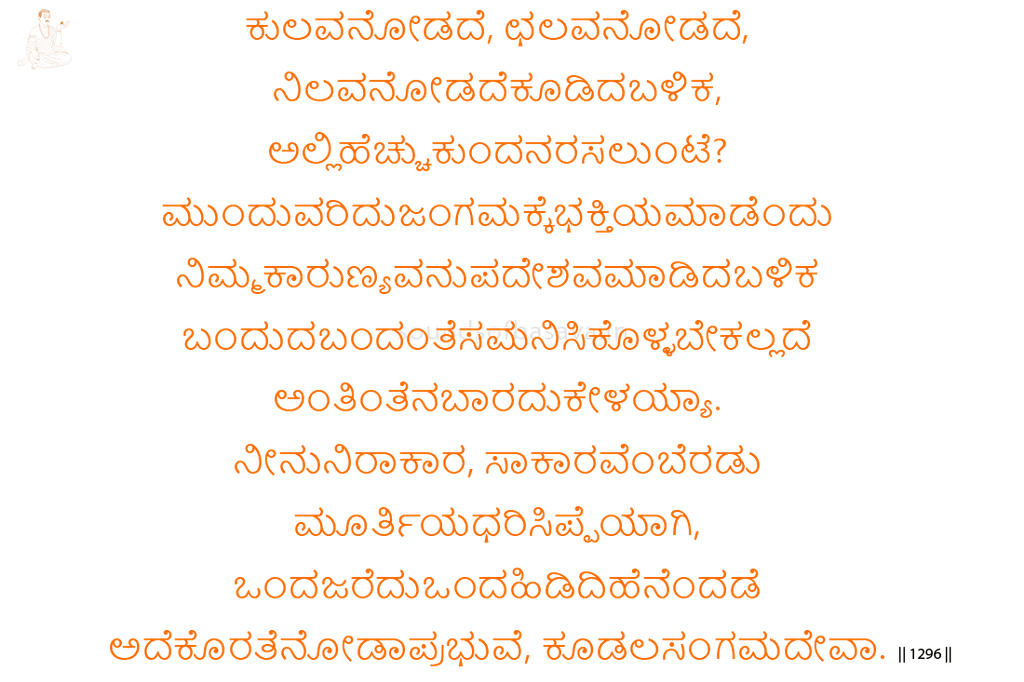
Kudalasangama Deva’s grace instructs Basavanna to advance and offer Bhakti to the Jangama. Those who come must therefore be received equally, without dividing them as “this one” and “that one.”
The Lord bears both the formless and formed modes. To reject one while holding to the other is itself a deficiency.
Imagery & Symbolic Relevance
The vachana first removes three grounds of distinction: caste, self-asserted status, and standing. These are the measures through which people ordinarily separate, rank, and judge one another.
Once such measures have been left aside and people have joined together, the question of greater and lesser loses its basis. Sacred fellowship cannot be formed without distinction and then governed again by hierarchy.
The movement then turns specifically toward the Jangama. Kudalasangama Deva, through His compassion, instructs Basavanna to go forward and offer Bhakti to the Jangama. Devotion to the Jangama is therefore not a social courtesy or optional addition; it arises from the Lord’s instruction.
Those who come must be received “as they come” and held in equal regard. Basavanna must not begin classifying them after receiving the command to serve the Jangama. The expressions “this one” and “that one” indicate renewed separation based on preference, background, appearance, or rank.
The final movement reveals the ground of this equal reception. Kudalasangama Deva bears both nirākāra, the formless, and sākāra, the formed. These are not two competing deities or opposing Divine realities.
Basavanna therefore says that rejecting one and holding only the other would itself be a deficiency. Exclusive attachment to the formless while refusing the formed presence, or attachment to form while denying the formless, divides what the Lord bears together.
The vachana thus joins social equality, devotion to Jangama, and complete recognition of Kudalasangama Deva. The refusal to rank people and the refusal to divide form from formlessness arise from the same discipline of undivided seeing.
Lingayoga
In Lingayoga, devotion to Linga must become equal and compassionate reception of Jangama. The practitioner cannot profess Divine non-division while continuing to measure those who come by caste, status, appearance, or standing.
The formed and formless modes of Kudalasangama Deva must both be honoured. The inward recognition of the formless cannot be used to dismiss the living Jangama, and outward worship of form cannot exclude the Lord’s formless presence.
The practical movement is therefore direct: receive without hierarchy, serve the Jangama through Bhakti, and do not divide the two modes borne by the Lord.
Editorial Commentary
Kula refers to caste or inherited social identity. Chala carries the sense of fixed insistence or self-asserted distinction, which here functions as pretension or partisan status. Nilavu refers to position, standing, or established rank.
Bandudu bandante samanisi koḷḷabēku means that those who come must be received as they come and regarded equally. The phrase does not permit renewed classification after the Lord has instructed devotion to Jangama.
Nirākāra and sākāra are the formless and formed modes borne by Kudalasangama Deva. Rejecting either one produces the incompleteness named in the conclusion.
Prabhuve means “O Lord” and directly addresses Kudalasangama Deva.
Related Vachana
Supporting Vachana
Sharana Sthala Vachana 1152 — Beyond the Vanity of Caste
Sharana Vachana 1152 asks where caste or lineage can be found in a body made of bones, covered by skin, and held together by nerves. Bathing may cleanse bodily dirt, but it does not remove caste-consciousness, and outward religious appearance cannot create inward purity. Such pretension does not please Kudalasangama Deva.
This prepares Vachana 1153 by removing the bodily and social basis of inherited superiority. Vachana 1152 exposes caste-pride as an imposed falsehood; Vachana 1153 carries that correction into lived fellowship. Once caste, pretension, and standing are no longer considered, the Jangamas who come must be received without greater–lesser distinction.
Advancing Vachana
Aikya Sthala Vachana 1334 — Who Showed Me That Linga and Jangama Are One?
Aikya Vachana 1334 declares that Linga is Jangama and Jangama is Linga. Worship of Linga while separation remained did not remove bhava. Jangama therefore came as Mukhalinga—the living-faced Linga—gave instruction and protection, and established the recognition that Pranalinga itself is Jangama.
Vachana 1153 commands devotion to Jangama without social distinction and rejects the division between the Lord’s formless and formed modes. Vachana 1334 reveals the deeper ground of that command: Jangama is not a lesser or separate object of devotion but the living presence of Linga.
What Vachana 1153 establishes as equal reception and freedom from divided worship becomes explicit realization in Vachana 1334: Linga and Jangama are one, and Pranalinga itself is Jangama.
