

Summary
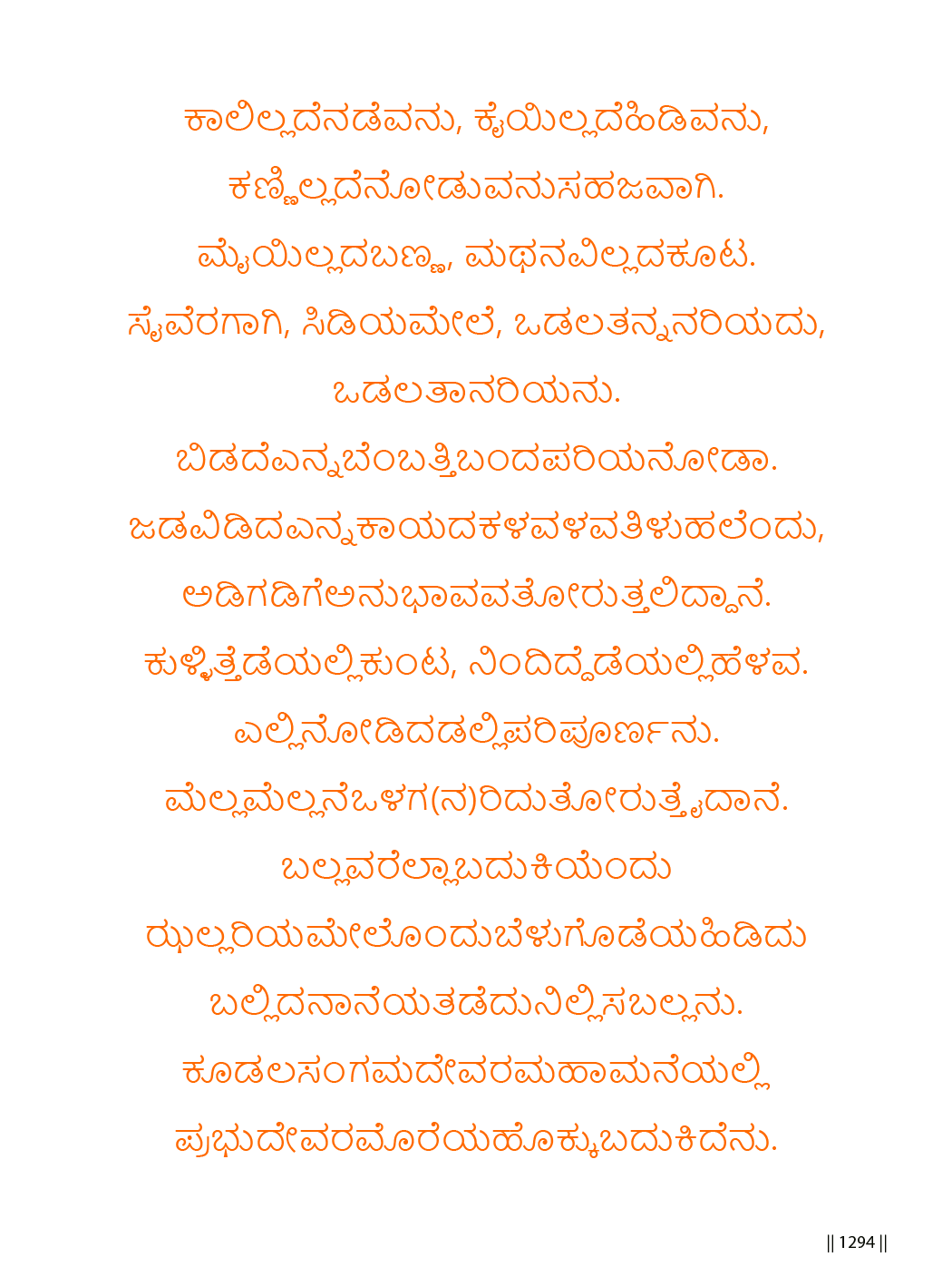
Basavanna describes the extraordinary state of Prabhudeva. He walks without dependence on feet, holds without hands, and sees without eyes. Bodily faculties do not determine his movement, action, or seeing.
Prabhudeva follows Basavanna without leaving him, reveals Anubhava step by step, and removes the confusion arising from bodily identification. Though outward bodily descriptions call him lame or disabled, wherever Basavanna looks, Prabhudeva is complete.
Basavanna therefore declares that he has truly lived by entering the protection of Prabhudeva within the Mahamane of Kudalasangama Deva.
Imagery & Symbolic Relevance
Walking without feet begins the series of paradoxes. Prabhudeva’s movement does not depend upon the ordinary bodily instrument of walking. The line does not deny his embodied appearance; it shows that bodily capacity cannot measure his realized state.
Holding without hands gives the second paradox. His power to receive, sustain, or take hold is not confined to physical grasping.
Seeing without eyes completes the opening triad. His seeing is sahaja—natural and unforced. It does not arise only through the physical eyes or deliberate observation.
The “colour without a body” presents a quality that is manifest without being confined to bodily form. Colour is recognizable, yet the body cannot be treated as its final source.
The “union without churning” shows joining without a process of forced mixing. The relation is not mechanically produced; it is already natural to the realized condition.
Prabhudeva is described as free, while the body neither knows itself nor provides the ground through which he knows himself. The body remains present, but it does not establish his identity or limit his awareness.
The statement that he followed Basavanna without leaving gives the teaching a personal movement. Prabhudeva is not presented as a distant realized figure. His presence accompanies Basavanna closely.
Basavanna’s body is described as covered by inertia and troubled by confusion. To make that bodily disturbance understood, Prabhudeva reveals Anubhava at every step. He does not offer one abstract explanation; realization is shown progressively within lived experience.
The expressions “lame where seated” and “disabled where standing” retain the vachana’s bodily paradox. Outward appearance may suggest limitation, yet the next declaration overturns that judgment: wherever Prabhudeva is seen, he is complete. Bodily measure and realized completeness do not coincide.
Prabhudeva gradually reveals the inward condition. The repeated sense of “little by little” shows patient disclosure. What cannot be grasped at once is made recognizable through continuing nearness.
The image of the white parasol, a traditional emblem of royal dignity and ceremonial authority, and the powerful elephant introduces public strength, display, and authority. The one whom bodily judgment calls limited can stop the mighty elephant. The image reverses ordinary measurement: visible power is halted by the one whose completeness does not depend upon bodily force.
The final declaration identifies the relationship governing the vachana. Basavanna enters Prabhudeva’s more—his refuge, protection, or shelter—and lives within Kudalasangama Deva’s Mahamane. Prabhudeva is the realized Sharana who reveals and protects; Kudalasangama Deva remains the Divine ground and Lord of the Mahamane.
Lingayoga
In Lingayoga, bodily faculty cannot be made the final measure of realization. Walking, holding, and seeing may occur through the body, but Anubhava is not confined to feet, hands, eyes, or physical strength.
The body’s disturbance must be understood rather than denied. Prabhudeva’s step-by-step revelation shows the function of the realized Jangama: he makes the Anga recognize where bodily identity obstructs seeing and leads it toward lived awareness of Linga.
The seeker therefore does not imitate the paradoxical actions. The practical movement is to remain under the guidance of the realized Sharana until the body is no longer mistaken for the full measure of the self.
Editorial Commentary
The grammatical movement culminates in Prabhudeva, meaning Allama Prabhudeva. The preceding actions and paradoxes describe his realized state and his continuing revelatory presence before Basavanna.
Kudalasangama Deva and Prabhudeva must remain distinct:
Kudalasangama Deva is Basavanna’s Lord and the Divine ground of the Mahamane.
Prabhudeva is the realized Sharana whose refuge Basavanna enters and through whose guidance Anubhava is disclosed.
The statements concerning lameness and bodily disability must not be treated as ridicule or as the final description of Prabhudeva. The Kannada immediately declares him complete wherever he is seen. The contrast exposes the inadequacy of judging realization by bodily appearance.
The vachana does not claim literal bodily disappearance. The body remains, but Prabhudeva neither derives his identity from it nor is confined by its apparent capacities.
Related Vachana
Supporting Vachana
Sharana Sthala Vachana 892 — Where the Mind and Body Find Their True Abode
In Sharana Vachana 892, Basavanna says that his body is drawn toward Allama and his mind toward Chennabasavanna. When body and mind are taken into the presence of these realized Sharanas, he asks where a separate “I” can continue to stand before Kudalasangama Deva.
This prepares Vachana 1149 directly. The Sharana vachana first places Basavanna’s body in relation to Allama rather than allowing it to remain self-governing. In Aikya Vachana 1149, Prabhudeva follows him, reveals Anubhava step by step, and frees understanding from bodily limitation.
What begins as the surrender of body and mind to the realized Sharanas becomes life under Prabhudeva’s protection within Kudalasangama Deva’s Mahamane.
Advancing Vachana
Aikya Sthala Vachana 1334 — Who Showed Me That Linga and Jangama Are One?
Aikya Vachana 1334 declares that Linga is Jangama and Jangama is Linga. Worship of Linga while maintaining separation did not remove bhava. The Jangama therefore came as Mukhalinga, instructed and protected Basavanna, and established the recognition that Pranalinga itself is Jangama.
Vachana 1149 presents Prabhudeva as the realized Sharana whose presence exceeds bodily limitation, accompanies Basavanna, and reveals Anubhava. Vachana 1334 makes the sacred basis of such guidance explicit: the living Jangama is not separate from Linga.
The movement is from refuge in the realized Prabhudeva to recognition of Linga–Jangama unity. What Basavanna experiences in Vachana 1149 through Prabhudeva’s protection is understood in Vachana 1334 as the living action of Pranalinga through Jangama.
