

Summary
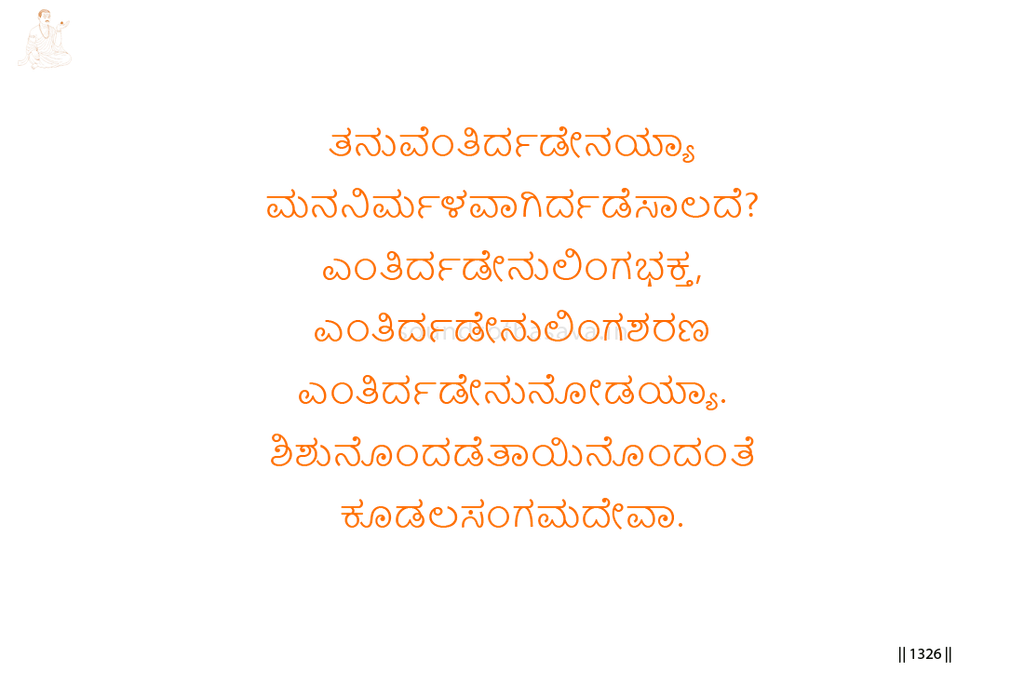
Basavanna asks what the condition of the body matters when the mind remains pure. Bodily suffering does not by itself determine spiritual truth.
Likewise, the names “Linga-bhakta” and “Linga-sharana” have no value merely as titles. The decisive measure is the inwardly unstained condition.
The concluding image reveals Kudalasangama Deva’s intimate compassion: as a mother suffers when her child suffers, the Lord does not remain apart from the devotee’s pain.
Imagery & Symbolic Relevance
The opening question concerns the condition of the body. Basavanna does not claim that the body is always free from suffering. He asks whether its changing condition can be the final measure of spiritual life.
The answer lies in the next line: if the mind is nirmala, is that not enough?
Nirmala means pure, clear, and free from stain. The mind is not ruled by resentment, possessiveness, fear, pride, or spiritual self-display. Bodily affliction may remain, but inward clarity is preserved.
The vachana then questions two identities:
Linga-bhakta;
Linga-sharana.
Basavanna asks what it matters to be called either one. The repeated question removes reliance upon religious naming. A title cannot substitute for the purity already established as the governing measure.
The movement is therefore from outer bodily condition, to inward purity, and then to the insufficiency of spiritual labels.
The final comparison introduces the child and mother. When the child suffers, the mother also suffers. The child’s pain does not remain isolated within the child.
Addressed to Kudalasangama Deva, the image presents the Lord through maternal compassion. The devotee’s suffering is known and felt within the Divine relation.
The image does not erase bodily pain. It removes the fear that the suffering devotee has been abandoned or left outside Kudalasangama Deva’s care.
Lingayoga
In Lingayoga, bodily condition and spiritual designation must not replace inward truth.
The practitioner may experience illness, exhaustion, or physical pain without allowing the mind to become stained by agitation, bitterness, pride, or despair.
The vachana also tests spiritual identity. Saying “I am a Linga-bhakta” or “I am a Linga-sharana” does not establish the condition claimed. The living measure is whether the mind remains clear before Kudalasangama Deva.
The practical movement is:
acknowledge bodily suffering without making it the whole identity;
preserve inward clarity;
release dependence upon spiritual titles;
remain assured that the Lord receives the devotee’s pain with maternal intimacy.
This is not indifference to suffering. The mother–child image reveals compassionate participation rather than detachment.
Editorial Commentary
Tanu refers to the embodied condition. The opening question gives bodily circumstance a secondary place without denying its reality.
Manavu nirmala means that the mind remains pure and unstained. Purity here is inward clarity, not bodily perfection.
“Linga-bhakta” and “Linga-sharana” are questioned as names or claims. The vachana places lived inward condition above designation.
The word nonda carries the force of suffering, hurt, or distress. The child–mother image therefore expresses shared pain, not merely outward crying.
Kudalasangama Deva is the mother in the concluding comparison, and the suffering devotee is the child held within that compassionate relation.
Related Vachana
Supporting Vachana
Sharana Sthala Vachana 19 — The Śaraṇas’ Assurance
Sharana Vachana 19 states that weariness, burden, and suffering do not disappear merely by being named. The body must bear what has come to it.
The turning point occurs when Kudalasangama Deva’s Sharanas arrive and say, “Do not fear.” The bodily condition remains, but fear loses its authority, and life is restored through their presence.
This prepares Vachana 1203 directly. Sharana Vachana 19 establishes steadiness within unavoidable suffering. Aikya Vachana 1203 carries the movement inward: bodily affliction is no longer the final measure when the mind remains pure.
The assurance of the Sharanas in Vachana 19 deepens into the mother–child relation of Vachana 1203, where the devotee’s suffering is held within Kudalasangama Deva’s compassion.
Advancing Vachana
Aikya Sthala Vachana 407 — The Living Temple
Aikya Vachana 407 begins with bodily pain and mental weariness. It then declares that the pain of the Shiva-bhakta is the pain of the Linga.
Vachana 1203 presents this relation through the child and mother: when the child suffers, the mother suffers.
Vachana 407 advances the same recognition explicitly:
bodily pain is acknowledged;
mental weariness is acknowledged;
suffering is brought to Kudalasangama Deva’s feet;
the devotee’s pain is known as the Linga’s pain.
The compassionate participation expressed through the mother-image in Vachana 1203 becomes a direct Linga–bhakta declaration in Vachana 407. Pain remains real, but it is no longer held as an isolated possession of the devotee.
