

Summary
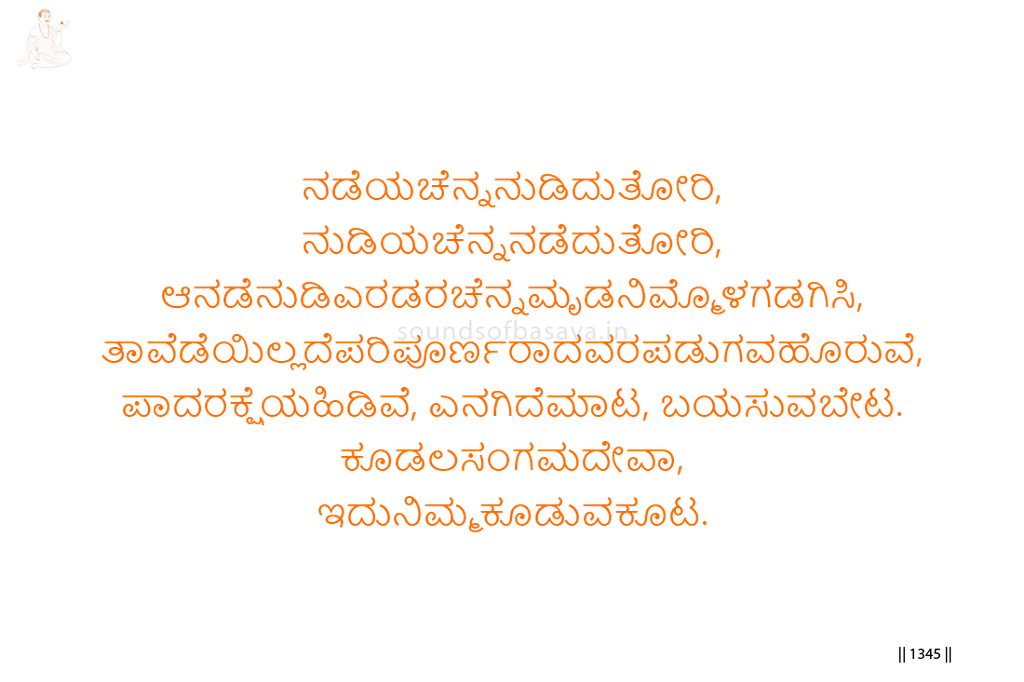
Basavanna asks that the beauty of conduct be revealed through speech and the beauty of speech through conduct.
When the beauty of both becomes manifest, it is placed within Kudalasangama Deva. Basavanna offers to carry the sandals of those who have become complete without retaining a separate place for themselves.
He seeks no other accomplishment or desired attainment. The fellowship of such complete ones is the communion through which he joins Kudalasangama Deva.
Imagery & Symbolic Relevance
The opening lines establish a reciprocal relationship:
speech must reveal the beauty of conduct;
conduct must reveal the beauty of speech.
Speech cannot remain separate from lived action, and conduct cannot contradict the truth expressed through speech.
The next line gathers both together. The beauty of naḍe and nuḍi becomes visible and is placed within Kudalasangama Deva.
The Lord is therefore not merely a witness who compares speech with conduct. He is the inward ground in whom their harmony rests.
The complete ones retain no separate place for themselves. Their speech, conduct, and inward orientation have become centred in the Lord rather than in personal distinction.
Basavanna expresses his reverence by offering to carry their sandals and hold their footwear. He does not seek equality, recognition, or rank among them. Service at their feet is sufficient.
The closing question removes further ambition. Basavanna has no other accomplishment to perform and no separate prize to seek.
The company of those whose speech and conduct are united becomes the kūṭa, the sacred fellowship that joins him with Kudalasangama Deva.
Lingayoga
In Lingayoga, speech and conduct must reveal the same inward truth.
It is insufficient to speak of Linga, surrender, Dasoha, or Aikya while conduct continues through pride, possessiveness, or self-interest. Likewise, outwardly correct conduct must not become performance without inward truth.
The movement is:
speech reveals lived conduct;
conduct verifies spoken truth;
the beauty of both is placed within Kudalasangama Deva;
separate self-position disappears;
service to the complete Sharanas becomes sacred fellowship;
that fellowship joins the seeker with the Lord.
Integration is therefore not merely moral consistency. It is the gathering of word and life within Kudalasangama Deva.
Editorial Commentary
Naḍe means conduct, walk, or the actual manner of living.
Nuḍi means speech, word, or utterance.
Chenna means beauty, excellence, or rightness. The beauty of conduct and speech becomes manifest when each confirms the other.
The phrase concerning both together means that the revealed beauty of conduct and speech is placed within Kudalasangama Deva.
Tāveḍeyillade means without retaining a separate place or independent position for oneself.
Paripūrṇa means complete or fully established.
The references to carrying sandals and holding footwear express humble service to the complete ones.
The concluding kūḍuva kūṭa is the communion or sacred fellowship through which Basavanna joins Kudalasangama Deva.
Related Vachana
Supporting Vachana
Sharana Sthala Vachana 1216 — The Alchemy of Integrity
Sharana Vachana 1216 requires a person to speak what can be lived and then live according to what has been spoken.
It prepares Vachana 1235 by closing the distance between word and conduct.
In Sharana Sthala, speech is tested by life. In Aikya Vachana 1235, the relationship becomes complete: speech reveals the beauty of conduct, conduct reveals the beauty of speech, and the beauty of both is placed within Kudalasangama Deva.
Advancing Vachana
Aikya Sthala Vachana 1204 — The Natural One Beyond Self
Aikya Vachana 1204 presents the sahaja one who acts and gives without claiming personal doership or ownership.
Vachana 1235 honours those whose speech and conduct have become beautiful together and who retain no separate place for themselves.
Vachana 1204 advances this into natural action:
integrity no longer requires deliberate display;
action arises without the claim “I acted”;
giving occurs without “I gave”;
no pride is retained concerning the realized condition.
The integrated life of Vachana 1235 thus ripens into the uncontrived action of the sahaja knower.
