

Summary
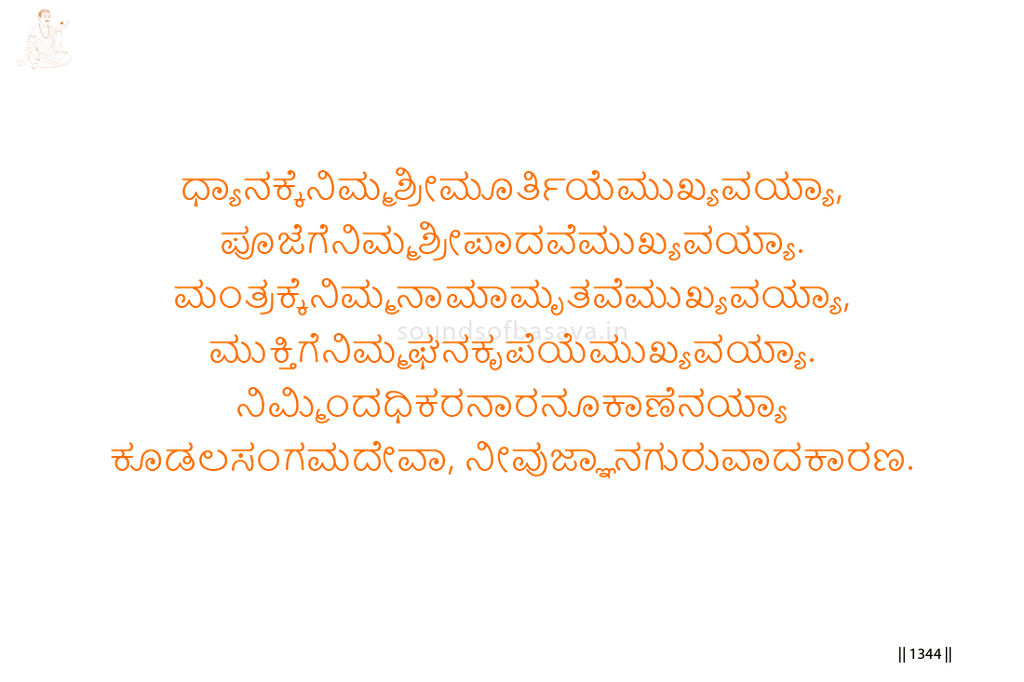
Basavanna identifies the essential centre of four sacred movements:
Kudalasangama Deva’s sacred form for meditation;
His sacred feet for worship;
the deathless nectar of His Name for mantra;
His immense grace for liberation.
He sees no one greater than Kudalasangama Deva because the Lord Himself is the Guru of Knowledge.
Imagery & Symbolic Relevance
The vachana follows a precise fourfold structure.
The Sacred Form for Meditation
Meditation must remain centred upon Kudalasangama Deva’s Sri-Murti, His sacred form.
Basavanna does not direct meditation toward an abstract idea or an independently imagined object. The Lord’s form gives meditation its proper centre and prevents awareness from scattering.
The Sacred Feet for Worship
For worship, the Lord’s Sri-Pada, sacred feet, are essential.
The feet are the place of refuge, reverence, and surrender. Worship reaches its proper orientation when the devotee places himself before the Lord rather than preserving spiritual self-importance.
The Name-Amrutha for Mantra
For mantra, Kudalasangama Deva’s Nama-Amrutha is essential.
Amrutha is the deathless nectar. The Divine Name is therefore not presented merely as a pleasing sound. It is the mantra that nourishes remembrance beyond the mortal and forgetful condition.
The Name and its nectar-like power remain inseparable.
Immense Grace for Liberation
For liberation, the Lord’s Ghana-Krupa, immense and abundant grace, is essential.
Meditation, worship, and mantra are named clearly, but liberation is not claimed as the product of personal effort. Its decisive ground is Kudalasangama Deva’s grace.
The closing declaration gathers all four movements. Basavanna sees none greater than the Lord because Kudalasangama Deva is Jnana-Guru, the Guru who reveals true Knowledge.
Lingayoga
The vachana brings the principal disciplines of Lingayoga into one Divine centre.
Meditation must not become concentration without relation; it rests upon the Lord’s sacred form.
Worship must not become ritual performance; it is directed to His sacred feet.
Mantra must not become mechanical speech; it receives life from the deathless nectar of His Name.
Liberation must not become self-claimed achievement; it depends upon His grace.
Kudalasangama Deva as Jnana-Guru unites these practices. The Knowledge required for the path is not separated from the Lord who is meditated upon, worshipped, remembered, and relied upon for liberation.
Editorial Commentary
Mukhya means principal, essential, or foremost. The repeated word gives each practice its proper centre.
Sri-Murti is the Lord’s sacred form. It should not be reduced merely to a mental symbol.
Sri-Pada means the sacred feet of the Lord.
Nama-Amrutha means the Divine Name as Amrutha—the deathless nectar. It carries the force of immortal and liberating nourishment, not ordinary sweetness.
Ghana-Krupa means immense, abundant, or profound grace.
Nimminda adhikaranaranu kanenu means, “I see no one greater than You.” Basavanna places no deity, practice, teacher, or power above Kudalasangama Deva.
Jnana-Guru means the Guru of Knowledge—the Lord through whom true understanding is revealed and established.
Related Vachana
Supporting Vachana
Sharana Sthala Vachana 1232 — Lifted from the Pit by Grace
Sharana Vachana 1232 states that Basavanna trusted, believed, and lived only through Kudalasangama Deva’s grace.
Its central image is a calf fallen into a muddy pit. The calf does not rescue itself; it is lifted out and shown its mother’s face. In the same way, Basavanna is raised from the pit of sin, shown the feet of Kudalasangama Deva’s Sharanas, and sustained through Chennabasavanna’s compassion.
This prepares Vachana 1230 by establishing grace as lived rescue rather than an abstract doctrine.
In the Sharana vachana, grace lifts, restores, and sustains. In Aikya Vachana 1230, that recognition becomes complete reliance: the Lord’s form, feet, Name, grace, and Knowledge govern the entire path.
Advancing Vachana
Aikya Sthala Vachana 80 — No Other Refuge
Aikya Vachana 80 declares that Basavanna knows no other within his mind. “Om Namah Shivaya” is both his mantra and his japa, while Kudalasangama Deva alone knows and alone is the Linga.
Vachana 1230 establishes the Lord’s Name as the essential mantra and sees no one greater than Him.
Vachana 80 deepens this into undivided inward establishment:
no second refuge remains in the mind;
the Name becomes continuous mantra and japa;
remembrance is not claimed as personal achievement;
Kudalasangama Deva alone remains as the knowing Linga.
The fourfold reliance of Vachana 1230 thus ripens into a mind in which no other support remains.
