

Summary
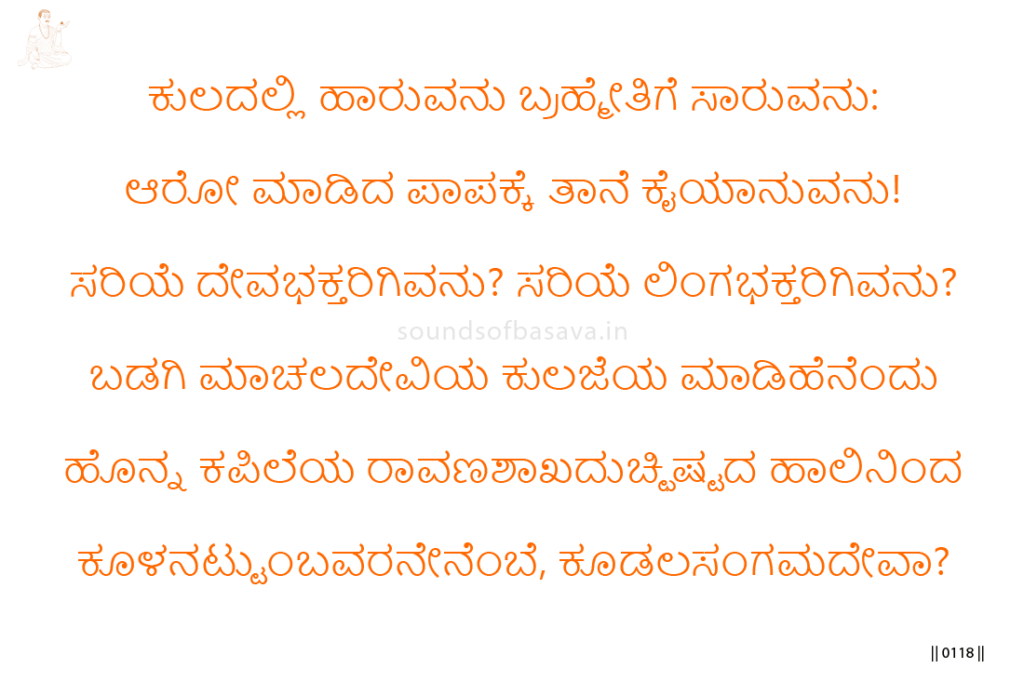
In this vachana, Basavanna rejects caste-pride and inherited spiritual superiority.
One may boast of lineage and proclaim Brahminhood, yet still become entangled in the sin of another. Basavanna asks whether such a person can truly be called a devotee of God or a devotee of the Linga.
He then turns to severe images of fabricated purity and polluted nourishment. A made-up claim of lineage, a golden Kapila cow, Ravana’s branch, leftover milk, and gruel cooked from such milk all expose the absurdity of claiming spiritual worth through external association. Before Kudalasangama Deva, devotion cannot be produced by birth, boast, name, or borrowed sanctity.
Imagery & Symbolic Relevance
Caste-pride is the first target of the vachana. Basavanna does not accept lineage as proof of devotion.
The one who proclaims Brahminhood may still be morally implicated. If he lends himself to another’s sin, his birth-claim cannot save him.
The questions, “Is this Deva-bhakti? Is this Linga-bhakti?” are the center of the teaching. Basavanna does not allow sacred identity to stand without lived truth.
The reference to making a lineage for Machaladevi points to an artificial claim of sanctity. Something constructed, declared, or socially named does not become spiritually pure by assertion.
The golden Kapila cow intensifies the irony. Even something that appears precious and sacred outwardly cannot purify what is inwardly tainted.
Ravana’s branch adds the burden of wrong association. A grand or famous lineage does not become holy merely because it is impressive.
The leftover milk and the gruel cooked from it complete the image. If the source itself is polluted, what is made from it cannot become pure nourishment.
Through these images, Basavanna dismantles borrowed greatness. Devotion cannot be inherited, manufactured, decorated, or cooked from impurity. It must be lived in truth before Kudalasangama Deva.
Lingayoga
In Lingayoga, the Anga cannot approach Linga through caste-pride.
Birth, lineage, social standing, and inherited identity belong to the outer field. They cannot establish inner union.
The relation to Linga requires inward purification. If pride remains, the seeker still stands apart from the truth he claims to worship.
This vachana therefore calls the practitioner away from inherited superiority and toward lived bhakti.
Practice matures when the seeker stops relying on birth and asks whether his life has become worthy before Kudalasangama Deva.
Editorial Commentary
This vachana is a strong correction of spiritual arrogance based on caste and lineage.
Basavanna does not allow birth, name, constructed identity, or sacred appearance to replace realized devotion.
Related Vachana
Supporting Vachana
Vachana 580 — The Water Dries, the Tree Withers
Vachana 580 warns against depending on passing objects such as water and tree without inner knowing. Vachana 583 continues this correction by warning against another false support: caste and inherited pride mistaken for devotion.
Advancing Vachana
Maheshwara Vachana 669 — The Water Snake and the Withdrawn Warrior
Vachana 583 rejects caste-pride, borrowed sanctity, and spiritual worth claimed through lineage. Maheshwara Vachana 669 advances this into final purification, where the remaining traces of pride and false identity must be removed before Kudalasangama Deva.
