

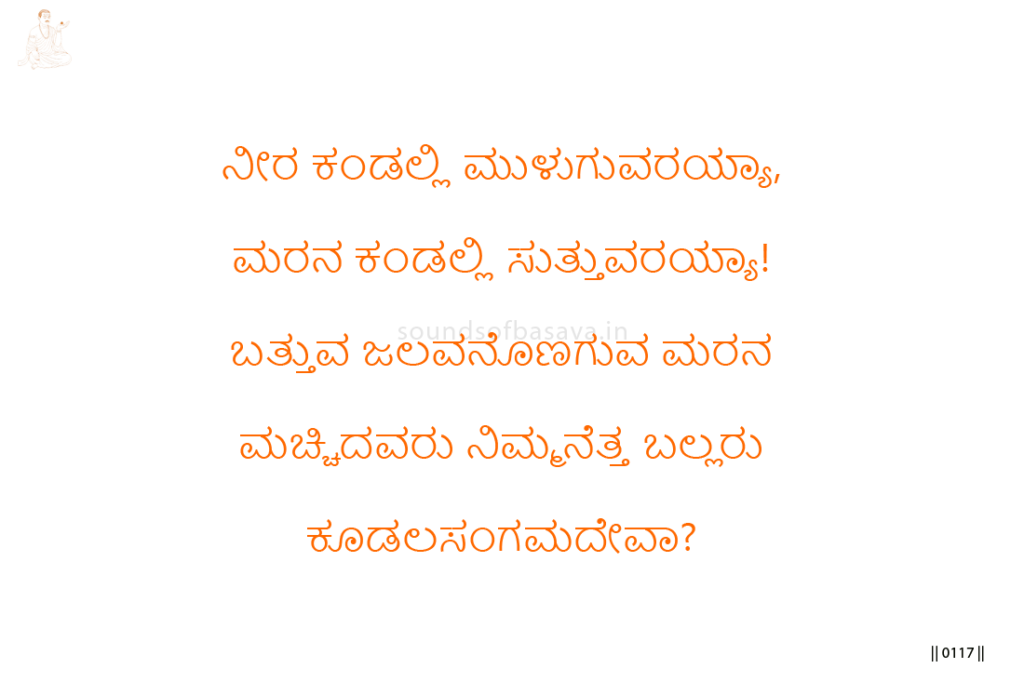
Summary
In this vachana, Basavanna questions worship that depends only on visible and passing objects.
When people see water, they plunge into it. When they see a tree, they circle around it. But water dries, and the tree withers.
Basavanna asks how those who cling to such perishable supports can know Kudalasangama Deva. The vachana teaches that outer forms may assist worship, but they cannot become the final refuge.
Imagery & Symbolic Relevance
Water is the first image. It may be used for bathing, cleansing, and ritual action.
But water can dry up. What appears useful as an object of practice is still subject to change.
The tree is the second image. It may be circled in reverence, but the tree too can wither.
Drying and withering expose impermanence. Basavanna asks the seeker to see what happens when the object of dependence disappears.
He does not reject every use of water or tree. He rejects the mind that clings to them without knowing Kudalasangama Deva.
The question therefore moves beyond outward ritual movement. If worship remains bound to what dries and withers, it cannot reveal the One who is to be known beyond passing supports.
Lingayoga
In Lingayoga, outer supports must lead inward.
Water, tree, place, object, posture, and ritual movement may assist the seeker, but none of them is the final aim.
The Anga must not remain attached to the support while forgetting Linga.
Practice matures when the seeker moves from object-bound action to inner recognition of Kudalasangama Deva.
The form may help begin the path, but awareness must not stop at the form.
Editorial Commentary
This vachana corrects worship that depends on perishable supports. Basavanna asks the seeker to look beyond what dries and withers and to seek Kudalasangama Deva directly.
Related Vachana
Supporting Vachana
Bhakta Vachana 578 — The Waiting Bird
Bhakta Vachana 578 supports this vachana by warning against mechanical practice without knowing Kudalasangama Deva. Vachana 580 continues this correction by warning against worship that depends on passing objects such as water and tree without inner recognition.
Advancing Vachana
Maheshwara Vachana 421 — Water the Root, and the Tree Blossoms
Vachana 580 shows that water dries and trees wither when they are treated as external supports of worship. Maheshwara Vachana 421 advances this into the correct use of the same imagery: water must be poured at the root for the tree to blossom, and offering must reach Jangama as the mouth of Linga. What is questioned here as dependence on perishable objects becomes, in Maheshwara Sthala, the discipline of directing offering to the living root before Kudalasangama Deva.
