

Summary
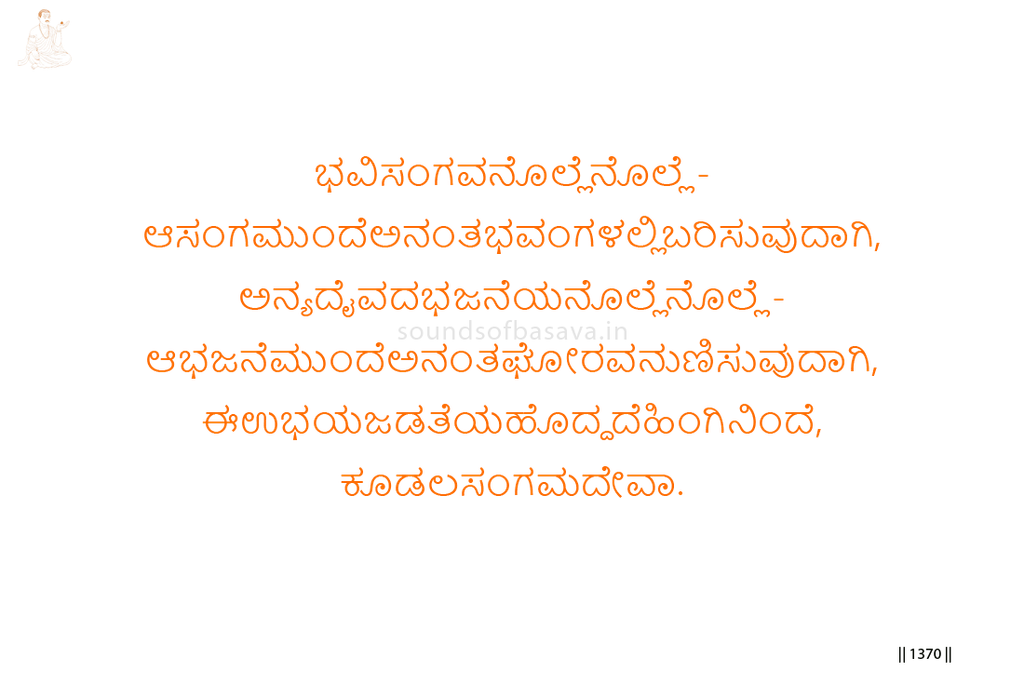
Basavanna refuses the company of the Bhavi because that association leads again into endless bhava—repeated becoming and birth. He also refuses the worship of another deity because divided devotion leads into endless spiritual danger.
Having cast off these two forms of jaḍatā—unawakened association and divided worship—he stands firmly before Kudalasangama Deva.
The vachana marks the end of dispersion. Basavanna neither seeks another field of belonging nor turns toward another Divine centre.
Imagery & Symbolic Relevance
The vachana is structured through two emphatic refusals:
“I will not, I will not accept Bhavi-sanga.”
“I will not, I will not accept the worship of another deity.”
The repetition shows finality. Basavanna is not weighing alternatives; the decision has already been made.
Bhavi-sanga
Bhavi indicates one whose life remains governed by bhava—worldly becoming, outward identification, and separation from the awakened Linga–Sharana relation.
The warning concerns the spiritual field of association rather than hatred of persons. Company shapes inward orientation. To seek nourishment and belonging in the Bhavi-field after knowing Kudalasangama Deva is to reopen the movement of endless becoming.
Worship of Another Deity
The second refusal concerns divided worship. Once Kudalasangama Deva has become the governing Divine relation, seeking ultimate refuge elsewhere scatters the mind among competing centres.
The stated result is ananta-ghora—endless dread, danger, or terrible consequence. The problem is not mere difference of name; it is the loss of undivided fidelity.
Casting Off the Twofold Jaḍatā
Basavanna calls both movements jaḍatā—spiritual dullness or unawakened insensibility:
association that draws awareness back into becoming;
worship that divides the heart.
Having cast off their covering, he does not continue searching. He simply says that he stands.
This standing is steadiness, not pride. The wandering mind has ceased because its ground has been found in Kudalasangama Deva.
Lingayoga
Lingayoga requires vigilance over the sources from which the practitioner receives companionship, direction, and refuge.
After the Linga-relation is known, the seeker cannot continue living from incompatible spiritual centres. The discipline is single-pointed fidelity: remain with Kudalasangama Deva without returning to the currents that renew becoming or divide devotion.
Editorial Commentary
Bhavi-sanga should not be interpreted as permission for social contempt. It concerns participation in an unawakened field that weakens the Linga–Sharana relation.
Anya-daiva-bhajana means worship directed toward another Divine centre.
Jaḍatā here is spiritual dullness or insensibility. Basavanna identifies both Bhavi-association and divided worship as its forms.
The conclusion says, “Having cast off the covering of both, I stood.” It expresses an established Aikya condition, not merely an intention to withdraw.
Related Vachana
Supporting Vachana
Sharana Sthala Vachana 671 — The Irreversible Bond
Sharana Vachana 671 says that after knowing Sharana-sambandha, one cannot return to the Bhavi-field. It makes receiving and fellowship the practical test of fidelity.
It prepares Vachana 1297 by establishing spiritual non-return. What appears there as a strict prohibition has matured here into effortless firmness: Basavanna no longer seeks Bhavi-company at all.
Advancing Vachana
Aikya Sthala Vachana 527 — You Alone Are the One
Aikya Vachana 527 declares Kudalasangama Deva to be the Master, the Eternal, Mahadeva, Pashupati, and the one God throughout heaven, earth, and the netherworld.
Vachana 1297 removes divided allegiance. Vachana 527 advances into its positive fulfilment: Kudalasangama Deva alone remains as the one Divine centre, beyond which no further word is needed.
