

Summary
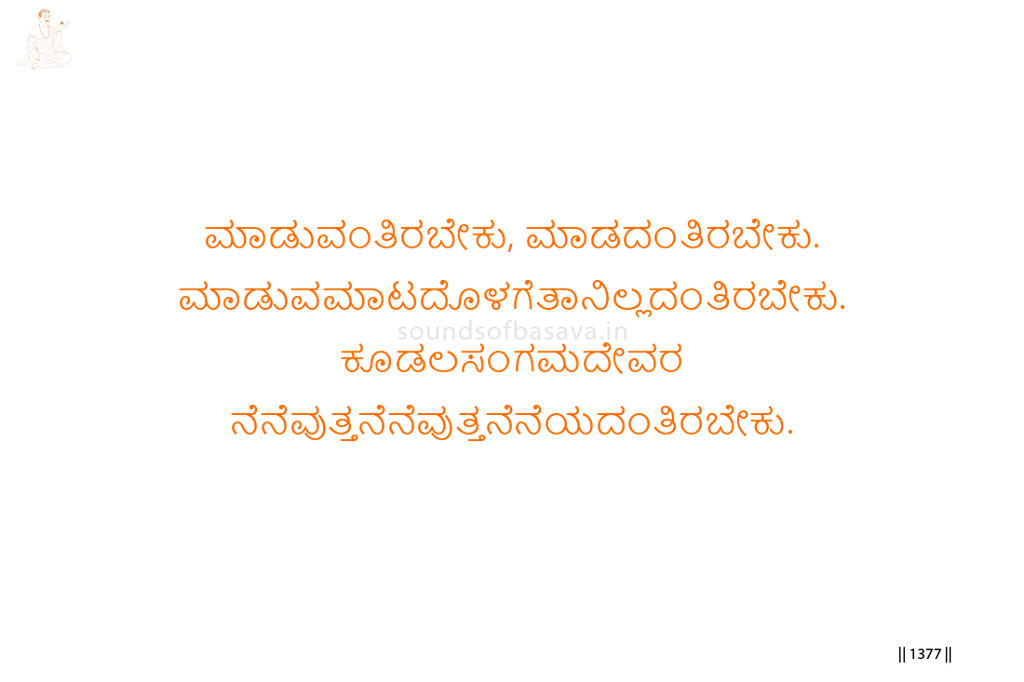
One must act and yet remain as though one has not acted. Within the action, the separate self must not stand as its author.
Likewise, one must remember Kudalasangama Deva continuously and yet remain as though there is no separate act of remembering.
Action continues and remembrance continues, but neither becomes the possession or achievement of an independent “I.”
Imagery & Symbolic Relevance
The vachana contains no material image. Its movement is formed through three paradoxical instructions.
Acting as Though Not Acting
Basavanna does not ask the seeker to abandon action. He asks that action occur without the inward claim, “I am doing this.”
Doing remains visible, but the self does not gather the act into personal authorship, merit, reputation, or spiritual identity.
Thus action and non-action are not placed as two opposing paths. The body may act fully while the separate doer remains absent.
The Self Absent Within the Act
The second line gives the inner condition required by the first: within what is being done, one must remain as though oneself is not there.
This does not mean unconsciousness, bodily disappearance, or refusal of responsibility. It means that the personal “I” does not enter the act to possess it.
The action is performed, but the self does not stand over it saying:
“I caused this”;
“this is my achievement”;
“I must receive its fruit.”
Remembering as Though Not Remembering
The repeated “remembering, remembering” shows continuity. Remembrance of Kudalasangama Deva must not break.
Yet Basavanna immediately says that one should remain as though not remembering. Deliberate remembrance has ripened until it no longer appears as a separate exercise performed by a rememberer.
Kudalasangama Deva is no longer brought into awareness only at selected moments. Remembrance has become the natural ground of action and rest.
The paradox therefore joins two conditions:
remembrance is uninterrupted;
no personal claim arises that “I am remembering.”
Lingayoga
Lingayoga must enter ordinary action without producing a spiritual doer.
Kayaka, worship, service, and remembrance continue, but the practitioner must not retain them as personal accomplishments. The discipline is to act attentively while returning authorship and fruit to Linga.
Remembrance matures when it no longer depends upon repeated self-reminding, yet never loses its orientation toward Kudalasangama Deva.
Editorial Commentary
The vachana does not recommend inactivity. It removes self-claim from action.
Tānilladante means “as though oneself were not there.” It concerns the absence of the separately claiming agent within the act, not the disappearance of the person or body.
Neneyutta neneyutta neneyadante preserves both continuous remembrance and the absence of deliberate self-consciousness about remembering.
Related Vachana
Supporting Vachana
Sharana Sthala Vachana 234 — Soundless Deed
Sharana Vachana 234 warns that even service to Linga and Jangama becomes burdened when the mind says, “I did.” When that claim is absent, Kudalasangama Deva gives without being asked.
It prepares Vachana 1314 by removing personal ownership after action. The present vachana deepens this into the condition in which the separate self does not enter the act at all.
Advancing Vachana
Aikya Sthala Vachana 1317 — Living, Enjoying, and Delighting Through the Ghanalinga
Vachana 1317 shows the fulfilled life that follows: living is grounded in Ghanalinga, partaking becomes Mahaprasada, and delight arises through Sahaja.
Vachana 1314 removes the separate doer and rememberer; Vachana 1317 carries that freedom into living, receiving, and rejoicing as one movement in Paramartha.
