

Summary
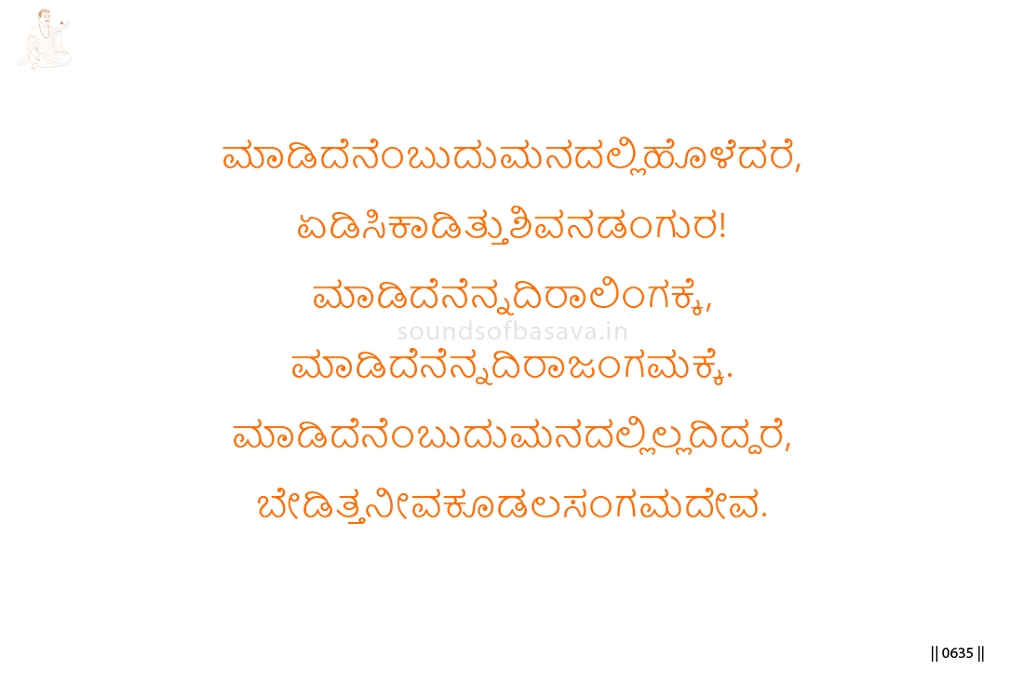
In this vachana, Basavanna examines the subtle ego that arises after action. Even a sacred act becomes burdened if the mind says, “I did.”
He therefore warns the seeker not to claim, “I did this for Linga,” or “I did this for Jangama.” The issue is not service itself, but the ownership quietly retained after service.
When the thought “I did” is absent, Kudalasangama Deva gives without being asked. Grace is not earned by the claim of the doer; it flows where action has become free from self-ownership.
Imagery & Symbolic Relevance
The phrase “I did” is the central image. It is not merely public boasting, but the inward trace of doership that can remain even after a good or sacred act.
Linga and Jangama are named to show the subtlety of the danger. One may serve the highest and still preserve the self as the one who served. Basavanna removes even that sacred self-claim.
Shiva’s drum gives the teaching its clearest form. The drum resounds, but it does not claim the sound. Action happens fully, yet no separate author needs to arise.
The final movement is unasked giving from Kudalasangama Deva. When the inward claim is absent, the act is no longer obstructed by ownership. The deed becomes soundless, not because nothing is done, but because no “I” echoes within it.
Lingayoga
In Lingayoga, this vachana refines Kayaka and Dasoha. Work and offering must not only be directed toward Linga and Jangama; they must also be free from the inward possession of merit.
The practice-point is to watch the mind after action. If “I did” arises, return the act to Linga and Jangama without retaining it as personal achievement.
For Sharana Sthala, the teaching is egoless service. The Sharana continues to act, serve, and offer, but like Shiva’s drum, does not claim the sound before Kudalasangama Deva.
Editorial Commentary
This vachana should be read as a correction of doership, not as a rejection of action. Basavanna’s concern is the subtle pride that may arise even after service to Linga and Jangama. The image of Shiva’s drum should remain central because it shows action without inner authorship.
Related Vachana
Supporting Vachana
Pranalingi Sthala Vachana 759 — The Living Kayaka
Pranalingi Vachana 759 supports this teaching by presenting action and giving as spiritually precious only when they are free from self-seeking. Vachana 234 carries that principle further: even after serving Linga or Jangama, the mind must not retain the thought “I did.” Together, the two vachanas show Kayaka and Dasoha purified of self-claim before Kudalasangama Deva.
Advancing Vachana
Aikya Sthala Vachana 1242 — Beyond the “I” Before the Linga
Aikya Vachana 1242 advances this teaching by asking where the separate “I” can remain before the reality called Linga. Vachana 234 removes doership from sacred action; Aikya Vachana 1242 carries that removal into the state where bodily life continues, but egoic individuality no longer stands apart from Linga. Thus the Sharana-stage purification of action advances into Aikya as life without separate self-claim before Kudalasangama Deva.
