

Summary
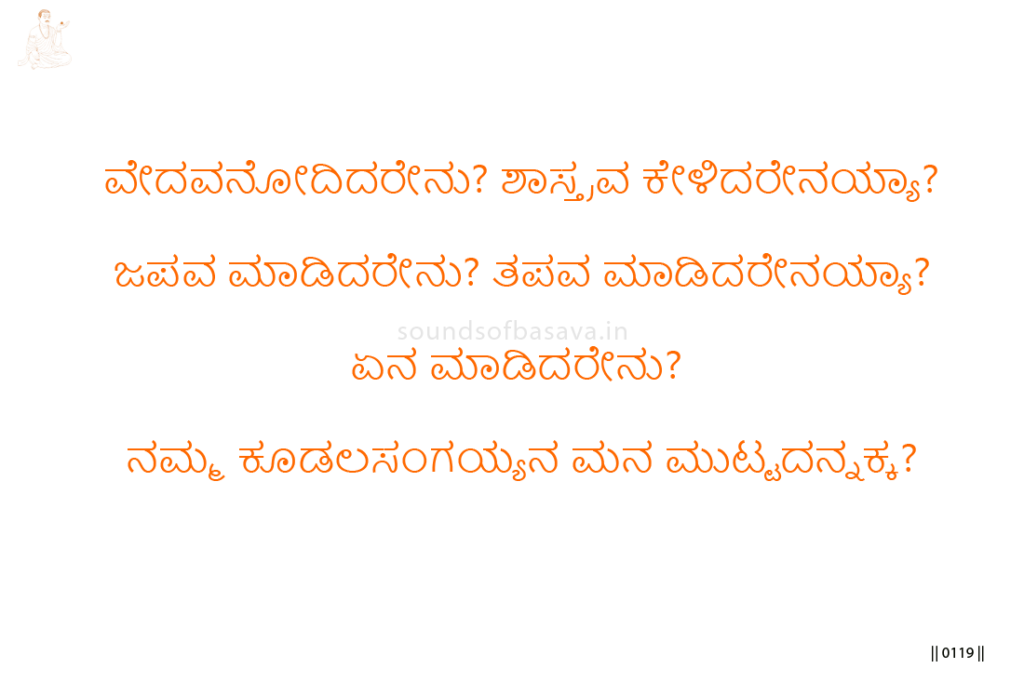
In this vachana, Basavanna asks what use there is in reading the Vedas or hearing the Shastras.
He then asks what use there is in japa, tapas, or any other practice if the heart has not been touched by Kudalasangayya.
The vachana gathers sacred learning, repetition, austerity, and religious action under one measure. Practice becomes meaningful only when it reaches the inner being.
Imagery & Symbolic Relevance
The Veda represents sacred recitation and inherited spiritual knowledge.
The Shastra represents doctrine, instruction, and religious teaching.
Japa represents repetition. Tapas represents discipline, restraint, and austerity.
Basavanna names these respected forms of practice, but he does not allow them to stand by themselves. Each is tested by the same question: has it touched the heart?
The phrase “heart touched” is central. It points to inward contact, not outer completion.
Reading may be completed. Teaching may be heard. Repetition may be performed. Austerity may be practiced. Yet if Kudalasangayya has not touched the inner life, the act remains unfinished.
The repeated “what use?” removes spiritual complacency. Basavanna asks the seeker to measure practice by transformation, not by performance.
Lingayoga
In Lingayoga, every practice must gather the Anga toward Linga.
Scripture, instruction, mantra, austerity, and discipline may support the path, but they must become living awareness.
If the mind remains untouched, the practice has not reached its purpose.
The heart is the field where outer action becomes inner recognition. Without that contact, the seeker remains outside the truth he studies or repeats.
Practice matures when Kudalasangama Deva is not merely named, read, or heard, but inwardly known.
Editorial Commentary
This vachana corrects religious effort without inner transformation.
Basavanna does not reject Veda, Shastra, japa, or tapas; he asks whether they have reached the heart before Kudalasangama Deva.
Related Vachana
Supporting Vachana
Vachana 583 — The Death of Pride
Vachana 583 rejects caste-pride and borrowed sanctity as measures of devotion. Vachana 599 continues this correction by showing that even scripture, japa, tapas, and sacred action must be measured by inner contact.
Advancing Vachana
Maheshwara Vachana 673 — The Needle’s Test
Vachana 599 asks whether any practice has value if the heart has not been touched by Kudalasangama Deva. Maheshwara Vachana 673 advances this into the Sharana who does not oscillate, where inward contact becomes unwavering life.
