

Summary
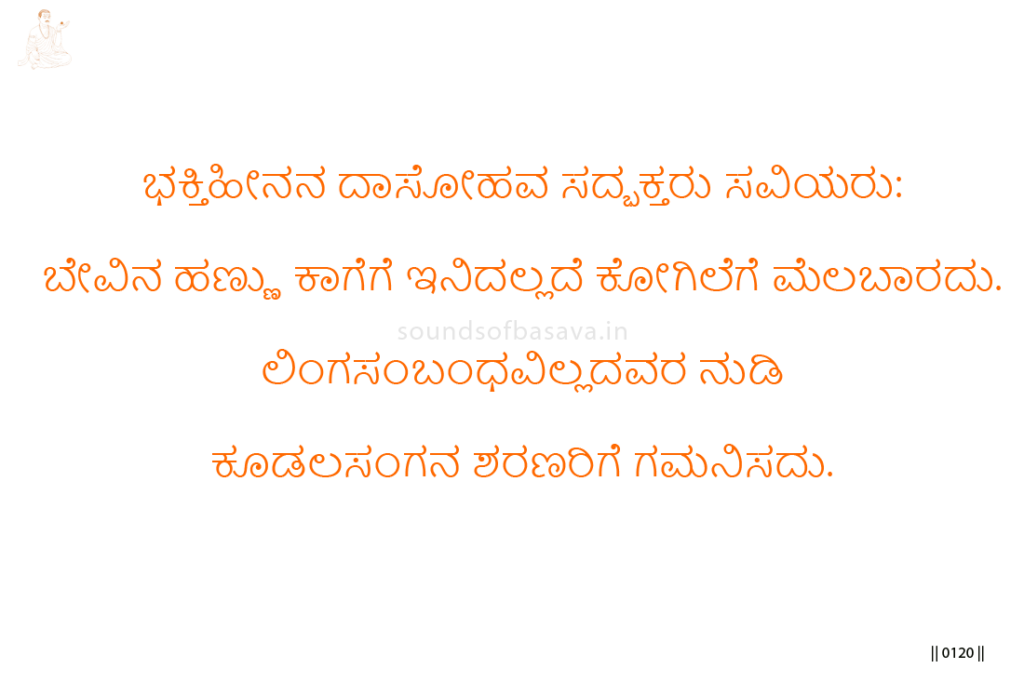
In this vachana, Basavanna teaches that the dasoha of one without bhakti cannot be received by true devotees.
An offering may appear generous, but if it does not arise from devotion, it lacks spiritual nourishment. He gives the image of the neem fruit: it may suit the crow, but the cuckoo cannot relish it.
Basavanna then applies the same measure to speech. Words spoken without Linga-sambandha cannot equal the speech of Kudalasangama Deva’s Sharanas. The vachana teaches that offering and speech become worthy only when they arise from living relation to Linga.
Imagery & Symbolic Relevance
Dasoha is the first concern of the vachana. Basavanna does not measure it by quantity, usefulness, or outward charity.
He measures it by bhakti. If devotion is absent, the offering remains spiritually unfit for the true devotee.
The neem fruit is the central image. Its bitterness may be acceptable to the crow, but it cannot be enjoyed by the cuckoo.
The crow represents a taste that can accept what is bitter and unrefined. The cuckoo represents the refined sensitivity of the true devotee.
This contrast shows that the receiver also matters. What may pass as acceptable in ordinary terms does not nourish the heart shaped by bhakti.
The phrase “without Linga-sambandha” is decisive. Speech without living relation to Linga cannot stand beside the speech of the Sharanas.
Basavanna therefore extends the teaching beyond food or charity. Service, speech, offering, and religious expression must all arise from the right source.
Lingayoga
In Lingayoga, the source of action determines its spiritual quality.
Dasoha must arise from bhakti. Speech must arise from Linga-sambandha. Service must carry inward alignment.
The Anga may give, speak, serve, and perform religious action, but if the relation to Linga is absent, the act remains bitter at its root.
The Sharanas of Kudalasangama Deva recognize this difference. They are not nourished by outer form alone.
Practice matures when offering, speech, and inner relation are no longer separated.
Editorial Commentary
This vachana protects dasoha from becoming empty charity or religious display.
Basavanna shows that an offering is purified not by appearance, but by the bhakti from which it arises.
Related Vachana
Supporting Vachana
Vachana 599 — The Heart’s Measure
Vachana 599 teaches that Veda, Shastra, japa, tapas, and all spiritual practices must be measured by inner contact. Vachana 607 continues this by showing that dasoha and speech must also be measured by bhakti and Linga-sambandha.
Advancing Vachana
Maheshwara Vachana 675 — The Broken Way of Delayed Turning
Vachana 607 teaches that dasoha without bhakti and speech without Linga-sambandha cannot nourish Kudalasangama Deva’s Sharanas. Maheshwara Vachana 675 advances this into undivided being, where offering, speech, and inner relation are no longer separated.
