

Summary
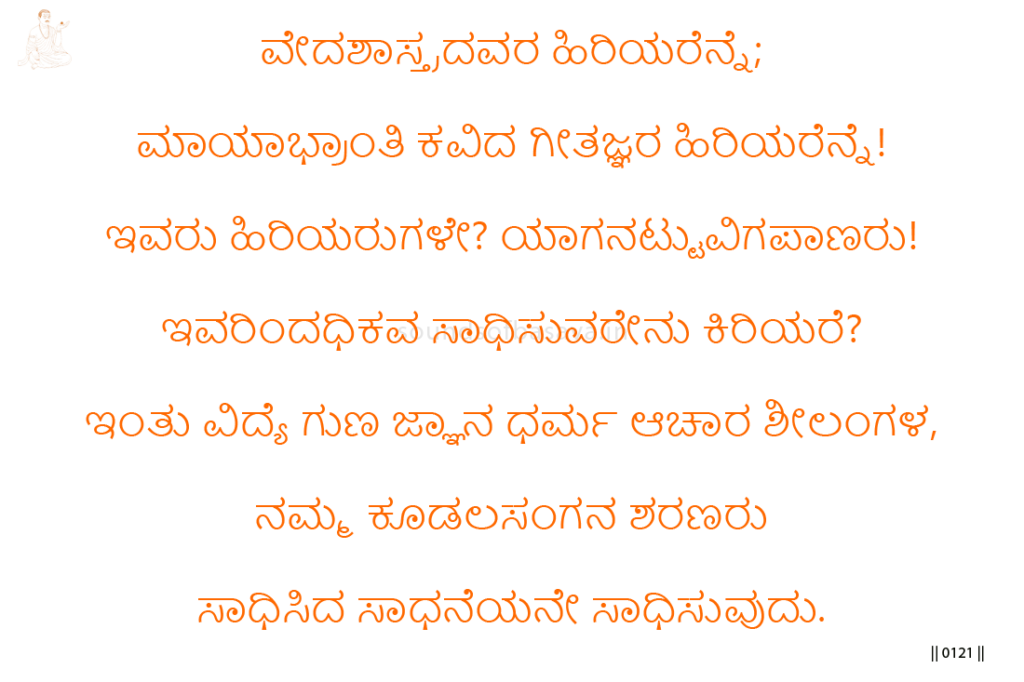
In this vachana, Basavanna questions who should truly be called elders.
Are those learned in Veda and Shastra alone to be called elders? Are poets, singers, and skilled reciters alone the great ones? If these alone are elders, what can the lesser ones attain?
Basavanna answers through the Sharanas of Kudalasangama Deva. Their attainment is the real attainment. It is fulfilled through vidye, guna, jnana, dharma, achara, and sheela.
The vachana teaches that spiritual greatness is not confined to scriptural possession, poetic skill, song, or recitation. It is fulfilled in the lived attainment of Kudalasangama Deva’s Sharanas.
Imagery & Symbolic Relevance
Veda and Shastra represent formal scriptural learning. They carry religious authority, memory, and inherited instruction.
Basavanna does not dismiss them. He questions whether they alone define spiritual seniority.
Poets, singers, and skilled reciters represent verbal refinement and public accomplishment. Their skill may be respected, but it is not the final proof of attainment.
The question about the lesser ones is central. Basavanna asks what remains for those who do not possess such recognized learning or expressive skill.
The answer is found in the Sharanas of Kudalasangama Deva. They have attained what must truly be attained.
Their attainment is not based on display. It is formed through vidye, guna, jnana, dharma, achara, and sheela: learning, virtue, knowledge, righteousness, conduct, and character.
Basavanna therefore shifts the measure from status to realization, and from verbal mastery to lived attainment.
Lingayoga
In Lingayoga, the path is not closed to those without scholastic or artistic standing.
The Anga must be refined through knowledge, conduct, character, and living relation to Linga.
Scripture may guide. Song may express devotion. Learning may illuminate. But these must become lived awareness.
The Sharanas of Kudalasangama Deva show the living standard. They do not merely possess words about truth; they attain and live the truth.
Practice matures when knowledge and conduct are joined, and when learning becomes life.
Editorial Commentary
This vachana corrects spiritual exclusivity.
Basavanna does not reject scripture, poetry, song, or learning. He refuses to let them become the only measure of spiritual greatness. The final measure is the attainment lived by Kudalasangama Deva’s Sharanas.
Related Vachana
Supporting Vachana
Bhakta Vachana 599 — The Heart’s Measure
Bhakta Vachana 599 supports this vachana by asking what use there is in reading the Vedas, hearing the Shastras, performing japa, practicing tapas, or doing any spiritual act if Kudalasangama Deva has not touched the heart. Vachana 612 continues that same correction by saying that scriptural learning, poetry, song, and recitation do not by themselves define true seniority. The measure is lived attainment before Kudalasangama Deva.
Advancing Vachana
Maheshwara Vachana 858 — Even the Conqueror of Death Remains Unknowing
Vachana 612 teaches that scripture, poetic skill, song, and recitation are not the final measure of realization. Maheshwara Vachana 858 advances this into a stronger Maheshwara-stage correction: even exalted attainments such as becoming sun and moon, surviving dissolution, occupying Hari’s throne, or gaining the distinction of Markandeya do not equal knowing the truth of Linga. What is opened here as the path beyond learned or artistic seniority becomes, in Maheshwara Sthala, the direct warning that no attainment is sufficient without true knowledge of Linga before Kudalasangama Deva.
