

Summary
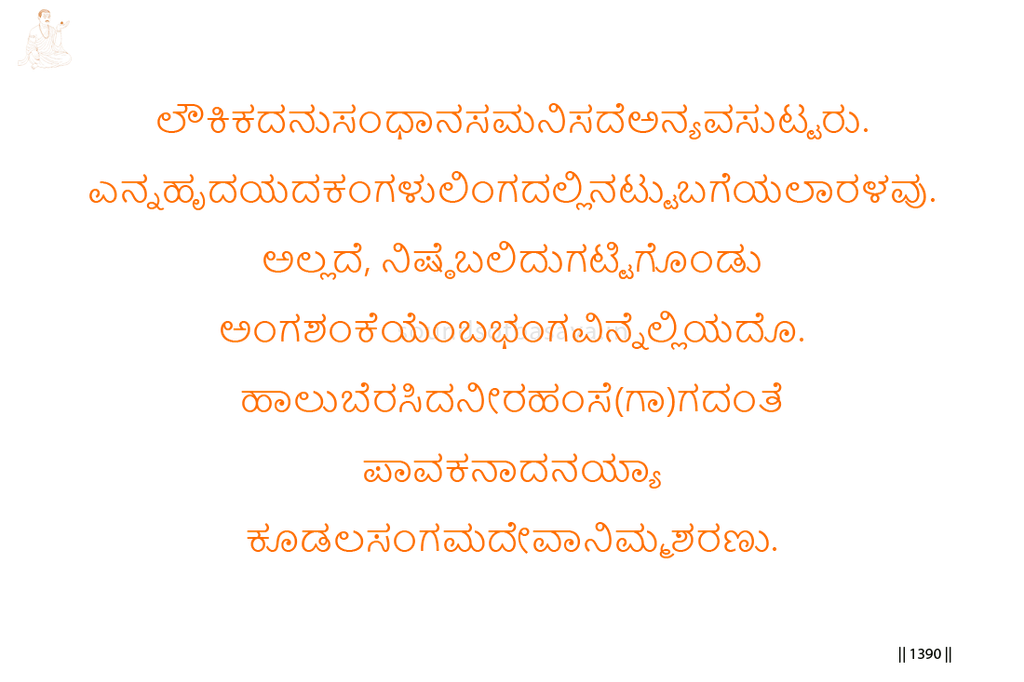
Others may burn away outward things without bringing worldly attachment to rest. Basavanna’s transformation occurs elsewhere: the eyes of his heart have become rooted in the Linga.
From that rooted vision, Nishṭe ripens and becomes firm. The fracture called Anga-doubt—the uncertainty that maintains separation between Anga and Linga—no longer has a place.
As the swan separates milk from water, Kudalasangama Deva has purified His Sharana. What was mixed has become clear, and Linga-awareness no longer remains entangled with worldly attachment.
Imagery & Symbolic Relevance
The vachana moves through outward burning, the rooted eyes of the heart, strengthened Nishṭe, the ending of Anga-doubt, and the swan separating milk from water.
Burning Without Ending Attachment
The opening distinguishes outward renunciation from inward transformation.
Others may burn or cast away many things, yet worldly attachment does not thereby come to rest. The removal of possessions, relationships, or visible supports does not necessarily remove the inward gaze that continues to seek and cling.
Basavanna therefore does not make destruction or abandonment the measure of purification. The decisive question is where the heart’s vision has become established.
The Eyes of the Heart Rooted in Linga
Basavanna says that the eyes of his heart have become rooted in the Linga.
These are not the physical eyes. They indicate inward vision—the faculty through which the heart recognises and remains turned toward Linga.
To be rooted is more than to glance, remember occasionally, or hold attention by effort. The vision has found its ground and no longer wanders between Linga and worldly attachment.
Basavanna then asks who can understand or measure this condition. The question expresses wonder. Such rootedness cannot be judged merely from outward conduct.
Nishṭe Ripened and Made Firm
When the heart’s vision becomes rooted, Nishṭe grows strong and becomes firmly established.
Nishṭe is not stubbornness or attachment to a religious identity. It is unwavering establishment in Linga.
The sequence is important: firmness does not arise through forced resolve alone. It grows from vision already rooted in its true ground.
The End of Anga-Doubt
The firmness of Nishṭe removes the disturbance called Anga-doubt.
Anga-doubt is the uncertainty that continues to ask whether Anga stands apart from Linga, whether Linga is truly present, or whether the relationship can be broken.
Once the inward vision is rooted, this doubt no longer governs the relation. Basavanna does not argue Anga-doubt away; it loses its ground through established seeing.
The Swan Separating Milk from Water
The swan gives the concluding image of purification.
Milk and water may be mixed so that they appear inseparable. The swan is traditionally understood as distinguishing them and receiving the milk while leaving the water.
Here the image concerns clear discrimination. Worldly attachment and Linga-awareness had remained mixed within the seeker’s experience. Through Kudalasangama Deva’s purification, they are no longer confused.
The image does not suggest destroying the world. The swan does not burn the mixture; it distinguishes what must be received from what must be left.
Kudalasangama Deva’s Sharana
The purification belongs to Kudalasangama Deva’s action. Basavanna identifies himself as Your Sharana, not as the independent producer of his purity.
The movement is therefore from ineffective outward burning to inward rooting, from rooting to firm Nishṭe, from firmness to the ending of Anga-doubt, and from mixture to purified clarity through the Lord’s grace.
Lingayoga
Lingayoga requires the inward gaze to become steady in Linga rather than merely removing external objects of attachment.
The practitioner must notice whether attention continues to wander even after outward discipline has been adopted. Nishṭe matures when remembrance, worship, and conduct arise from one rooted orientation.
The swan-image gives the practical measure: receive what belongs to Linga-awareness and leave what renews worldly attachment. The doubtless condition described in the vachana is fulfilled realization and must not be claimed before this clarity has become stable.
Editorial Commentary
Anusandhāna indicates sustained inward connection or orientation. Worldly orientation may remain even after outward things are abandoned.
The eyes of the heart signify inward vision, not physical sight.
Nattu means planted, fixed, or rooted. It indicates established vision rather than temporary concentration.
Nishṭe is steadfast establishment in Linga.
Anga-shanke is doubt or uncertainty concerning Anga and its relation to Linga.
The hamsa, or swan, signifies matured discrimination that distinguishes milk from the water mixed with it. In this vachana, it expresses purification through clear separation of Linga-awareness from worldly attachment.
Related Vachana
Supporting Vachana
Sharana Sthala Vachana 1340 — Other Than Linga, What Else Shall I Seek?
Sharana Vachana 1340 gathers seeking, contemplation, reverence, receiving, fellowship, and pilgrimage into Linga, Jangama, Prasāda, and the company of Shiva’s devotees. Basavanna refuses every scattered spiritual centre and knows no other pilgrimage.
It prepares Vachana 1349 by disciplining the gaze toward one sacred orientation. What is first declared in Sharana Sthala as the refusal to seek elsewhere ripens in Vachana 1349 into the heart’s vision becoming rooted in Linga and Anga-doubt losing its ground.
Advancing Vachana
Aikya Sthala Vachana 941 — See the Sahaja Sharana
Vachana 1349 establishes firm Nishṭe, purified vision, and freedom from Anga-doubt.
Vachana 941 unfolds the life that follows from such firmness. Kudalasangama Deva’s Sharana is unstained by doubt, holds form and formlessness without division, deceives neither body nor life, and abides in uninterrupted Sahaja.
The rooted vision of Vachana 1349 therefore advances into a continuous embodied state whose inward realization and outward life no longer contradict each other.
