

Summary
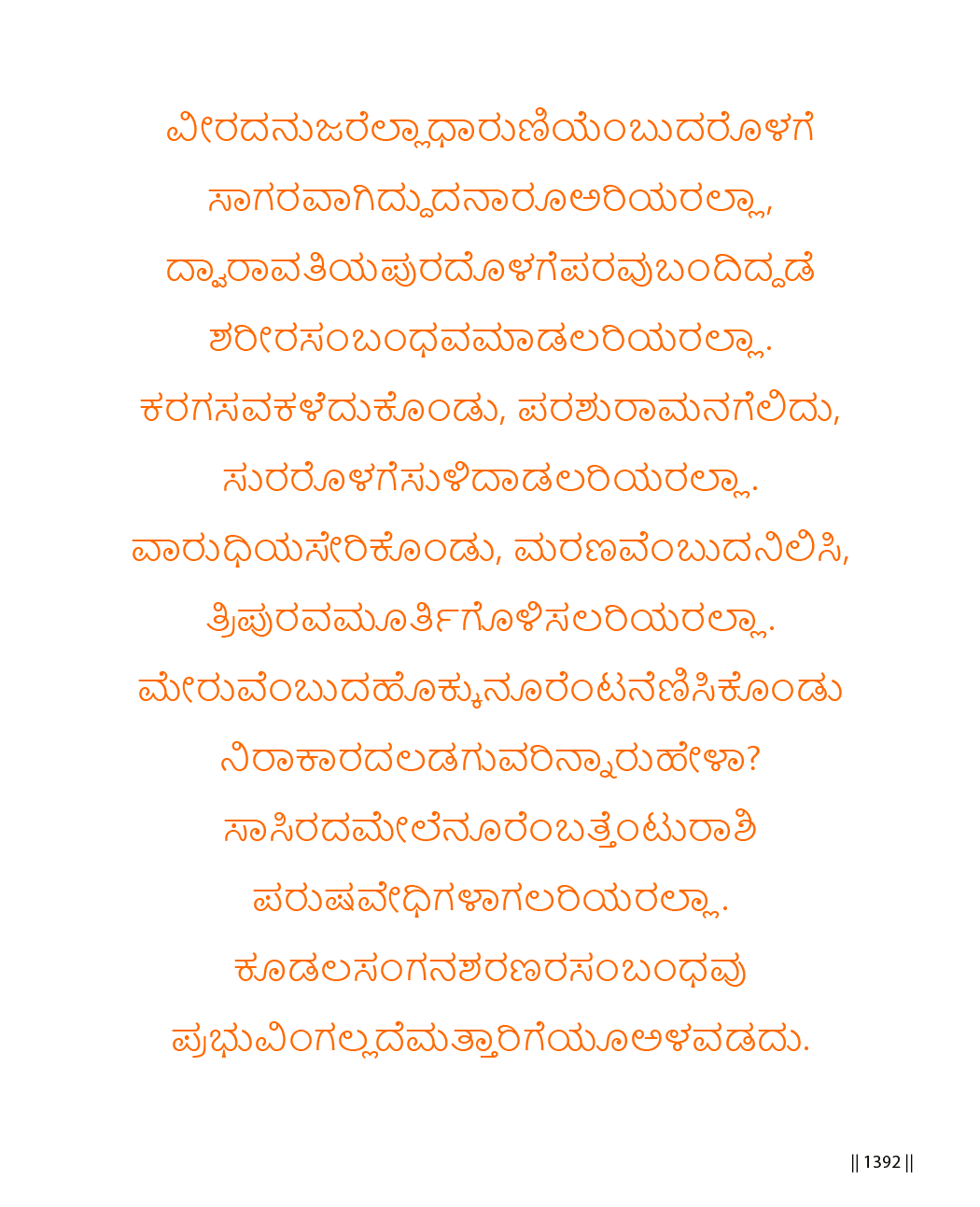
The earth may contain heroes, yet they do not know the ocean hidden within it. Great festivals, heroic conquests, movement among the gods, victory over death, ascent of Meru, entry into the Formless, and extraordinary alchemical attainments still do not reveal the bond of Kudalasangama’s Sharanas.
Each achievement appears vast, but none becomes the measure of this sambandha.
Basavanna concludes that the bond of Kudalasangama’s Sharanas does not come within anyone else’s grasp except Prabhudeva’s. It is not an achievement added to the seeker, but a realized relationship beyond power, number, height, form, or comparison.
Imagery & Symbolic Relevance
The vachana unfolds through a succession of immense worldly, heroic, celestial, and spiritual attainments. Each is named only to show that it remains unable to reveal the Sharanas’ bond.
The Earth and the Hidden Ocean
The opening places the ocean within the earth.
The kinsmen of heroes may inhabit the vast earth, yet they do not know the ocean held within it. The earth represents the visible field in which strength and achievement appear; the ocean suggests a depth concealed within that visible field.
Heroic stature does not disclose this depth. One may occupy the earth without knowing what it contains.
The image establishes the measure for the entire vachana: visible greatness is not the same as inward depth.
The Festival of Dwaravati
Basavanna next refers to the great occasion or festival arising in Dwaravati.
Even participation in such grandeur does not establish sharīra-sambandha, the intimate embodied relationship spoken of here. Outward gathering, celebration, splendour, or bodily association cannot create the bond of the Sharanas.
The line does not condemn sacred celebration. It distinguishes ceremonial participation from realized relationship.
The Weapon, Parashurama, and the Gods
The next movement gathers heroic power:
bearing or relinquishing the weapon;
conquering Parashurama;
moving among the gods.
Each act implies exceptional strength, victory, or celestial access. Yet the repeated negative remains: they still do not know.
The bond cannot be conquered as an enemy, gained as a reward for heroism, or acquired by entering a higher realm.
The Great Waters, Death, and Tripura
Basavanna then enlarges the scale further.
One may reach or cross the great waters, arrest death, and assume the exalted form or state associated with Tripura. These are extraordinary accomplishments, but they still do not disclose the sambandha.
The line does not teach that such feats must literally be performed. It places even the greatest imagined victories beneath the bond of the Sharanas.
Stopping death does not establish the relationship, because the central question is not longevity or supernatural power. It is whether separation remains.
Meru, the Hundred and Eight, and the Formless
The ascent continues through Meru.
One may enter Meru, reckon the hundred and eight, and become absorbed in the Formless. Basavanna then asks who can speak of such persons.
The question preserves wonder at exalted attainment, but it does not identify that attainment with the Sharanas’ bond. Height, sacred enumeration, and even entry into the Formless remain inadequate as its measure.
The bond is not simply the highest point in a graded ascent.
The One Thousand One Hundred and Eighty-Eight Parusha-Vedhis
The vachana next invokes one thousand one hundred and eighty-eight groups of Parusha-vedhis.
Parusha indicates the alchemical touchstone or transformative contact. A Parusha-vedhi therefore carries the suggestion of extraordinary transmuting capacity.
Even an immense multitude possessing such transformative power cannot produce or comprehend the bond. Spiritual relationship is not the result of accumulating powers, transformations, or perfected persons.
The numerical vastness strengthens the contrast: what is beyond measure cannot be reached by increasing quantity.
The Bond of Kudalasangama’s Sharanas
The final line names what all the earlier attainments could not reveal: the sambandha of Kudalasangama’s Sharanas.
This relationship cannot be gained as a possession or measured as an accomplishment. The Sharana does not stand outside it and claim, “I have obtained this bond.” The relationship has become the Sharana’s lived condition.
Kudalasangama Deva remains the Lord whose Sharanas are named. Allama Prabhudeva, as the one to whom this immeasurable relationship is accessible.
Lingayoga
Lingayoga cannot be measured by unusual experience, religious grandeur, scriptural enumeration, bodily austerity, supernatural power, or claims of formless absorption.
These may become occasions for spiritual pride if the seeker retains them as personal achievements. The required movement is toward right sambandha—living relation with Linga and Kudalasangama Deva’s Sharanas through surrender, service, and freedom from self-claim.
The incomparable bond described here is a realized Aikya condition. It should not be claimed merely because the seeker belongs to a community, serves a Sharana outwardly, or speaks of unity.
Editorial Commentary
Sambandha means relationship, bond, or inseparable connection. Here it is a lived sacred relation, not merely association, lineage, or bodily proximity.
Parusha means an alchemical touchstone or transformative contact. It must not be confused with Purusha.
The numbers one hundred and eight and one thousand one hundred and eighty-eight belong to the vachana’s scale of extraordinary attainment. They should not be converted into an unsupported cosmological system.
Aḷavaḍadu carries the sense that this bond cannot be contained, measured, comprehended, or made accessible to another.
Prabhu in the final line refers to Allama Prabhudeva. Kudalasangama Deva remains the Lord whose Sharanas possess the immeasurable bond.
Related Vachana
Supporting Vachana
Sharana Sthala Vachana 451 — Breaking of Bonds
Sharana Vachana 451 exposes the lesser bonds that may remain even after one calls oneself a Bhakta: caste-pride, inherited identity, old dependence, gain, and fear. Basavanna breaks these bonds and declares that he is bound only to Kudalasangama Deva’s Sharanas.
It prepares Vachana 1354 by establishing right belonging. What is deliberately chosen in Sharana Sthala—the abandonment of false bonds and belonging to the Sharanas—ripens in Aikya into a sambandha beyond every worldly, celestial, and spiritual measure.
Advancing Vachana
Aikya Sthala Vachana 1242 — Beyond the “I” Before the Linga
Vachana 1354 removes every external accomplishment as a measure of the Sharanas’ bond.
Vachana 1242 reveals why that bond cannot be possessed or compared. Before the great reality called Linga, the separate “I” has no place to stand. Although the Sharana continues to bear a body, he is not ordinary and does not remain separated from the natural Divine reality.
The immeasurable relationship of Vachana 1354 thus deepens into the condition where no independent self remains to own, display, or measure that relationship.
