

Summary
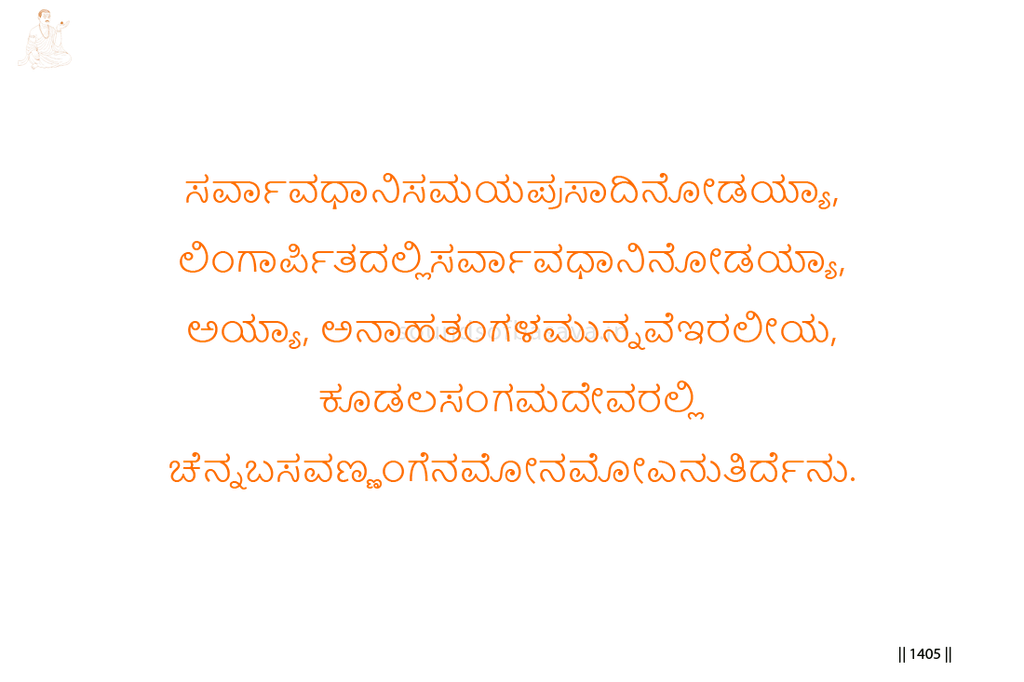
Basavanna asks the listener to behold Chennabasavanna as Sarvāvadhāni—the one whose awareness is complete, vigilant, and uninterrupted.
He is Samaya-Prasādi: at every moment, his awareness remains rightly established in sacred receiving. Within everything offered to Linga, he remains fully awake; nothing returns to personal possession, forgetfulness, or careless action.
His state is already established even before the subtle awareness called Anāhata arises. His wakefulness does not depend upon a particular inner experience.
Seeing Chennabasavanna established in Kudalasangama Deva, Basavanna repeatedly bows: “Namo, Namo.”
Imagery & Symbolic Relevance
The Vachana contains no material image. Its movement is formed through two calls to behold, a statement concerning Anāhata, and Basavanna’s repeated salutation to Chennabasavanna.
“Behold the Sarvāvadhāni”
The opening word is an invitation to see.
Basavanna does not merely describe a quality called vigilance. He directs attention toward a living person in whom that quality has become fully embodied.
Sarvāvadhāni means one whose awareness is complete and all-attentive. His attention does not awaken only during worship and lapse during ordinary action. It remains continuous through the whole of life.
This is not strained watchfulness. Chennabasavanna does not repeatedly force the mind back toward Linga. Awareness has become his established condition.
Samaya-Prasādi
Chennabasavanna is called Samaya-Prasādi.
Samaya carries the sense of the proper moment, right order, and sacred alignment. Prasādi is one whose life has matured through receiving everything as Prasada.
The expression therefore reveals one who remains rightly established in Prasada at every moment.
He does not divide experience into what is sacred and what belongs privately to himself. What comes is received in the right relation, without possessiveness or personal claim.
His vigilance is therefore joined to sacred receiving. He is awake not merely to observe life, but to receive every moment within the order of Linga.
Sarvāvadhāni Within Linga-Arpita
Basavanna repeats the call to behold him as Sarvāvadhāni within Linga-Arpita.
Linga-Arpita is not completed by saying once, “I have offered everything to Linga.” What is offered must remain offered.
The one who has offered body, mind, action, experience, and possession must remain awake so that none of them returns to the claim of “mine.”
Chennabasavanna’s greatness lies in this uninterrupted condition. Every act remains within the offering. Awareness does not separate itself from what is being offered.
His vigilance prevents a division between:
worship and ordinary action;
offering and receiving;
sacred intention and daily conduct;
Linga-remembrance and embodied life.
Everything remains within one Linga-centred awareness.
Offering Without Return to Ownership
An offering may outwardly be made while inward ownership continues.
A person may offer an action to Linga yet later claim its success. One may offer wealth yet retain pride in having given. One may offer the body yet continue to live through possessiveness and self-importance.
Sarvāvadhāna prevents this return.
In Chennabasavanna, offering does not become a past act remembered as personal merit. Linga-Arpita remains present and active. What has entered Linga does not return as self-claim.
Before Anāhata
Basavanna then says that Chennabasavanna abides even before the Anāhata states arise.
Anāhata means the unstruck—the subtle awareness or resonance that does not arise through ordinary external contact.
The statement places Chennabasavanna’s wakefulness prior to dependence upon such experience. He does not become vigilant only after a subtle spiritual state appears.
His establishment is already present.
Anāhata may arise as an inward sign or experience, but it is not the source of his awareness. The source is his complete establishment in Kudalasangama Deva.
The sequence is therefore important:
awareness is already established;
Linga-Arpita is already complete;
subtle experience may arise within that established condition.
Chennabasavanna does not depend upon an experience to confirm his relation with Linga.
Established in Kudalasangama Deva
The concluding line identifies the ground of Chennabasavanna’s vigilance.
He is established in Kudalasangama Deva.
Sarvāvadhāna is not an independent personal capacity. Samaya-Prasāda is not a special accomplishment possessed by Chennabasavanna. Linga-Arpita is not a self-created achievement.
All these qualities arise from and remain within his complete establishment in Kudalasangama Deva.
Kudalasangama Deva remains the Lord. Chennabasavanna remains the realised Sharana whose life makes uninterrupted awareness visible.
“Namo, Namo”
Basavanna’s response is repeated salutation.
He does not attempt to measure, classify, or equal Chennabasavanna’s state. He bows again and again.
The repetition expresses reverence arising from recognition. Basavanna sees in Chennabasavanna the fulfilment of vigilant offering, Prasada, and established awareness.
The salutation is directed to Chennabasavanna as the living Sharana established in Kudalasangama Deva.
Lingayoga
Lingayoga requires vigilance after offering.
It is not enough to dedicate worship, work, food, wealth, or action to Linga and then return inwardly to personal ownership. The practitioner must remain attentive to whether pride, injustice, desire, anger, comparison, or self-interest re-enters what has been offered.
Samaya-Prasāda gives the positive discipline. Every moment must be received in right relation with Linga. Awareness must remain present both while offering and while receiving the result.
The practitioner should not wait for an extraordinary inner state before becoming steady. Worship, conduct, Kayaka, Dasoha, and relationship with Jangama must already be grounded in continuous remembrance.
The effortless and uninterrupted vigilance described in Chennabasavanna belongs to realised establishment. Practice prepares it through truthful offering that is renewed in every action.
Editorial Commentary
Sarvāvadhāni means the completely vigilant, all-attentive, or ever-awake one. It indicates uninterrupted awareness rather than ordinary alertness.
Samaya-Prasādi indicates one whose receiving of Prasada remains rightly ordered and spiritually aligned at every moment.
Linga-Arpita means offered to Linga. The term includes the continuing condition after offering, not only the initial act.
Anāhata means unstruck. Here it indicates a subtle inward awareness or resonance that arises without ordinary external contact.
The statement that Chennabasavanna abides before Anāhata means that his realization does not depend upon the arising of a particular subtle experience.
Namo, Namo is Basavanna’s repeated salutation of reverence.
Related Vachana
Supporting Vachana
Sharana Sthala Vachana 1345 — The Vigilance of Linga-Arpita
Sharana Vachana 1345 defines the vigilance required of the one who has offered everything to Linga.
The offered being must remain awake so that injustice does not enter and the six inner enemies do not take possession. Through this vigilance, bodily ownership loosens, the senses lose their binding authority, and the body becomes Prasada-Kāya.
The Vachana concludes by presenting Chennabasavanna as the living embodiment of this ripened condition in Kudalasangama Deva.
This prepares Vachana 1388 exactly. Sharana Vachana 1345 establishes what vigilant Linga-Arpita requires; Vachana 1388 beholds Chennabasavanna as Sarvāvadhāni within that completed offering.
The earlier Vachana defines the discipline. The present Vachana bows before its realised embodiment.
Advancing Vachana
Aikya Sthala Vachana 1183 — Behold the One Ripened in the Dense Reality
Vachana 1388 praises Chennabasavanna’s uninterrupted awareness, rightly ordered Prasada, and complete vigilance within Linga-Arpita.
Vachana 1183 reveals the fullness into which this vigilance has ripened. Chennabasavanna has known and entered the Dense Reality, established the Great Guru within, and offered body, mind, and wealth to Guru, Linga, and Jangama.
His Kaya has become Prasada, the Shatsthala movement has reached fulfilment, and he abides completely in Kudalasangama Deva.
The ever-awake condition of Vachana 1388 therefore advances into whole-being realization in Vachana 1183. Vigilance is no longer seen only as continuous awareness; it has entered Guru-relation, embodied offering, Kaya-Prasada, Jangama-relation, and complete Shatsthala fulfilment.
