

Summary
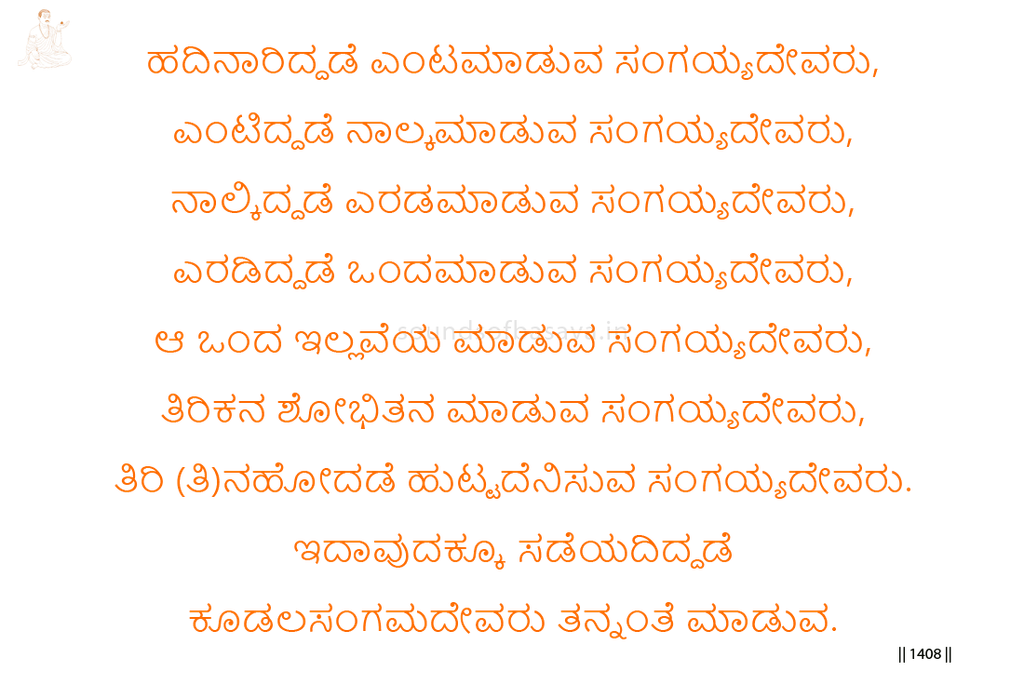
Sangayya Deva reduces eight to four, four to two, and two to one. He then removes even that final one as a separately countable remainder.
The same Sangayya Deva can make a beggar radiant and make one who goes seeking alms appear inwardly fulfilled.
If the seeker remains unshaken through every reduction and reversal, Kudalasangama Deva transforms him into His own likeness.
The Vachana therefore reveals the Lord as the sole agent of transformation. Multiplicity is gathered, duality is reduced, even the claim of oneness falls away, and the seeker is formed through unwavering receptivity to Divine action.
Imagery & Symbolic Relevance
The Vachana unfolds through two related movements: the reduction of number and the reversal of outward condition. Both reveal Sangayya Deva’s power to transform without leaving the seeker dependent upon any passing form.
Eight Made Four
The first movement reduces eight to four.
What was spread across several divisions is gathered into a smaller field. The movement is not toward further accumulation but toward simplification.
Sangayya Deva is the grammatical agent. The seeker does not perform this reduction through personal calculation or effort. The Lord gathers what had appeared dispersed.
Four Made Two
Four is then reduced to two.
The distinctions have become fewer, yet duality still remains. Two continues to preserve relation through opposition: this and that, self and other, worshipper and worshipped.
Sangayya Deva carries the movement beyond this divided structure.
Two Made One
Two is made one.
The apparent opposition is gathered into unity. What had been experienced as separate no longer stands through two independent centres.
Yet the Vachana does not stop with the declaration of one. Even oneness can become something mentally possessed: “I have reached the One,” or “I am established in unity.”
Sangayya Deva therefore continues the transformation.
The One Made Without Separate Remainder
The final one is made as though it were absent.
This means that even “one” no longer remains as a separate object to be counted, held, displayed, or claimed. The last numerical distinction falls away.
The movement is therefore:
multiplicity becomes gathered;
duality becomes unity;
unity itself ceases to stand as a possession.
Nothing remains for the seeker to count as an attainment.
The Beggar Made Radiant
Sangayya Deva makes the beggar radiant.
A beggar is ordinarily recognised through lack, dependence, worn appearance, and social insignificance. Divine transformation overturns that measure.
Radiance does not arise from wealth or status. The one outwardly regarded as poor may shine through an inward fullness given by the Lord.
The image reveals that visible condition cannot determine spiritual worth.
The Alms-Seeker Made Fulfilled
When one goes seeking alms, Sangayya Deva makes him appear as though he lacks nothing.
Outwardly, the person still seeks and receives. Inwardly, dependence has been transformed into fullness.
The image joins humility and completeness. Receiving from another does not create spiritual poverty when the heart has no possessive demand.
The seeker may carry the bowl of dependence while abiding without inward deficiency.
Remaining Unshaken Through Every Change
The decisive condition comes near the end: the seeker must remain unaffected by all these transformations.
He must not become proud when made radiant or despair when appearing poor. He must not cling to multiplicity, duality, unity, social honour, outward lack, or inward fulfilment.
His axis remains in Kudalasangama Deva while conditions are reduced, reversed, granted, or withdrawn.
This steadiness allows the Lord’s action to complete itself without resistance or self-claim.
Kudalasangama Deva Making Him Like Himself
The Vachana culminates in Kudalasangama Deva making the undisturbed seeker like Himself.
The seeker does not fashion this likeness through personal achievement. Kudalasangama Deva is the one who makes.
The likeness lies in the steadiness, fullness, freedom from division, and absence of possessive reaction that the Lord establishes in him.
Sangayya Deva, repeatedly named through the transforming movements, is addressed fully in the conclusion as Kudalasangama Deva. The entire sequence belongs to the Lord’s action.
Lingayoga
Lingayoga gathers a life that has become divided among many desires, identities, fears, and spiritual claims.
The practitioner begins by bringing body, mind, speech, conduct, worship, and Prana into one Linga-centred orientation. Yet even the thought, “I have become one,” must not become a final possession.
The Vachana also tests steadiness amid changing conditions. Poverty and radiance, dependence and fullness, reduction and elevation must not displace the inward relation with Linga.
The practical discipline is to remain receptive while Kudalasangama Deva simplifies, removes, reverses, or transforms. The fulfilled state arises when no change produces pride, fear, resistance, or self-claim, and the Lord alone becomes the agent and measure of life.
Editorial Commentary
Sangayya Deva is the intimate form of address used throughout the sequence for Kudalasangama Deva, whose full name appears in the concluding line.
The numerical movement begins with eight, then proceeds through four, two, and one.
The final one becoming absent indicates that no separately countable or possessible unity remains.
Tiruka means a beggar or mendicant. The image contrasts outward poverty with Divine radiance.
The one seeking alms appears fulfilled because inward completeness no longer depends upon outward possession.
The final Divine likeness is bestowed by Kudalasangama Deva. It is the fruit of remaining entirely receptive and unshaken through His transforming action.
Related Vachana
Supporting Vachana
Sharana Sthala Vachana 969 — The Refusal to Be Drawn Away
Sharana Vachana 969 instructs the body not to tremble, the mind not to run, and the seeker not to be drawn away by what appears higher or lower.
It establishes the discipline of non-deviation. Fear, attraction, elevation, and decline must not move the seeker away from Kudalasangama Deva.
This prepares Vachana 1395 precisely. The steadiness practised in Sharana Sthala becomes the condition through which Divine transformation can be received in Aikya. Whether Sangayya Deva reduces multiplicity, removes even the last one, makes the beggar radiant, or makes the alms-seeker fulfilled, the realised one remains unshaken.
Advancing Vachana
Aikya Sthala Vachana 1398 — Beyond All Lineage and Comparison
Vachana 1395 reduces numerical distinction until even the final one no longer remains as something separately possessed. Kudalasangama Deva then forms the undisturbed seeker in His own likeness.
Vachana 1398 turns attention from the transformed seeker toward the Lord Himself. Divine genealogies, relationships among deities, equivalences, and theological comparisons cannot contain Kudalasangama Deva, whose origin cannot be traced and whose greatness has no comparison.
The reduction of Vachana 1395 therefore culminates in direct beholding. Once number, opposition, social appearance, and self-measurement have lost their authority, Kudalasangama Deva alone stands as the unborn and incomparable Reality.
The likeness bestowed in Vachana 1395 matures into reverent vision in Vachana 1398: the seeker no longer measures himself or the Lord, but beholds Kudalasangama Deva alone.
