

Summary
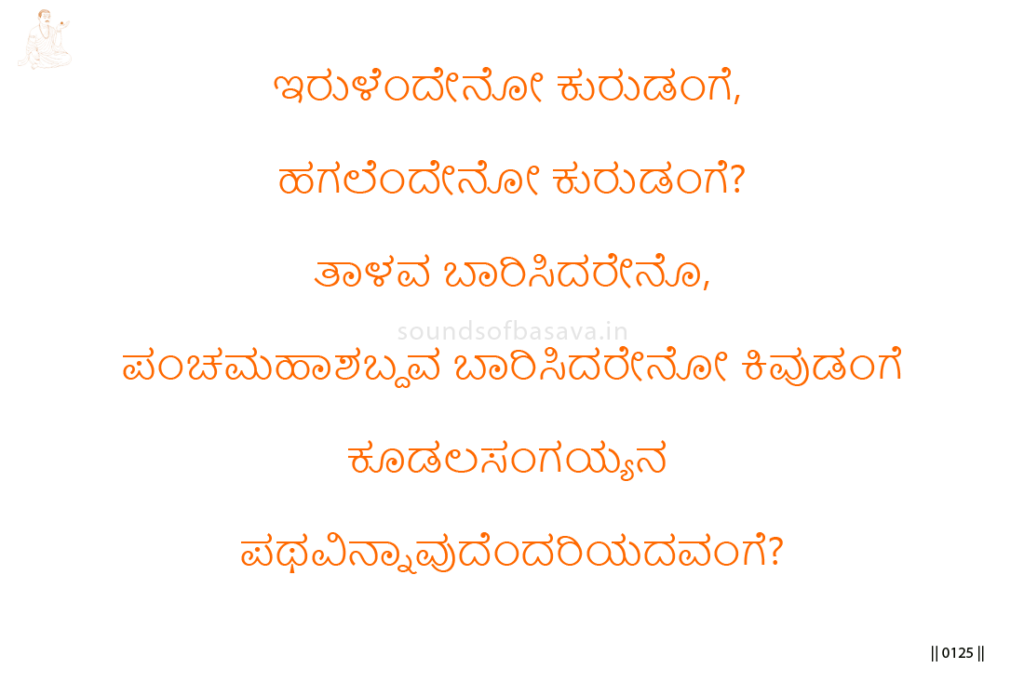
In this vachana, Basavanna asks what night and day can mean to one who is blind.
Night and day exist, but the blind person cannot perceive their difference. He then asks what rhythm or the five great sacred sounds can mean to one who is deaf. Sound may be present, but without hearing it cannot be received.
Basavanna applies these images to the path of Kudalasangama Deva. The path may be present, taught, and lived, yet one who lacks awakened perception cannot know it. The vachana teaches that spiritual truth must be directly received, not merely exist outside the seeker.
Imagery & Symbolic Relevance
The blind person is the first image. Night and day are real, but their difference does not open to one who lacks sight.
The issue is not the absence of light. The issue is the absence of the faculty that can receive light.
The deaf person is the second image. Rhythm and the pañca-mahā-śabda may resound, but they do not become meaningful to one who cannot hear.
Here Basavanna deepens the teaching. Sacred sound has power, but that power must be received by a capable faculty.
The path of Kudalasangama Deva is brought under the same principle. It is not enough that the path exists, or that others walk it, speak of it, sing of it, or teach it.
The seeker must become capable of knowing it.
The imagery therefore teaches that presence alone is not realization. Light requires sight. Sound requires hearing. The path requires awakened awareness.
Lingayoga
In Lingayoga, the Anga must become receptive to Linga.
The seeker may stand near practice, hear its words, observe its forms, or imitate its disciplines. Yet without awakened perception, the path remains closed.
This vachana points to the need for inner faculty. Drishti must become true seeing. Hearing must become inward reception. Practice must become Anubhava.
Kudalasangama Deva is not hidden because He is absent. He remains unknown where awareness has not opened.
Practice matures when the seeker becomes capable of receiving what is already present.
Editorial Commentary
This vachana teaches spiritual receptivity.
Basavanna shows that the path is not known merely because it exists; it is known when the inner faculty awakens before Kudalasangama Deva.
Related Vachana
Supporting Vachana
Vachana 626 — Bitterness Meets Grace
Vachana 626 teaches that outer sweetness cannot change the bitter root unless the inner nature itself is transformed. Vachana 632 continues by showing that even light, rhythm, sacred sound, and the path of Kudalasangama Deva cannot be received unless perception is awakened.
Advancing Vachana
Maheshwara Vachana 686 — The Builder and the Sculpture
Vachana 632 shows blindness before light and deafness before sacred sound. Maheshwara Vachana 686 advances this into the last veil, where the final obstruction before true seeing must be removed before Kudalasangama Deva.
